
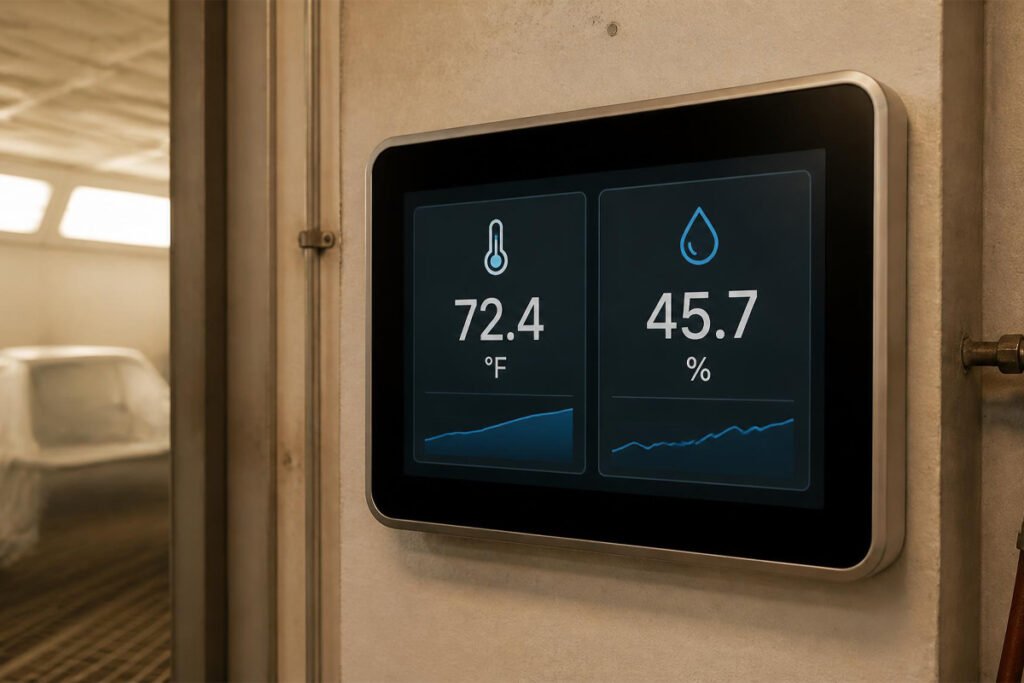
You mixed your paint exactly to spec, ran your air through a proper inline filter, and sprayed a clean coat with your HVLP gun. But instead of a glossy finish, you get a hazy, milky-white clouding across the surface — or the paint stays tacky for hours longer than the can said it should, or it dries so fast you’re left with visible dry spray and a rough, sandy texture instead of a smooth coat. None of these are contamination problems or technique problems. They’re environmental problems, and they’re some of the most common reasons a spray job goes wrong for reasons that have nothing to do with the paint itself.
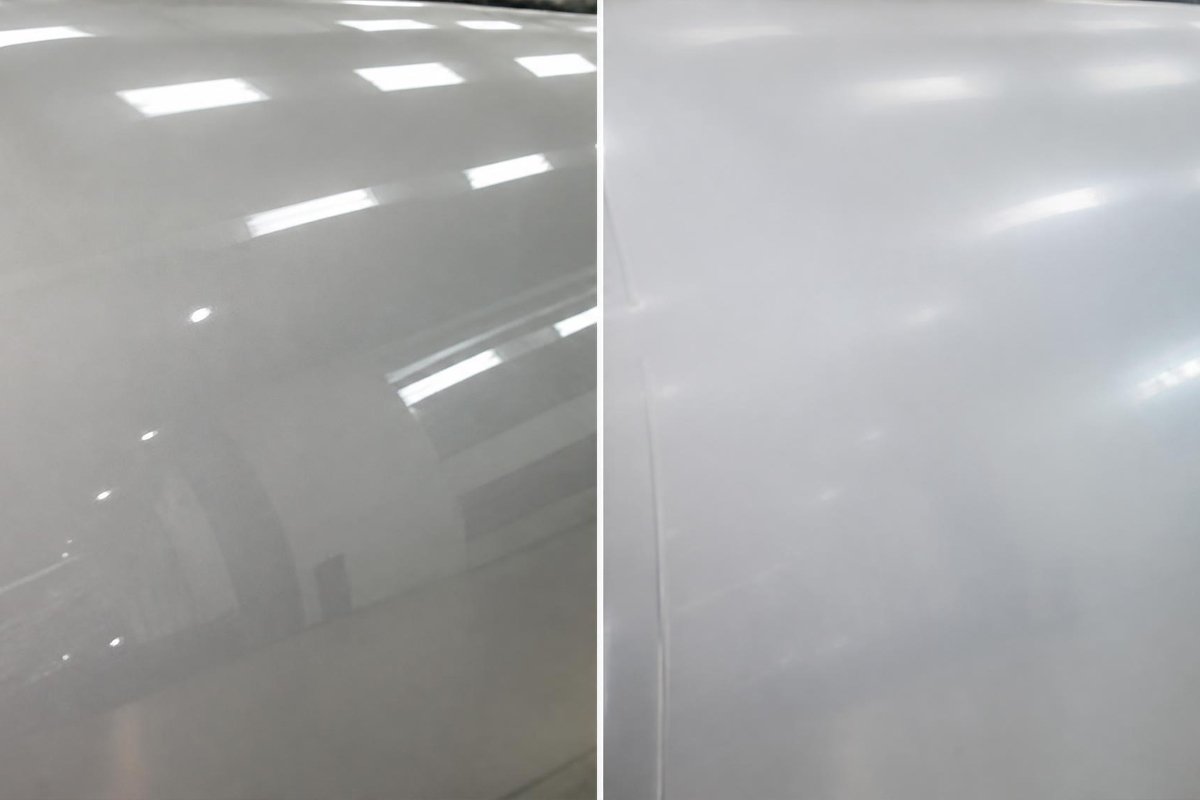
Humidity and temperature affect paint chemistry more than most home painters realize. High humidity is the classic cause of “blushing” — that milky haze that appears as solvent evaporates and pulls moisture out of the surrounding air faster than it can escape, trapping tiny water droplets in the finish. Temperatures that are too cold slow cure times dramatically and can prevent proper film formation entirely; temperatures that are too hot cause paint to flash off before it has a chance to level, leaving a rough, dry-looking texture. Every paint can lists an ideal application range for a reason, and without a way to actually measure your booth’s real conditions, you’re guessing.
This guide covers what to look for in a spray booth hygrometer/thermometer — accuracy, display readability, wireless range, and data logging — and reviews five real options that cover everything from a simple wall-mounted display to a wireless sensor you can check from your phone without walking into a solvent-heavy space.
Quick Answer
The best hygrometer for a spray booth depends on how you want to check it and how precise you need to be. For most home garage booths, the ThermoPro TP55 offers a large, easy-to-read touchscreen display you can check from across the room without walking up to it. If you want serious accuracy and the ability to log conditions over time, the SensorPush HT.w is a wireless sensor that syncs to an app and is accurate enough for tracking trends across multiple projects. For a simple, no-frills, no-app option, the AcuRite Digital Hygrometer mounts anywhere with a magnet, clip, or kickstand and just works. Budget-conscious painters who still want phone connectivity should look at the Govee H5075, which delivers solid Bluetooth performance at a lower price. And if you want to compare your booth’s internal conditions against outdoor or garage-ambient air, the VIVOSUN Indoor/Outdoor Wireless Hygrometer handles both readings on one display.
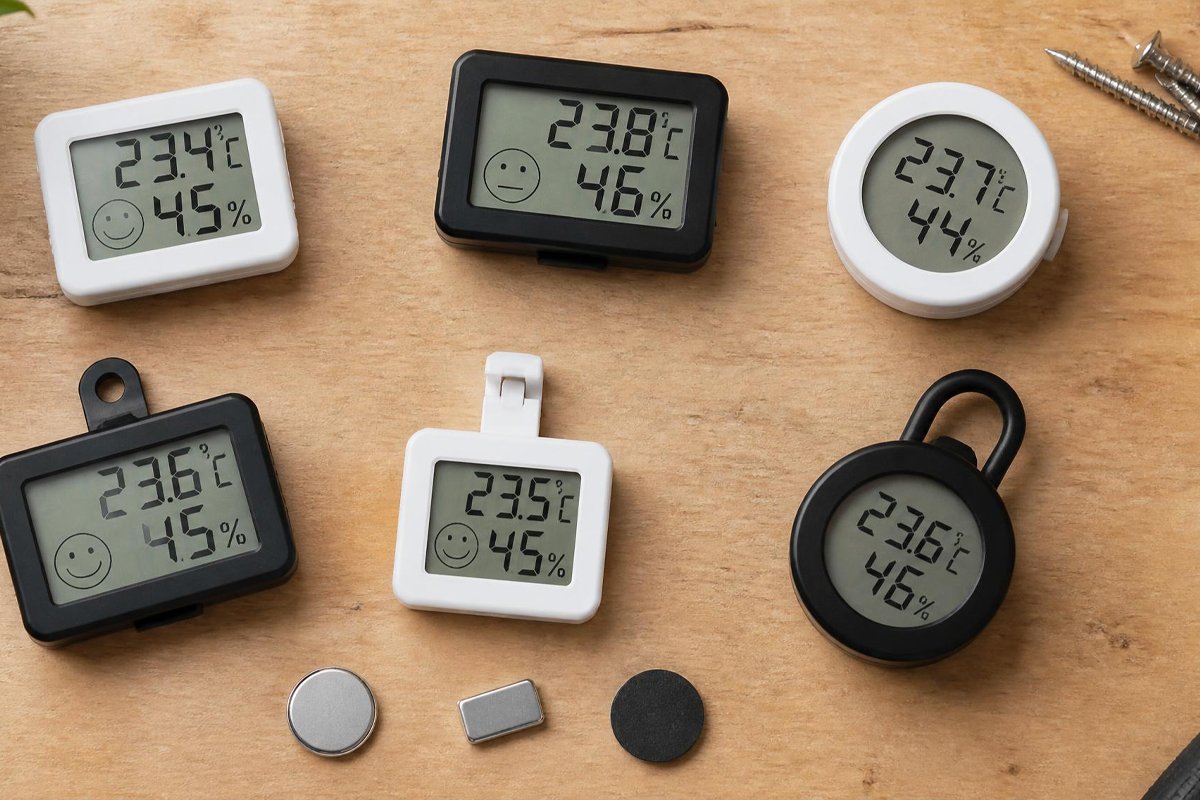
Table of Contents
- Why Humidity and Temperature Matter for Spray Painting
- How to Choose the Right Hygrometer
- Best Hygrometers for Spray Booths in 2026
- Comparison Table
- Best Hygrometers for Different Setups
- How to Use a Hygrometer to Time Your Paint Job
- Common Mistakes
- Expert Tips
- Final Verdict
- FAQ
Why Humidity and Temperature Matter for Spray Painting {#why-it-matters}
Most spray paints and clear coats list an ideal application range somewhere around 65–85°F and below roughly 70% relative humidity, though this varies by product and is always worth checking on your specific can or technical data sheet. Outside that range, several predictable problems show up:
- High humidity slows solvent evaporation and is the leading cause of blushing — a cloudy, milky finish caused by moisture condensing into the film as it dries.
- Low temperature slows cure and can prevent proper film formation, leaving a soft, easily damaged finish long after it should have hardened.
- High temperature causes paint to flash off too quickly, preventing it from leveling out and often causing a rough, “dry spray” texture with visible overspray dust trapped in the coat.
A hygrometer and thermometer combo takes the guesswork out of deciding whether today is actually a good day to spray, rather than finding out after the fact that conditions worked against you. This is the same logic behind checking your compressed air for moisture before spraying — you’re controlling a variable that affects the finish but isn’t part of the paint or the gun itself.
How to Choose the Right Hygrometer {#how-to-choose}
Ask yourself these three questions before buying:
1. Do I need to check it remotely, or is a wall-mounted display fine? If your booth is in a detached garage or shed, a wireless model you can check from your phone saves a trip out in solvent-heavy air just to glance at a reading.
2. How much accuracy do I actually need? Casual furniture painters can work fine with a general-accuracy consumer unit; anyone doing automotive clear coats or precise timing between coats benefits from a more accurate, better-calibrated sensor.
3. Do I want to track conditions over time? Some units log data over days or weeks, which is useful if you’re trying to identify the best time of day or season for spraying in your specific space.
If your booth’s ventilation setup is still a work in progress, our spray booth ventilation fan guide is worth reading alongside this one — airflow and humidity control work together.
Best Hygrometers for Spray Booths in 2026 {#best-hygrometers}
1. ThermoPro TP55 — Best Overall
Overview: The ThermoPro TP55 stands out specifically for its large 4-inch touchscreen display with oversized numerals, designed to be legible from several feet away — a genuinely useful feature in a spray booth where you don’t want to lean in close to a small screen while wearing a respirator.
Approximate Price: Typically listed in the $20–$35 range.
Key Features:
- 4-inch touchscreen display, the largest in its class
- Optional backlight for low-light booth conditions
- Simple, no-app operation — read it directly off the unit
- Tracks both current readings and daily high/low ranges
Best For: Home garage booths where you want a clear, glanceable reading without pulling out your phone.
Pros: ✅ Display size and clarity are genuinely a step above most competitors at this price ✅ No app or Bluetooth pairing required — just read it directly ✅ Backlight helps in dimmer booth setups
Cons: ❌ No remote/wireless monitoring — you still need to be in the room to check it ❌ No long-term data logging beyond basic daily high/low tracking
Our Verdict: Based on manufacturer specs and widely echoed tester feedback, this is the hygrometer most home painters should start with — the oversized display solves the single biggest annoyance of small, hard-to-read units, without adding app complexity you may not need.
2. SensorPush HT.w — Best for Accuracy & Data Logging
Overview: The SensorPush HT.w is built around serious measurement accuracy and wireless range, using Bluetooth to sync readings to an app rather than relying on an onboard display at all — a meaningful trade-off for painters who want precision and history tracking over a glanceable readout.
Approximate Price: Typically listed in the $50–$70 range.
Key Features:
- Accuracy rated within roughly 2% relative humidity and 0.36°F
- Up to 325 feet of Bluetooth range in open conditions
- Stores up to 20 days of data directly on the device, even without an active phone connection
- Compact form factor with magnet or clip mounting
Best For: Automotive-grade work or anyone who wants to track and compare conditions across multiple projects over time.
Pros: ✅ Genuinely tight accuracy specs compared to typical consumer hygrometers ✅ On-device data storage means you don’t lose history if your phone isn’t nearby ✅ Long Bluetooth range means checking from inside the house is realistic for a detached garage
Cons: ❌ No standalone display — you’re checking it through your phone, which isn’t ideal mid-spray with gloves on ❌ Higher price point than simple standalone units
Our Verdict: For anyone treating spray finishing as a precision process rather than a casual hobby, the accuracy and logging here genuinely matter — being able to look back and confirm “conditions were actually fine” after a finish problem, rather than guessing, is a real diagnostic advantage.
3. AcuRite Digital Hygrometer — Best Simple, No-App Option
Overview: AcuRite’s hygrometer is built around straightforward, no-nonsense operation — mount it, glance at it, done — with flexible mounting via magnet, clip, or a folding kickstand that adapts to wherever your booth setup has room for it.
Approximate Price: Typically listed in the $10–$20 range.
Key Features:
- Runs on a single AA battery
- Multiple mounting options: magnetic, clip-on, or folding kickstand
- Simple digital readout, no app or pairing required
- Reasonably accurate for general workshop monitoring
Best For: Painters who want a “set it and forget it” reading without any setup complexity or subscription/app dependency.
Pros: ✅ Lowest price point on this list alongside genuine reliability ✅ Flexible mounting fits almost any booth configuration ✅ Single AA battery keeps ongoing cost and maintenance minimal
Cons: ❌ Accuracy is adequate for general monitoring but not marketed at the precision level of the SensorPush ❌ No remote checking or data logging beyond the current reading
Our Verdict: For casual furniture and craft painters who just want a reliable, cheap way to confirm “is it too humid to spray today,” this covers the job without any unnecessary complexity or cost.
4. Govee H5075 — Best Budget App-Connected Option
Overview: The Govee H5075 sits in the middle ground between a basic standalone unit and a premium sensor like the SensorPush — it offers Bluetooth app connectivity at a noticeably lower price point, making remote checking accessible without the premium cost.
Approximate Price: Typically listed in the $15–$25 range.
Key Features:
- Bluetooth connectivity with companion app
- Compact size suitable for mounting inside a booth or nearby wall
- Historical data tracking within the app
- Simple LCD display for direct reading as well
Best For: Painters who want basic remote/app checking without paying premium-sensor pricing.
Pros: ✅ Genuinely useful price-to-feature ratio for anyone wanting app connectivity ✅ Combination of onboard display and app access covers both quick glances and remote checks ✅ Compact enough to tuck into a booth corner without getting in the way
Cons: ❌ Bluetooth range is more limited than the SensorPush, so it’s better suited to attached or nearby garages than detached, distant sheds ❌ Accuracy is solid for general use but not positioned as a precision instrument
Our Verdict: This is a sensible middle-ground pick for anyone who wants the convenience of checking booth conditions from their phone without spending SensorPush-level money to get there.
5. VIVOSUN Indoor/Outdoor Wireless Hygrometer — Best for Comparing Booth vs. Ambient Conditions
Overview: Originally built for grow-tent monitoring (an application with very similar humidity-sensitivity needs to spray booths), this unit tracks both an indoor and outdoor — or booth versus garage-ambient — reading simultaneously, which is genuinely useful for understanding whether your booth’s internal conditions differ meaningfully from the surrounding space.
Approximate Price: Typically listed in the $20–$30 range.
Key Features:
- Simultaneous indoor and outdoor (dual-sensor) readings
- Touchscreen display with backlight
- Up to roughly 200 feet of wireless range between sensor and display
- Tracks min/max history for both readings
Best For: Painters who want to understand how their booth’s internal environment compares to the rest of their garage or shop, particularly useful if you’re deciding whether to run your ventilation fan before spraying to normalize conditions first.
Pros: ✅ Dual-sensor comparison is a genuinely useful feature most single-sensor units don’t offer ✅ Large touchscreen display is easy to read at a glance ✅ Reasonable wireless range for most home garage layouts
Cons: ❌ Requires managing two sensor units instead of one ❌ Marketed primarily for grow-tent use, so painting-specific guidance isn’t included in the packaging
Our Verdict: If you’ve ever wondered whether your booth is actually more humid than the rest of your garage — a real possibility in an enclosed space with less airflow — this is the tool built specifically to answer that question with real numbers instead of a guess.
Comparison Table {#comparison-table}
| Hygrometer | Best For | Display Type | Wireless Range | Approx. Price |
|---|---|---|---|---|
| ThermoPro TP55 | Easy-read standalone monitoring | 4″ touchscreen | None (standalone) | $20–$35 |
| SensorPush HT.w | Accuracy & data logging | App-based (no onboard display) | Up to 325 ft | $50–$70 |
| AcuRite Digital Hygrometer | Simple, no-app monitoring | Basic LCD | None (standalone) | $10–$20 |
| Govee H5075 | Budget app connectivity | LCD + app | Moderate (Bluetooth) | $15–$25 |
| VIVOSUN Indoor/Outdoor | Booth vs. ambient comparison | Touchscreen | Up to 200 ft | $20–$30 |
Prices fluctuate by retailer and current promotions — treat these as general ranges rather than fixed figures.
Best Hygrometers for Different Setups {#by-setup}
Casual Home Garage Booths
The ThermoPro TP55 or AcuRite hygrometer both cover the basics well — a quick, reliable glance is usually all a furniture or craft painter needs before starting a project.
Detached Garages, Sheds, or Remote Booths
The SensorPush or Govee let you check conditions from inside the house before walking out to a cold shed in the middle of winter, saving a wasted trip if conditions aren’t right yet.
Automotive & Precision Finish Work
The SensorPush’s tighter accuracy specs and data logging make it easier to identify exactly what went wrong if a finish problem shows up, rather than guessing after the fact — pair this with proper drying rack setup so cure conditions stay consistent after spraying too.
How to Use a Hygrometer to Time Your Paint Job {#how-to-use}
Step 1: Check Conditions Before You Prep, Not Just Before You Spray
Knowing early whether today’s humidity is workable saves you from sanding and tack-clothing a piece only to find out you need to wait until tomorrow.
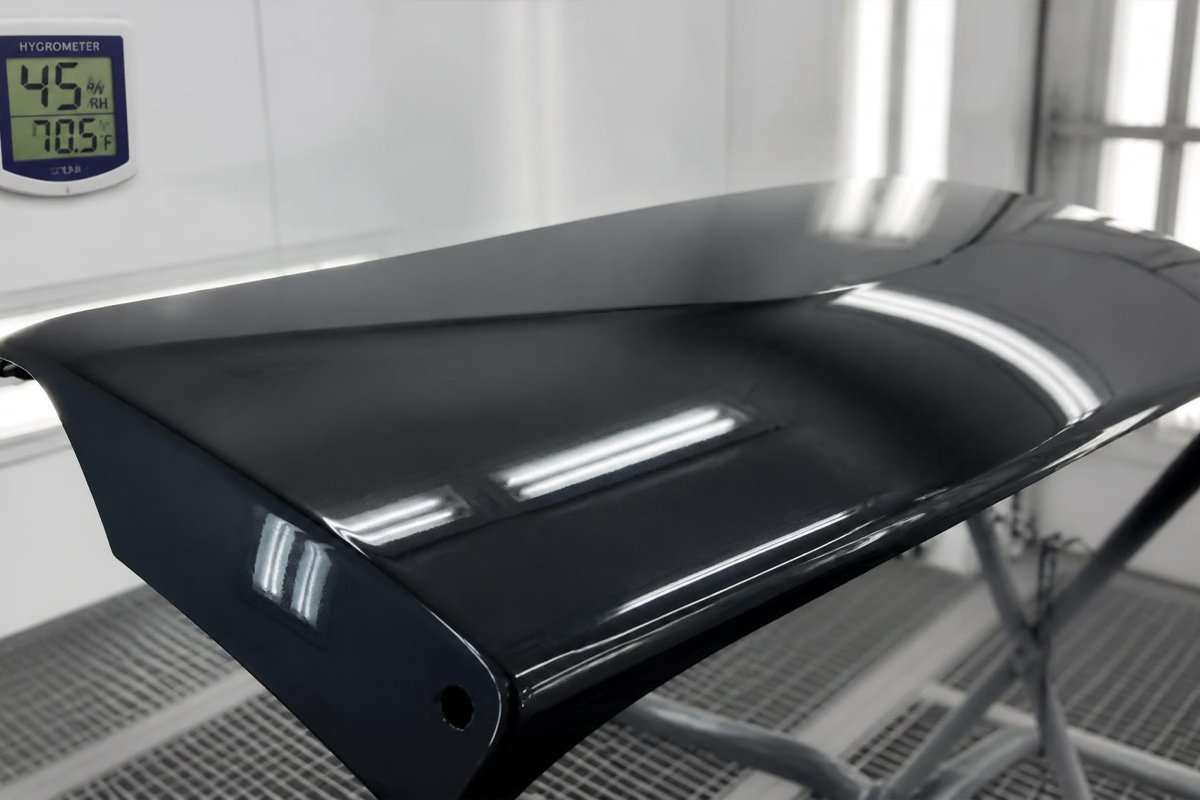
Step 2: Compare Your Reading Against Your Paint’s Technical Data Sheet
Most paint cans or manufacturer websites list an ideal temperature and humidity range — treat your hygrometer reading as the number to check against that range, not just a general “feels fine” judgment.
Step 3: Run Your Ventilation Fan Before Checking a Final Reading
If your booth has been closed up, run your exhaust fan for several minutes first — trapped humidity in an enclosed booth can read higher than the rest of your garage until it’s had a chance to exchange air.
Step 4: Recheck Between Coats on Long Projects
Conditions can shift meaningfully over a few hours, especially outdoors-adjacent garages during weather changes — a quick recheck between coats catches a shift before it affects your next layer.
Step 5: Log Unusual Results When a Finish Problem Shows Up
If you get blushing, slow cure, or dry spray texture, check what your hygrometer read at the time — this turns a mystery finish problem into a data point you can actually learn from for next time.
Common Mistakes {#common-mistakes}
1. Spraying based on how the air “feels” instead of an actual reading. Humidity that feels comfortable to a person can still be well outside a paint’s ideal application range — this is exactly the kind of setup pitfall covered in our common spray paint mistakes guide.
2. Checking conditions once at the start and never again. Temperature and humidity can shift meaningfully over a multi-hour project, especially with weather changes or a booth that heats up once your ventilation fan and lighting have been running for a while.
3. Ignoring the difference between booth conditions and general garage conditions. An enclosed booth without good airflow can trap humidity higher than the rest of the room — checking only a general room thermometer can give a false sense that conditions are fine when your actual spraying space isn’t.
Expert Tips {#expert-tips}
Keep a simple log of conditions alongside your project notes. Over time, this builds a personal reference for what worked and what didn’t in your specific space, which is more useful than generic guidance since every garage and climate is a little different.
Position your sensor at spray height, not just anywhere in the room. Humidity and temperature can vary by a few feet of height in an enclosed booth, so a sensor near where you’re actually spraying gives a more relevant reading than one mounted near the ceiling or floor.
Don’t rely on outdoor weather forecasts as a substitute for an in-booth reading. An enclosed garage or booth can run meaningfully more humid or warmer than the outside air, especially without active ventilation — same principle as why proper exhaust airflow matters beyond just fume clearing.
Final Verdict {#final-verdict}
- Best Overall: ThermoPro TP55 — a large, easy-to-read display that solves the most common annoyance with cheap hygrometers.
- Best for Accuracy & Logging: SensorPush HT.w — precision and history tracking for serious or automotive-grade work.
- Best Simple, No-App Option: AcuRite Digital Hygrometer — cheap, flexible mounting, zero setup complexity.
- Best Budget App-Connected Pick: Govee H5075 — remote checking without premium pricing.
- Best for Booth vs. Ambient Comparison: VIVOSUN Indoor/Outdoor Hygrometer — answers whether your booth itself is the humidity problem.
Whichever you pick, it’s a small investment that removes real guesswork from your process — pair it with our guides on booth ventilation, inline air filtration, and drying racks to control every environmental variable between prep and cure.
Frequently Asked Questions {#faq}
What humidity level is too high for spray painting? This varies by product, but many paints and clear coats recommend staying below roughly 70% relative humidity — always check your specific paint’s technical data sheet or can label for its exact recommended range.
Can I spray if it’s too cold, just with a longer dry time? Cold temperatures don’t just slow drying — they can prevent proper film formation and adhesion entirely below certain thresholds, so “just waiting longer” doesn’t always fix a temperature that’s genuinely too low for the product.
Do I need a wireless hygrometer, or is a basic one enough? If your booth is attached to your living space or easy to check in person, a basic standalone unit is fine; wireless models earn their price mainly for detached garages, sheds, or anyone who wants to check conditions without walking into solvent-heavy air.
How accurate do consumer hygrometers actually need to be? For general furniture and craft painting, typical consumer accuracy (within a few percent relative humidity) is fine; automotive or precision work benefits from tighter-spec sensors like the SensorPush.
Does running my ventilation fan change the humidity reading? Yes — running exhaust airflow exchanges booth air with the surrounding room or outside air, which can raise or lower the reading depending on conditions outside your booth, so it’s worth checking again after running the fan for a few minutes.
Can high humidity actually ruin a finish, or does it just slow drying? Both — beyond just slowing cure time, high humidity is a leading cause of blushing, the cloudy, milky appearance that happens when moisture gets trapped in the film as solvent evaporates.
Where should I mount my hygrometer in the booth? Near where you’re actually spraying, at roughly the height of your workpiece, gives a more relevant reading than a unit mounted near the ceiling, floor, or just outside the booth entirely.
Do these units work for tracking curing conditions after spraying, not just before? Yes — the same reading that tells you whether it’s safe to start spraying also helps confirm your piece is curing in reasonable conditions afterward, especially relevant if you’re using a drying rack in a separate area from your spray booth.
Author: Rodney Shiner Last Updated: July 2026