
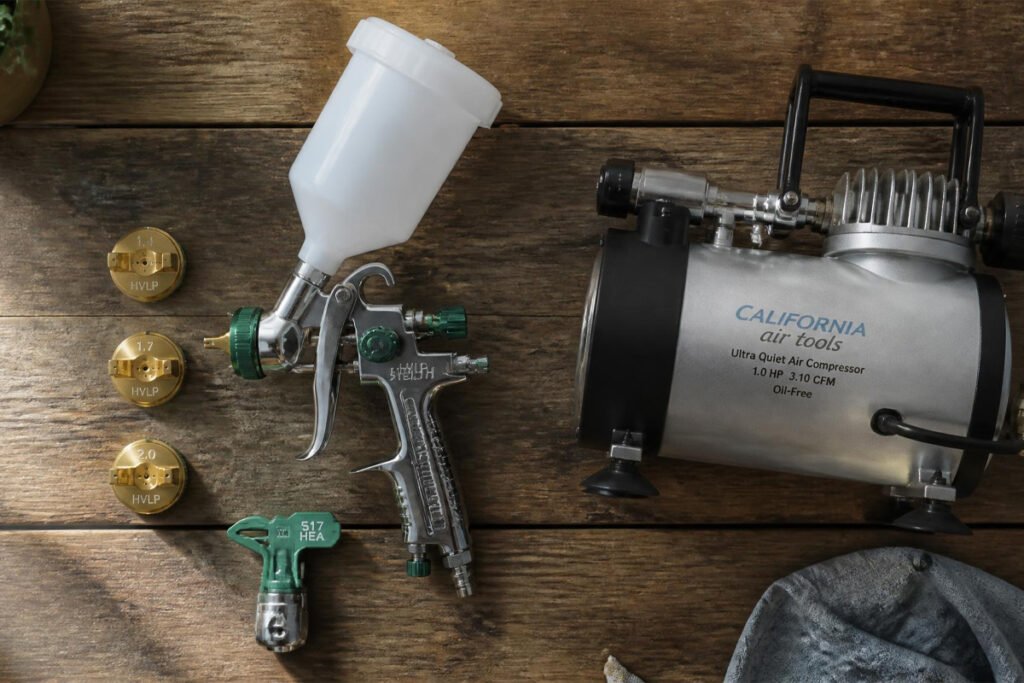
A great paint sprayer is only half the equation. Most of the streaks, orange peel, clogging, and wasted paint people complain about don’t come from the gun itself — they come from using the wrong tip size, an underpowered compressor, or skipping a simple in-line filter. If you’re still deciding between sprayer types, our HVLP vs Airless Paint Sprayer comparison is worth reading first, since the right accessories depend heavily on which system you own.
Get the accessories right, and even a budget setup — like the picks in our best airless paint sprayer under $200 guide — can lay down a finish that looks shop-sprayed. This guide breaks down the paint sprayer accessories actually worth buying in 2026, with honest pros and cons for each, so you can build a setup that matches your project instead of guessing.
Quick Answer
The right accessories depend on what you’re spraying and how. For furniture, cabinets, and trim, a set of interchangeable brass HVLP tips (1.0–2.0mm) paired with a compact, quiet oil-free compressor is the sweet spot. For fences, decks, and exterior siding with an airless sprayer, a Graco RAC IV reversible tip in the 311–415 range saves the most time by clearing clogs instantly. For automotive or fine finish work, LVLP tips (1.3–1.7mm) with a higher-CFM compressor give the best atomization. In short: match tip size to material thickness first, then size your compressor to keep up with that tip — everything else is a convenience upgrade.
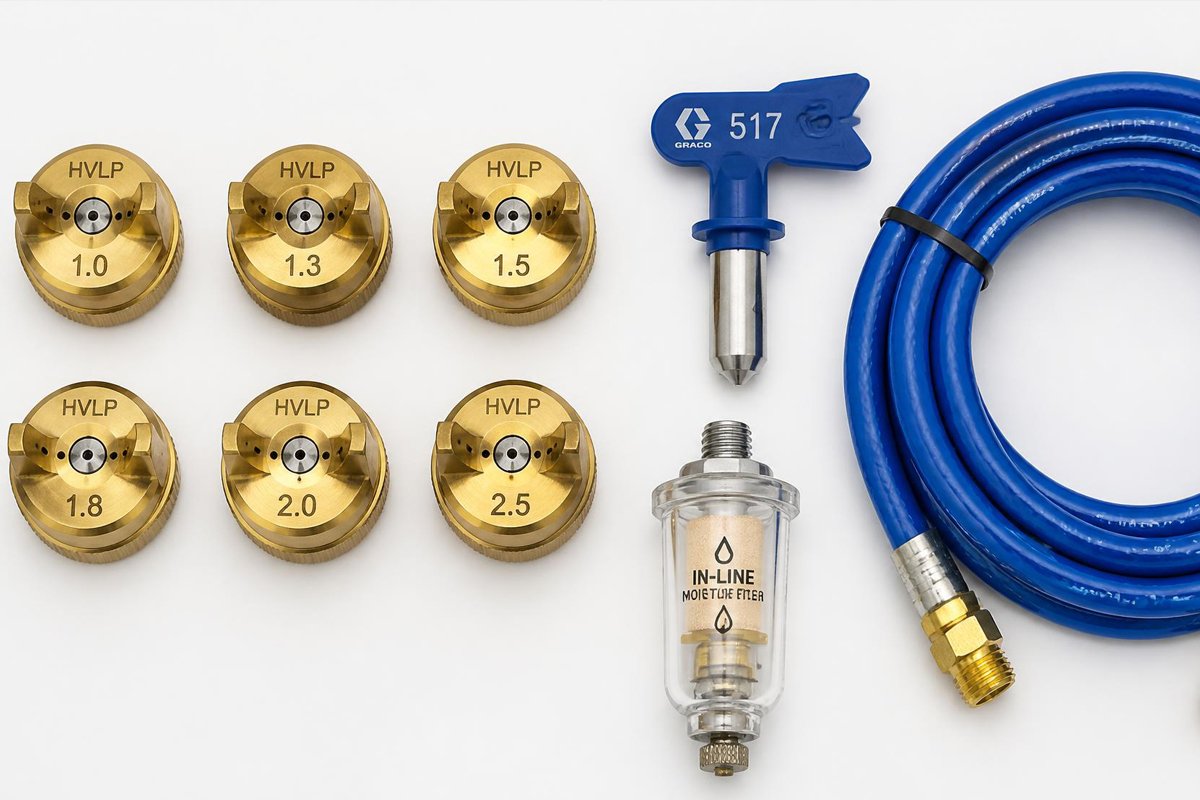
Table of Contents
- What Paint Sprayer Accessories Actually Do
- How to Choose the Right Accessories for Your Project
- Best Spray Tips & Nozzles
- Best Air Compressors for Spray Guns
- Best Hoses, Filters & Add-On Kits
- Comparison Table
- Accessories for Different Project Types
- How to Set Up Your Sprayer Correctly
- Common Mistakes
- Expert Tips
- Final Verdict
- FAQ
What Paint Sprayer Accessories Actually Do
A paint sprayer is really a system, not a single tool. The tip/nozzle controls how much material comes out and in what pattern — this is the single biggest factor in finish quality, as covered in our 10 Best HVLP Spray Guns for DIYers guide. The compressor (for HVLP/LVLP guns) or pump (for airless units) supplies the air or pressure that atomizes the paint — see our full 10 Best Air Compressors for HVLP Spray Guns roundup for sizing details. Hoses carry that air or paint without pressure loss, and in-line filters or moisture traps stop water, oil, and debris from ruining your finish — our Best Inline Air Filter for HVLP Spray Guns guide covers this in depth. When people say a sprayer “isn’t working right,” it’s almost always one of these four pieces mismatched to the job, not the sprayer itself.
How to Choose the Right Accessories for Your Project
Before buying anything, ask yourself:
- What am I spraying — thin stains, latex paint, or thick primers? Thinner materials need smaller tips (1.0–1.4mm); thicker paints and primers need larger ones (1.7mm+ for HVLP, or a 415–515 airless tip). If you’re unsure which paint type fits your project, our guide to choosing the right spray paint can help.
- How big is the project? A single piece of furniture doesn’t need the same air volume as an entire fence or house exterior — oversizing your compressor just adds cost and noise.
- Where am I spraying? Indoor furniture and cabinet work benefits hugely from a quieter, oil-free compressor; outdoor exterior jobs can tolerate louder, higher-output units, but check our how to spray paint outdoors guide for weather-related setup tips.
According to OSHA’s guidance on spray finishing operations, proper airflow and pressure settings aren’t just about finish quality — they also reduce overspray and airborne particulate exposure, which is worth keeping in mind when sizing your setup.
Best Spray Tips & Nozzles
Graco RAC IV Reversible Airless Spray Tips (211–515 range)
Overview: These are the standard replacement/upgrade tips for most airless sprayers, including the budget-friendly models featured in our best airless paint sprayer under $200 guide. The headline feature is the reversible tip design — when it clogs, you flip it, pull the trigger to blast the clog out backward, and flip it back, clearing blockages in seconds instead of minutes. Key Features:
- Reverse-A-Clean clog-clearing design
- Sizes from 211 (fine stains/sealers) to 515 (thick exterior paint)
- Fits most major airless sprayer brands, not just Graco
- Durable tungsten carbide tip material Best For: Airless sprayer users doing fences, decks, siding, or large interior walls Pros: ✅ Clears clogs almost instantly ✅ Wide size range covers nearly every material ✅ Cross-compatible with other sprayer brands Cons: ❌ Only relevant if you own an airless sprayer, not HVLP ❌ Sold individually, so a full size range costs more upfront Our Verdict: If you already own an airless sprayer, a set of two or three RAC IV tips (a 311 for trim/furniture and a 415 for walls/siding) covers almost everything a homeowner will ever spray.
Brass HVLP Nozzle Sets (1.0mm / 1.4mm / 1.7mm / 2.0mm)
Overview: Most quality HVLP guns — including several in our 10 Best HVLP Spray Guns for DIYers guide — now ship with interchangeable brass nozzles rather than one fixed tip. Brass holds tolerance better than the plastic tips found on cheaper guns, which means more consistent atomization over the life of the tip. Key Features:
- Multiple sizes in one kit for switching between primer, paint, and clear coat
- Brass construction resists wear better than plastic
- Compatible with most gravity-feed HVLP and LVLP guns
- Often bundled with extra gaskets and a cleaning brush Best For: Furniture, cabinets, trim, and detail/automotive touch-up work Pros: ✅ One kit covers thin stains through thick primers ✅ More durable than stock plastic tips ✅ Noticeably finer, more even atomization Cons: ❌ Small tips (1.0–1.3mm) need thinned paint or they’ll clog ❌ Requires occasional cleaning between color changes Our Verdict: This is the single highest-value upgrade for anyone doing the kind of streak-free cabinet or furniture work we cover in how to spray paint furniture without streaks — the difference in finish smoothness between a worn stock tip and a fresh 1.4mm brass tip is immediately visible.
Best Air Compressors for Spray Guns
California Air Tools 5510SE / 8010 (Oil-Free, Ultra-Quiet)
Overview: California Air Tools built its reputation on genuinely quiet, oil-free compressors, which matters more than most buyers expect — oil contamination is a common cause of “fisheyes” (small craters) in a finish. For a full breakdown of sizing and CFM requirements, see our 10 Best Air Compressors for HVLP Spray Guns guide. Key Features:
- Oil-free dual-piston pump, low-maintenance
- Noticeably quieter operation than standard pancake compressors
- 5.5–8.0 gallon tank options depending on model
- Wheel kit included on larger models for easy repositioning Best For: Indoor furniture, cabinet, and trim spraying where noise and paint cleanliness both matter Pros: ✅ Oil-free eliminates fisheye risk ✅ Much quieter than typical shop compressors ✅ Low maintenance, no oil changes Cons: ❌ Lower CFM output than pro-grade units, so full-size HVLP guns on large surfaces will need pause-and-recover breaks ❌ Larger tank models are heavier and less portable Our Verdict: For hobbyists and serious DIYers doing furniture and cabinet refinishing, this is close to ideal — you’re trading a bit of raw output for something you can actually run in an attached garage without upsetting the household.
Porter-Cable C2002 / DeWalt DWFP55126 (6-Gallon Pancake, Oil-Free)
Overview: These two sit in almost every “best compressor for painting” roundup for good reason — both are oil-free 6-gallon pancake compressors that deliver roughly 2.6 CFM at 90 PSI, enough for LVLP guns and airbrush work. They’re a solid match for beginners working through our spray painting for beginners starter guide. Key Features:
- Oil-free pump, 150–165 max PSI
- 6-gallon tank with quick recovery time
- Included accessory kit (hose, blow gun, fittings) on most bundles
- Compact, portable pancake footprint Best For: General DIY use — trim, small furniture, touch-ups, and light home projects Pros: ✅ Budget-friendly and widely available ✅ Comes ready to spray out of the box ✅ Portable enough to move between rooms or job sites Cons: ❌ Not powerful enough for full-size automotive HVLP guns or large exterior jobs ❌ Louder than the California Air Tools models Our Verdict: This is the practical “get started” compressor — if you’re not sure how much you’ll use a sprayer long-term, this is the lowest-risk entry point that still performs reliably.
Best Hoses, Filters & Add-On Kits
In-Line Air Filter / Moisture Trap
Overview: An inexpensive add-on that sits between your compressor and gun, catching condensed water and debris before it reaches your paint. We cover this accessory in full detail in our Best Inline Air Filter for HVLP Spray Guns guide, since on humid days or with older compressors, skipping this is one of the most common causes of tiny water spots ruining an otherwise good finish. Key Features:
- Removes moisture and particulate from the air line
- Simple screw-on installation, no tools required
- Clear bowl so you can see when it needs draining Best For: Anyone spraying in humid conditions or using an older, non-refrigerated compressor Pros: ✅ Cheap insurance against ruined finishes ✅ Takes seconds to install Cons: ❌ Needs periodic draining or it stops helping Our Verdict: This is the accessory people skip and then regret — it costs very little relative to the paint and time it can save.
Extended Air Hose (25–50 ft, Reinforced)
Overview: A longer, kink-resistant hose lets you keep the compressor stationary while reaching an entire room, fence line, or vehicle without dragging equipment around. Key Features:
- PVC or rubber-reinforced construction to resist kinking
- Standard quick-connect fittings
- Available in lengths from 25 to 100 feet Best For: Larger rooms, exterior jobs, or garage setups where the compressor stays in one spot Pros: ✅ Big convenience upgrade for the price ✅ Reduces wear on the gun’s own fittings Cons: ❌ Longer hoses can cause a slight pressure drop, so check your compressor’s rated output Our Verdict: Worth adding as soon as you’re spraying anything larger than a single small item.
Comparison Table
| Accessory | Best For | Price Range | Key Benefit | Watch Out For |
|---|---|---|---|---|
| Graco RAC IV Tips | Airless sprayer users | $ | Instant clog clearing | Airless only |
| Brass HVLP Nozzle Set | Furniture/cabinets | $$ | Multi-size versatility | Small tips need thinned paint |
| California Air Tools 5510SE/8010 | Indoor/furniture work | $$$ | Quiet, oil-free | Lower CFM for big jobs |
| Porter-Cable C2002 / DeWalt DWFP55126 | General DIY | $$ | Ready-to-spray kit | Not for large exterior jobs |
| In-Line Moisture Filter | Any humid environment | $ | Prevents water spots | Needs periodic draining |
| Extended Air Hose | Large rooms/exteriors | $ | Freedom of movement | Slight pressure drop over length |
Accessories for Different Project Types
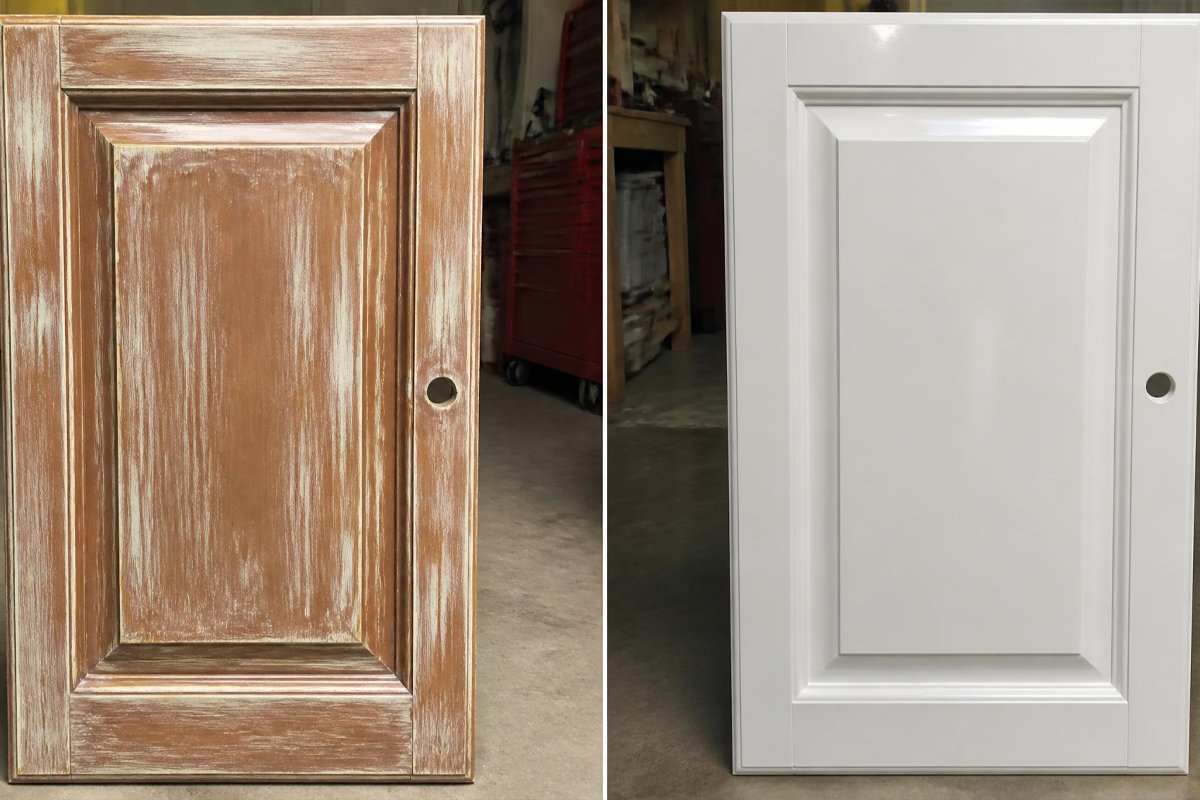
Furniture & Cabinet Refinishing
Stick with a brass HVLP nozzle set (1.0–1.7mm) and a quiet oil-free compressor like the California Air Tools 5510SE. Pairing your setup with one of the 5 Best Turntables for Spray Painting Furniture makes it far easier to get even coverage without constantly repositioning yourself around the piece.
Fences, Decks & Exterior Siding
An airless sprayer with a couple of Graco RAC IV tips (311 for railings/trim, 415–515 for broad surfaces) will move through large areas far faster than any HVLP setup. If you’re working outdoors, our plastic outdoor furniture spray paint guide and spray painting outdoors tips cover weather and surface prep considerations specific to exterior work.
Automotive Touch-Ups & Detail Work
LVLP nozzles in the 1.3–1.5mm range paired with a higher-output compressor (5+ CFM) give the fine atomization needed for clear coats and base coats without excessive overspray. For smaller chip repairs, our 5 Best Touch-Up Paint Kits for Car Paint Chips guide is a useful companion, and for full panel work, see how to spray paint a car at home.
How to Set Up Your Sprayer Correctly
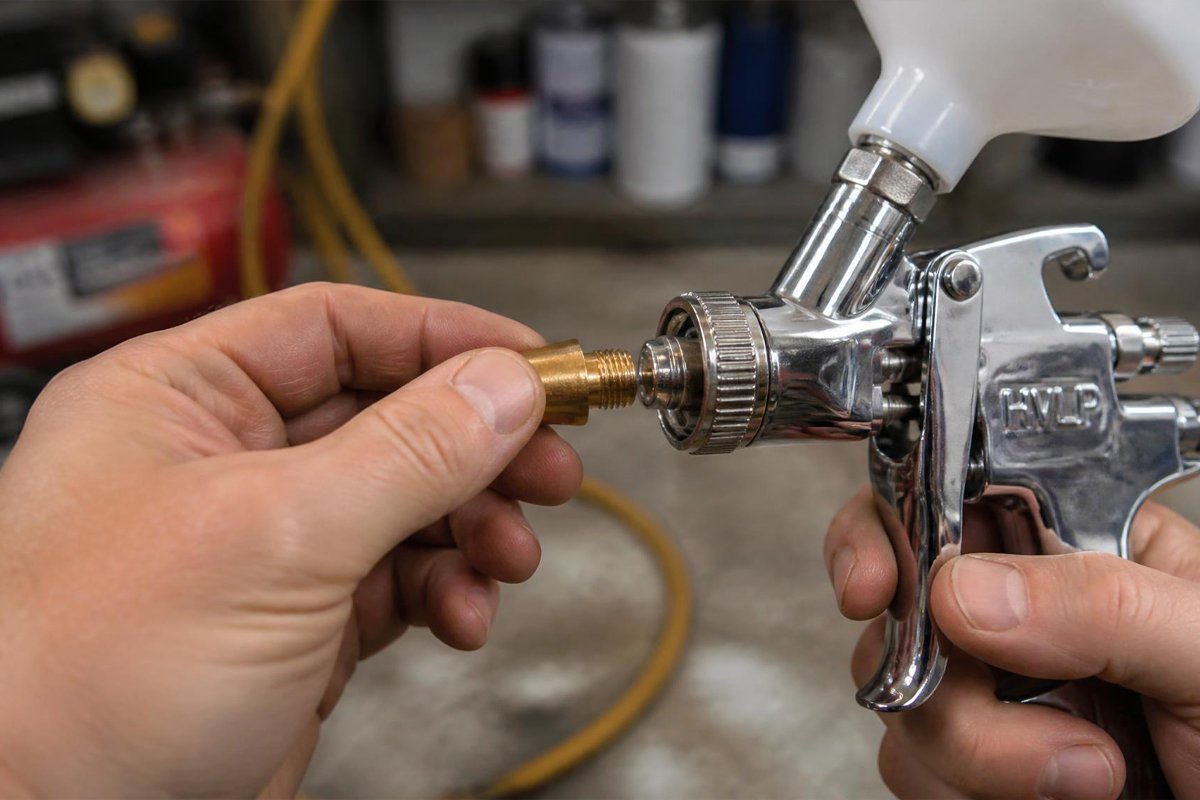
Step 1: Match the Tip to the Material
Check your paint or primer’s viscosity against the tip size chart included with your nozzle set — thinner materials need smaller openings, thicker ones need larger.
Step 2: Size the Compressor to the Gun
Confirm your compressor’s CFM output meets or exceeds what your gun requires at your chosen tip size; running below spec causes a sputtering, uneven spray pattern.
Step 3: Install an In-Line Filter and Set Up Ventilation
Attach a moisture trap between the compressor and hose, especially in humid climates or with non-refrigerated units, and make sure your space has adequate airflow — our Best Spray Booth Ventilation Fan guide and 5 Best Portable Spray Paint Booths for DIYers can help if you’re setting up a dedicated space.
Step 4: Gear Up and Test the Pattern on Scrap
Before touching your actual project, put on proper protection — see our 5 Best Respirators and Masks for Spray Painting guide — then spray a test pattern on cardboard or scrap wood and adjust pressure and distance (8–12 inches is standard for most guns) until it’s even. For technique fundamentals, our best spray paint techniques for a professional finish guide is a good reference.
Step 5: Clean Up and Let It Dry Properly
Flush the tip and gun right after spraying, and set finished pieces somewhere dust-free to cure — a proper drying rack prevents the smudges and stuck-on debris that ruin an otherwise perfect coat.
Common Mistakes
Using one tip size for everything. A single 1.4mm tip won’t give good results on both thin stain and thick primer — invest in a multi-size set instead of forcing one nozzle to do it all. Using the wrong tip for the material is also a leading cause of the bubbling finish covered in why your spray paint is bubbling.
Undersizing the compressor. A compressor rated below your gun’s CFM requirement will cause pressure drops mid-spray, leading to uneven coverage, drips, and runs — see our guide on how to fix spray paint drips and runs if this has already happened to you.
Skipping the moisture filter. Water in the line is invisible until it shows up as pinholes or spots in your finish — by then it’s too late to fix without redoing the coat.
Spraying around kids or pets without a plan. Fine overspray and fumes travel further than you’d expect in an open garage — our spray painting around kids and pets safety guide covers how to set boundaries before you start.
Expert Tips
Buy tips in a range, not a single size. Even if your current project only needs one size, a 3-pack costs little more than buying tips individually later, and you’ll need the other sizes eventually.
Don’t chase maximum CFM if you’re doing indoor work. A bigger compressor is often louder and bulkier for no real benefit on small to medium indoor projects — match the tool to the job, not the spec sheet.
Keep a spare set of gaskets and O-rings on hand. These wear out faster than the tips themselves and are the most common reason a gun starts leaking air or paint at the nozzle. If you’re just starting out, our spray painting safety overview is worth bookmarking alongside your accessory kit.
Final Verdict
Best Overall: A brass HVLP nozzle set paired with a California Air Tools oil-free compressor — versatile, quiet, and clean. Pair it with picks from our 10 Best HVLP Spray Guns for DIYers guide for a complete setup. Best Budget: Porter-Cable C2002 or DeWalt DWFP55126 with the stock included tips — enough for most DIY jobs at the lowest entry cost. Best for Large Exterior Jobs: Graco RAC IV tips in the 311–515 range on an airless sprayer. Best for Beginners: Start with a mid-size brass nozzle set and a 6-gallon oil-free pancake compressor — and work through our spray painting for beginners starter guide to build good habits from day one.
Frequently Asked Questions
Do I really need different spray tip sizes, or can one work for everything? One tip can technically spray most materials if you thin them enough, but you’ll get better coverage, less waste, and fewer clogs by matching tip size to material thickness instead.
How much CFM do I need for an HVLP spray gun? Most HVLP guns need somewhere between 4–12 CFM depending on tip size and gun design — check your specific gun’s manual, since undersizing the compressor is the most common cause of poor spray patterns.
How long do spray tips typically last? Brass HVLP tips can last for dozens of projects with proper cleaning; airless tips like the Graco RAC IV wear out faster with abrasive materials (like some primers) and may need replacing every few hundred gallons sprayed.
Airless vs. HVLP tips — what’s the real difference? Airless tips use high pressure to atomize paint mechanically and are built for speed on large surfaces; HVLP tips work with a compressor’s airflow for a finer, more controlled finish. Our HVLP vs Airless Paint Sprayer comparison breaks this down in more detail.
Why does my spray pattern keep sputtering? This is almost always either an undersized compressor struggling to keep up, a partially clogged tip, or paint that’s too thick for the tip size in use — check all three before assuming the gun itself is broken.
Is an oil-free compressor really necessary for painting? It’s strongly recommended. Oil-lubricated compressors can introduce fine oil mist into the air line, which causes fisheyes (small craters) in the finish unless you add a separate oil/water separator.
Do I need an in-line moisture filter if I already have a good compressor? Yes, especially in humid climates — even quality compressors accumulate condensation in the tank and lines over time, and a cheap filter is far less costly than redoing a spoiled finish.
Can I use the same tip for both primer and topcoat? You can with a mid-size tip (around 1.5–1.7mm HVLP or a 415 airless), but a dedicated slightly larger tip for primer and smaller one for topcoat will give noticeably better results on both.
Last Updated: July 2026