
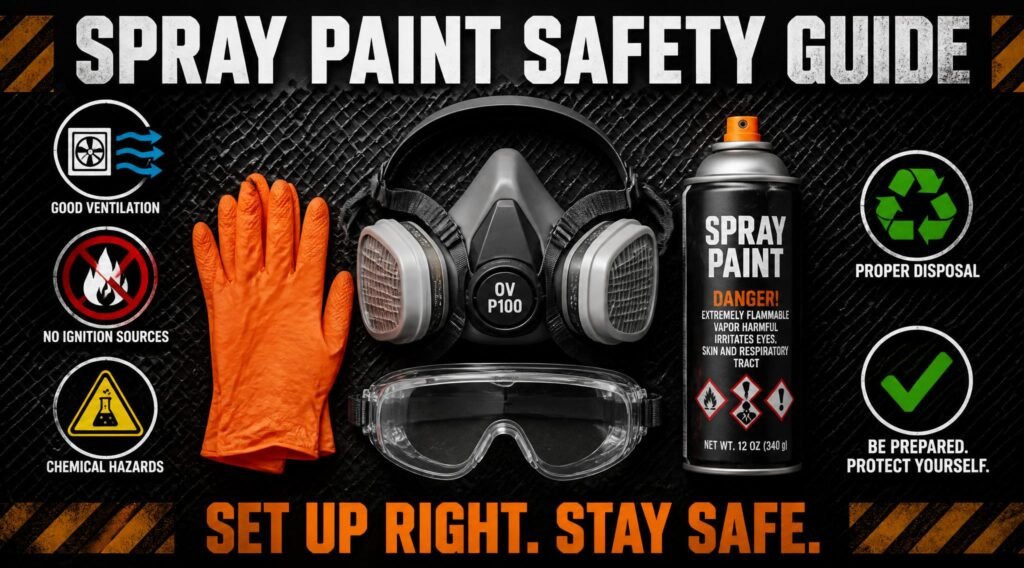
Spray painting is a satisfying and efficient way to finish surfaces — but it involves chemicals, propellants, and fine airborne particles that pose real health risks if safety is ignored. The good news is that spray painting safely is entirely straightforward when you know what to watch out for and set up correctly before you start.
This guide covers the complete picture: protective equipment, ventilation, fire safety, proper disposal, first aid, and the specific risks associated with different types of spray paint and different working environments.
Are You Set Up Safely? A 5-Point Pre-Paint Checklist
Run through this checklist before starting any spray painting session. Each point corresponds to a real risk that causes real harm when skipped:
| Check | Safe Condition | Risk If Skipped |
|---|---|---|
| Respirator with correct cartridges on hand | OV/P100 cartridge respirator — not a dust mask | VOC inhalation; headache, dizziness, long-term lung damage |
| Adequate ventilation confirmed | Windows open, fan blowing out, no enclosed space | Vapor buildup to dangerous concentration within minutes |
| No ignition sources within the work area | No pilot lights, open flames, sparks, or smoking | Fire or explosion from flammable aerosol propellants |
| Nitrile gloves and eye protection ready | Gloves + safety glasses or goggles | Skin sensitization, solvent absorption, eye injury |
| Disposal plan in place for rags and empty cans | HHW facility access or outdoor drying area | Spontaneous combustion of solvent rags; illegal disposal |
Every item on this list takes under two minutes to address. None of the health problems associated with spray painting happen to people who consistently work through this checklist before picking up a can.
Understanding the Risks
Spray paint exposes you to three distinct categories of risk. Understanding each one clearly is what allows you to protect against all three simultaneously rather than addressing them reactively after something goes wrong.
Inhalation Hazards
Spray paint releases volatile organic compounds — chemicals that evaporate at room temperature and enter the lungs with every breath. At low concentrations, VOCs cause headaches, dizziness, and nausea. At high concentrations in poorly ventilated spaces, they can cause rapid disorientation, loss of consciousness, and — with repeated chronic exposure — serious respiratory damage and neurological effects.
The paint mist itself is a separate inhalation hazard. Fine airborne paint particles penetrate deep into the lungs. Prolonged exposure without respiratory protection causes lung irritation and, in serious cases, chemical pneumonia.
VOC levels vary significantly by product type:
| Paint Type | VOC Level | Inhalation Risk |
|---|---|---|
| Water-based acrylic | Low–Medium | Moderate — ventilation and OV cartridge required |
| Oil-based / alkyd | High | High — outdoor or heavy ventilation essential |
| Lacquer / solvent-based | Very High | Very High — outdoor only; full-face or OV/P100 minimum |
| Automotive 2K / urethane | Extreme | Extreme — isocyanates present; supplied-air respirator recommended |
| Low-VOC specialty formulas | Very Low | Low — still requires ventilation; not zero risk |
Skin and Eye Contact
Paint and solvents cause skin irritation and, with repeated exposure, chemical sensitization — an immune response that can make future exposures trigger allergic reactions even at low concentrations. Aerosol propellants under high pressure can cause serious eye injury from close-range spray. Some pigments, particularly in older paints, contain heavy metals including lead and chromium that are absorbed through skin and are cumulative toxins.
Fire and Explosion Risk
All aerosol spray paint cans contain pressurized flammable propellants — typically butane, propane, or a blended mixture. This is not a theoretical risk: aerosol cans can and do explode when punctured, left in hot vehicles, stored near heat sources, or used near open flames and sparks. A can sitting in a hot car on a summer day can reach internal temperatures sufficient to cause rupture.
Personal Protective Equipment: What You Actually Need
Respiratory Protection
This is where most casual spray painters get it dangerously wrong. A dust mask — including an N95 — filters particles but provides zero protection against VOC vapors. Using a dust mask instead of a proper respirator gives the user a false sense of protection while they continue inhaling chemical vapors unimpeded.
What you actually need:
| Paint Type | Minimum Respirator | Recommended |
|---|---|---|
| Water-based acrylic spray paint | OV/P100 half-face respirator | OV/P100 half-face respirator |
| Oil-based or alkyd spray paint | OV/P100 half-face respirator | OV/P100 half-face respirator + outdoor use |
| Lacquer or solvent-based paint | OV/P100 half-face respirator | Full-face OV/P100 respirator |
| Automotive 2K / urethane paints | Supplied-air respirator | Supplied-air respirator (non-negotiable) |
| Any paint — enclosed indoor space | OV/P100 minimum | Maximize ventilation regardless of respirator |
OV stands for organic vapor. P100 is a particulate filter rating. The combination cartridge addresses both the chemical vapor and the fine paint particle hazard simultaneously.
Cartridge replacement: Cartridges become saturated over time and stop filtering effectively with no visible sign of failure. If you can smell chemicals through the respirator, the cartridge is spent and must be replaced immediately. For regular users, replace cartridges every 6 months regardless of usage, or per manufacturer guidance. Store respirators in a sealed bag between uses to prevent passive off-gassing that degrades cartridges even when not in use.
Eye Protection
Safety glasses provide adequate protection against overspray and accidental splash for most spray painting work. For extensive sessions, goggles that form a complete seal around the eyes offer better protection — particularly important when working overhead or with high-pressure spray where rebound is more likely.
Standard prescription glasses do not qualify as safety protection. If you wear prescription glasses, either use over-glasses safety goggles or prescription safety glasses.
Skin Protection
Nitrile gloves are the correct choice for spray painting — latex gloves provide insufficient chemical resistance and vinyl gloves offer even less. Change gloves regularly during extended sessions; solvents permeate nitrile over time, and gloves used with lacquer thinner or mineral spirits should be discarded after each use rather than reused.
For major projects, a disposable Tyvek coverall provides full-body protection and is far easier to dispose of than trying to clean paint-contaminated clothing. At minimum, wear old clothing you do not mind ruining and cover any exposed forearms and ankles.
Ventilation: The Most Critical Safety Factor
Ventilation is the single most important safety measure in spray painting — more important than any piece of PPE, because no cartridge respirator completely eliminates VOC exposure, and fire risk from vapor concentration is a separate hazard that respiratory protection does not address at all.
VOCs concentrate rapidly in enclosed spaces, reaching dangerous levels within minutes of sustained spraying. The goal of ventilation is constant air exchange — moving contaminated air out and replacing it with fresh air before concentrations build.
Ventilation by Setting
Outdoors The safest option by a significant margin. Natural air movement disperses vapors continuously. Work on a calm day to prevent overspray from traveling into neighboring areas. Be aware that paint mist travels further than it appears — cover nearby vehicles, furniture, and plants, and be considerate of neighboring properties.
In a Garage Open the garage door fully before starting and keep it open for at least 30 minutes after finishing to clear vapor buildup. Add a box fan blowing out to accelerate air exchange. Do not spray near gas water heaters or furnaces — pilot lights are ignition sources that have caused fires. Never leave spray cans in a closed garage on hot days.
Indoors — Living Spaces Use only low-VOC, water-based products indoors. Open all windows and doors to create cross-ventilation. Use a box fan set to exhaust (blowing air out of the room, not in — this creates a negative pressure zone that draws in fresh air from other openings). Keep sessions short and take breaks in fresh air every 15–20 minutes. A collapsible spray shelter — a tent designed to contain overspray — can be useful for small indoor projects and reduces cleanup.
Never spray paint:
- In a basement with no windows or only small windows
- In an attached garage with the door closed
- In any enclosed space without active ventilation running before you start
- Near a running vehicle, furnace, water heater, or any appliance with a pilot light
Fire Safety with Spray Paint
All aerosol spray paint cans contain pressurized flammable propellants. This is non-negotiable safety information that must be applied every single time:
Absolute fire safety rules:
| Rule | Why It Matters |
|---|---|
| Never spray near open flames, pilot lights, or sparks | Aerosol propellant vapors ignite instantly |
| Do not smoke while spray painting or until area is cleared | Cigarette ash and embers are sufficient ignition sources |
| Keep cans away from heat sources (car interiors, direct sun, heaters) | Cans rupture above 120°F (49°C) internal pressure |
| Never incinerate spray paint cans — including empty ones | Residual propellant causes explosive failure |
| Store cans below 120°F (49°C) | Applies to sheds, garages, and vehicles in summer |
| Keep a fire extinguisher accessible during spray painting sessions | Response time matters if ignition occurs |
The most common fire scenario is not dramatic carelessness — it is someone spraying in a garage with a gas water heater running, not realizing the pilot light is there. Identify every potential ignition source before you start and eliminate or work away from it.
Working with Specific High-Risk Products
Oil-Based and Solvent-Based Paints
These formulations have the highest VOC content and the greatest fire risk of any consumer spray paint category. They should always be used outdoors or in a workspace with powerful active ventilation. An OV/P100 half-face respirator is the minimum; a full-face respirator is better. Dispose of rags used with mineral spirits or lacquer thinner with particular care — see the disposal section below.
Automotive Paints and 2K Clear Coats
Many automotive paints — especially two-component (2K) urethane clear coats and 2K primers — contain isocyanates. Isocyanates are among the most hazardous substances commonly available to consumers. They cause occupational asthma through a sensitization process: initial exposures may cause only mild symptoms or none at all, but once sensitization occurs, even tiny future exposures can trigger severe, potentially life-threatening asthmatic responses. There is no cure for isocyanate sensitization.
For any 2K automotive product, a supplied-air respirator is the only adequate protection. A standard cartridge respirator — even a high-quality OV/P100 — does not provide sufficient protection against isocyanates. This is not a recommendation that can be downgraded for convenience or cost. If supplied-air equipment is not available, do not use 2K automotive products.
Lead Paint on Existing Surfaces
Painted surfaces in homes and structures built before 1978 in the United States may contain lead-based paint. Spray painting over or sanding down lead-painted surfaces releases lead dust and particles — a serious and cumulative health hazard, particularly dangerous for children and pregnant women. There is no safe level of lead exposure for children.
Test any painted surface from a pre-1978 structure for lead using an EPA-approved test kit before sanding or spray painting over it. If lead is present, follow EPA lead-safe work practices, which include specific containment, PPE, and disposal requirements. In many jurisdictions, lead-safe renovation work on rental properties requires certification.
Disposal of Spray Paint and Related Materials
Correct disposal protects both your health and the environment. Improper disposal of spray paint materials is a common cause of both environmental contamination and household fires.
| Material | Correct Disposal Method | Do NOT Do This |
|---|---|---|
| Empty cans (fully depressurized) | Spray until nothing exits; dispose with recycling or regular trash (check local regulations) | Puncture or incinerate |
| Partially full cans | Household Hazardous Waste (HHW) facility | Put in regular trash or pour down drain |
| Solvent-soaked rags (mineral spirits, lacquer thinner) | Lay flat outdoors to dry completely, then HHW facility | Pile in a bin, bag, or container — spontaneous combustion risk |
| Paint-contaminated masking paper and tape | Allow to dry completely, then regular trash | Dispose while still wet — landfill regulations |
| Used nitrile gloves with solvent contact | Allow to off-gas outdoors briefly, then regular trash | Reuse after heavy solvent exposure |
Spontaneous combustion of solvent-soaked rags is a real and serious risk. Oxidizing solvents — particularly linseed oil, but also some paint thinners — generate heat as they dry in a pile. A bundle of solvent-soaked rags in a closed bin can ignite without any external flame. Always spread rags flat in a well-ventilated outdoor area to dry before disposal, and never pile them in enclosed containers while still wet.
First Aid for Common Spray Painting Accidents
Inhalation of Fumes
Move to fresh air immediately. If symptoms — headache, dizziness, nausea, chest tightness, or disorientation — are present, get outside and stay outside until fully recovered. If symptoms persist after 10–15 minutes in fresh air, seek medical attention. Do not re-enter the painted space until it has been fully ventilated and the vapor smell has dissipated. Call Poison Control (1-800-222-1222 in the US) if you are uncertain about the severity of exposure.
Skin Contact
Wash the affected area thoroughly with soap and water as soon as possible. Do not use solvent, paint thinner, or mineral spirits to remove paint from skin — this dramatically increases the absorption of harmful chemicals into the bloodstream. For persistent skin irritation, redness, or signs of allergic reaction, consult a doctor and bring the paint can or its label for ingredient identification.
Eye Contact
Immediately flush the affected eye with clean, lukewarm water for a minimum of 15 minutes. Hold the eyelid open throughout flushing. Remove contact lenses before or during flushing if easily possible. Seek medical attention if any irritation, redness, pain, or vision changes persist after flushing. Bring the product label or Safety Data Sheet (SDS) to the medical provider — it tells them exactly what chemicals are involved.
Aerosol Can Injury
If a can ruptures or discharges unexpectedly and causes a puncture wound or laceration, treat it as a medical emergency and seek immediate care. High-pressure injection injuries from pressurized containers are more serious than they appear externally and require prompt medical evaluation.
Common Spray Painting Safety Mistakes to Avoid
1. Using a dust mask instead of a respirator The most common and most dangerous mistake. A dust mask protects against particles but offers zero protection against VOC vapors — the primary chemical hazard in spray painting. If you can smell the paint through your mask, you are inhaling it. Replace with an OV/P100 cartridge respirator.
2. Calling a garage “ventilated” with only the door open A single open door creates minimal air exchange. Add a fan actively exhausting air outward and keep the door open for at least 30 minutes after finishing. A garage with one door open and no fan can still accumulate dangerous vapor concentrations during extended spraying.
3. Spraying near water heaters or furnaces Pilot lights are ignition sources. They are not visible from several feet away, they are not obvious to the eye, and they are always on. Know where every gas appliance is in your workspace before you start and ensure you are working a safe distance from all of them.
4. Storing cans in hot cars or sheds A sealed aerosol can in a hot car or unventilated metal shed in summer can reach the temperature at which internal pressure causes rupture. Store spray paint in a cool, dry location away from heat sources year-round.
5. Using 2K automotive products with a standard respirator Isocyanates in 2K urethane products are not adequately filtered by OV/P100 cartridges. Many people use these products without knowing what they contain. Check the Safety Data Sheet (downloadable from the manufacturer’s website for any product) before using any automotive two-component coating.
6. Piling solvent rags in a bin Solvent-soaked rags left in a pile — in a bin, bucket, or bag — can self-ignite through the heat generated by oxidation as the solvent dries. This is not rare: it is a documented cause of structure fires. Always spread rags flat outdoors to dry before disposal.
7. Skipping PPE for “just a quick spray” The exposure from a two-minute touch-up without a respirator in a closed garage is not zero. Accumulated short exposures add up. Consistent habits — gloves and respirator every time, regardless of duration — are the only approach that actually protects you.
Frequently Asked Questions
Q: Can I spray paint indoors with windows open and no respirator? No. Open windows help but do not eliminate vapor concentration in an enclosed space, particularly for oil-based products. A respirator with OV cartridges is required any time you spray paint in an enclosed space, regardless of ventilation level. The combination of ventilation and proper respiratory protection is what provides adequate safety.
Q: How do I know when my respirator cartridges need replacing? If you can detect the smell of paint or solvent through the respirator, the cartridge is saturated and must be replaced immediately. For regular users, replace cartridges every 6 months regardless of apparent condition. Store the respirator in a sealed zip-lock bag between uses to prevent passive off-gassing that degrades cartridges even when the respirator is sitting on a shelf.
Q: Is spray painting outdoors completely safe without a respirator? Not completely. In still or low-wind conditions outdoors, vapor concentrations directly around the work area can still reach levels worth protecting against, particularly with high-VOC oil-based products and during extended sessions. Outdoors is much safer than indoors, but a respirator is still recommended for any project lasting more than a few minutes or using solvent-based products.
Q: What should I do with half-empty spray paint cans I no longer need? Take them to a Household Hazardous Waste facility. Most counties and municipalities operate free HHW collection events or permanent drop-off sites. Do not put partially full aerosol cans in regular trash — they are a puncture and fire risk in waste handling. Search “[your county] household hazardous waste” to find your nearest facility.
Q: I felt dizzy while spray painting. Is that serious? Dizziness during spray painting is a sign that you are experiencing VOC exposure above a safe level. Move to fresh air immediately. If the dizziness resolves quickly in fresh air, increase ventilation and ensure you are wearing appropriate respiratory protection before continuing. If symptoms persist for more than 15 minutes in fresh air, seek medical attention. Repeated dizziness from spray paint exposure warrants a conversation with a doctor about cumulative exposure.
Conclusion
Spray painting safely is not complicated — it requires consistent application of a small number of principles every time: the right respirator with OV cartridges, genuine ventilation with active air exchange, no ignition sources in the work area, and appropriate skin and eye protection. These measures address all three risk categories simultaneously.
The health problems and accidents associated with spray painting almost universally happen to people who skip one of these basics, usually because the project seemed quick or the conditions seemed adequate without checking. Set up correctly every time, and spray painting is a low-risk activity that produces excellent results for years.
Once your safety setup is in place, technique is what separates a professional-looking finish from a frustrating one. Our complete guide to spray paint selection and technique for any project covers everything you need to know to get the best results from your products.
Pingback: Spray Painting Around Kids and Pets: A Complete Safety Guide | Spray Painter Guide
Pingback: How to Spray Paint a Bike Frame: The Complete Step-by-Step Guide | Spray Painter Guide
Pingback: 5 Best Safety Glasses & Goggles for Spray Painting: Complete Buying Guide | Spray Painter Guide