
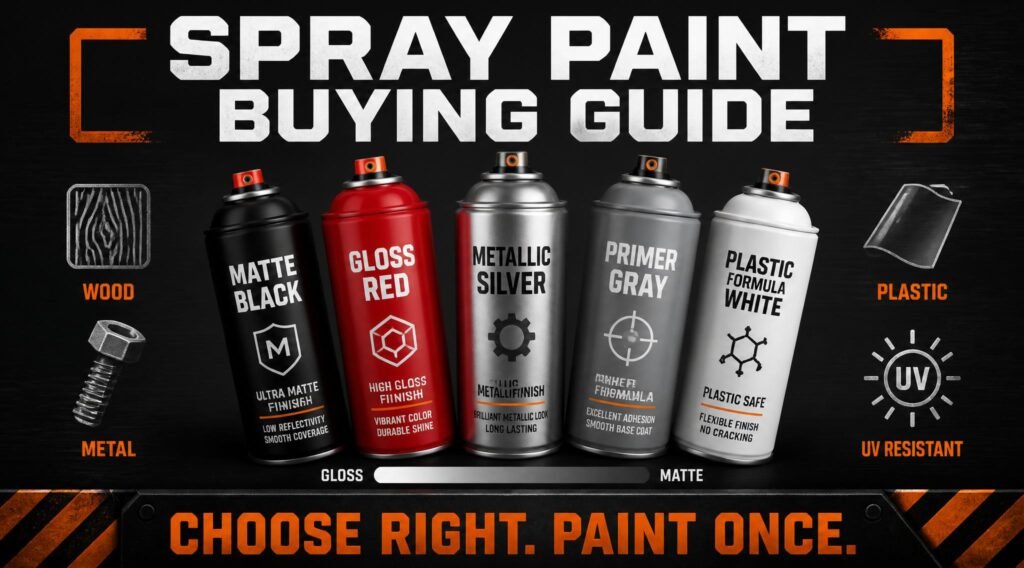
Walk into any hardware store and you will be confronted with an overwhelming wall of spray paint options. Flat, gloss, satin, enamel, acrylic, oil-based, latex, primer included, primer not included — the choices are endless and the labels are not always clear about what actually matters.
The right spray paint for your project depends on three main things: the surface you are painting, where the item will be used (indoor vs. outdoor), and what finish you want. This guide cuts through the confusion and helps you pick the right product every time — whether you are painting a rusty mailbox, a piece of furniture, a plastic bumper, or a decorative craft project.
Is This the Right Paint for Your Project? A 5-Question Selector
Before you buy anything, answer these five questions. Each answer narrows your options significantly and prevents the most common and costly spray paint mistakes:
| Question | Your Answer Determines |
|---|---|
| What material are you painting? | Paint formulation and primer requirements |
| Will the item be used outdoors or indoors? | UV resistance, weatherproofing, and VOC needs |
| What finish level do you want? | Sheen selection (flat through high-gloss) |
| How much durability does the surface need? | Acrylic vs. oil-based vs. enamel |
| Are you changing from a dark color to a light one? | Whether you need a dedicated primer coat |
Working through these five questions takes less than two minutes and will save you from the single most common spray paint problem: peeling, poor adhesion, or a finish that degrades far too quickly.
Step 1: Know Your Surface
The most important factor in choosing spray paint is the surface you are painting. Different materials require different formulations, and using the wrong type is the single most common reason spray paint peels, chips, or fails within months.
Surface-by-Surface Guide
| Surface | Key Requirement | Primer Needed? | Recommended Products |
|---|---|---|---|
| Bare metal (indoor) | Rust inhibitor | Yes — metal primer | Rust-Oleum Stops Rust, Krylon ColorMaster Metal |
| Bare metal (outdoor) | Rust inhibitor + UV resistance | Yes — metal primer | Rust-Oleum Stops Rust Outdoor |
| Wood (smooth) | Right viscosity, grain filler | Recommended | Wood-specific spray paint + shellac primer for pine/cedar |
| Plastic (PP, PE, PVC) | Adhesion promoter | Yes — plastic primer | Krylon Fusion, Rust-Oleum 2X Ultra Cover |
| Masonry / Concrete | High-build, freeze-thaw flexible | Recommended | Masonry-specific spray paint |
| Glass / Ceramic | Maximum adhesion, often oven-cure | Yes | Multi-surface with adhesion primer |
| MDF / Particle Board | Sealer to prevent absorption | Yes — sealing primer | Any spray primer + topcoat |
Metal Surfaces
Metal needs paint with rust-inhibiting properties, especially for any outdoor application. Look for paints labeled for metal that explicitly list rust inhibitors in the formulation. For bare metal, always prime first with a metal-specific primer — paint-and-primer-in-one products are not adequate for bare or rusted metal surfaces where maximum adhesion and rust protection are required.
Good starting options include Rust-Oleum Stops Rust and Krylon ColorMaster Metal, both widely available and proven on a broad range of metal projects.
Wood Surfaces
Wood is porous and absorbs paint unevenly, which leads to blotchy coverage and grain raising if the wrong product is used. Wood-specific spray paints are formulated with the right viscosity to fill the grain without excessive buildup. For pine, cedar, or any knotty or resinous species, a shellac-based or oil-based primer is essential to prevent tannin bleed — a yellowing or staining effect that bleeds through light topcoats.
Plastic Surfaces
Plastic is one of the most challenging surfaces to paint because most paints cannot chemically bond to it without help. Look specifically for labels that say “for plastic,” “bonds to plastic,” or “adhesion promoter included.” Krylon Fusion and Rust-Oleum 2X Ultra Cover are the most popular and reliable choices for general plastic painting.
Not all plastics are the same — PP (polypropylene), PE (polyethylene), and PVC each have different surface energies and may require different adhesion strategies. When in doubt, a dedicated plastic primer applied before your topcoat is the safest approach.
Masonry and Concrete
Masonry surfaces need high-build, flexible paints that can fill minor surface texture variations and withstand freeze-thaw cycles without cracking or peeling. Always use paints specifically labeled for masonry, brick, or concrete — general-purpose spray paint will not bond properly to these highly alkaline surfaces and will fail quickly outdoors.
Glass and Ceramic
These slick, non-porous surfaces are notoriously difficult to paint and require specific products. Use multi-surface paint with strong adhesion properties and always prime. Glass paint often requires baking in a household oven at 350°F for 30 minutes to achieve full cure and durability — without this step, the paint remains fragile and will scratch or chip easily.
Step 2: Indoor vs. Outdoor Use
Where your painted item will live determines the durability requirements of your paint. This decision is just as important as surface selection.
Outdoor Use Requirements
Outdoor spray paint must withstand:
- UV radiation — causes fading, chalking, and gloss loss in paints without UV stabilizers
- Temperature extremes — expansion and contraction cycles that cause cracking and peeling
- Moisture and humidity — promotes rust on metal and adhesion failure on wood
- Mechanical wear — abrasion, impact, and general handling
Look for paints explicitly labeled “exterior” or “outdoor use.” These contain UV stabilizers and weathering agents that indoor paints simply do not include. An indoor paint used outdoors will begin to fade and degrade within one season.
Indoor Use Priorities
Indoor spray paint can prioritize different qualities:
- Low VOC content — volatile organic compounds affect indoor air quality; especially important in enclosed workshops, basements, or living spaces
- Faster dry times — practical for projects where extended ventilation is inconvenient
- Wider decorative finish range — indoor paints offer more specialty finishes (chalk, metallic, fabric, etc.)
The safe rule: Outdoor-rated paint can always be used indoors without any issues. Indoor paint will fail when used outdoors. If you are unsure where an item will end up, choose outdoor-rated.
Step 3: Choose Your Finish
Finish level is a visual and practical decision. Here is what each level looks like, how durable it is, and what it is best suited for:
| Finish | Sheen Level | Best For | Notes |
|---|---|---|---|
| Flat / Matte | None | Walls, ceilings, craft projects | Hides surface flaws; hardest to clean |
| Eggshell | Very slight | Interior furniture, walls | Easier to wipe down than flat |
| Satin | Soft, low-luster | Furniture, trim, metal, cabinetry | The most versatile all-purpose finish |
| Semi-Gloss | Moderate shine | Kitchens, bathrooms, high-use furniture | Durable and washable |
| Gloss / High-Gloss | Maximum shine | Decorative objects, automotive, accents | Shows every surface flaw — prep is critical |
| Metallic | Reflective / decorative | Accents, hardware, decorative objects | Contains metallic pigments; purely decorative |
| Hammered | Textured | Metal furniture, industrial looks | Hides surface imperfections well |
Practical guidance on gloss level selection:
Higher gloss finishes amplify every surface imperfection — scratches, dents, uneven filler, brush marks, and texture variations all become more visible under a high-gloss coat. If your surface is not close to perfect, choose satin or semi-gloss instead of gloss. The shinier the finish, the more critical your surface preparation becomes.
Flat finishes, by contrast, hide surface flaws effectively but are more difficult to clean and less durable in high-contact applications. A flat finish on a dining chair will show wear quickly; a satin or semi-gloss finish will last far longer and wipe clean easily.
Step 4: Choose Your Paint Type
Acrylic / Water-Based
The best default choice for most projects. Key characteristics:
- Fast drying (touch dry in 20–30 minutes for most brands)
- Low odor — usable in reasonably ventilated spaces
- Easy water cleanup of equipment and hands
- Good adhesion on most surfaces when properly primed
- Available in every finish level
The limitation of acrylic spray paint is chemical and moisture resistance — for surfaces that will be exposed to solvents, heavy moisture, or physical abuse, oil-based or enamel formulations are more appropriate.
Oil-Based / Alkyd
The choice when maximum durability is required:
- Harder, more durable cured finish than acrylic
- Superior chemical and moisture resistance
- Requires mineral spirits for equipment cleanup
- Slower drying — typically 8–24 hours between coats
- Stronger odor — requires good ventilation
Best applications: exterior metal, floors, surfaces exposed to heavy use or chemicals, situations where the hardest possible finish is needed.
Enamel
“Enamel” describes hard, durable coatings that can be either oil-based or water-based — it refers to the hardness of the cured film rather than the chemistry. Enamel spray paints are the right choice for surfaces that receive heavy daily use: kitchen cabinets, appliances, metal furniture, and industrial equipment.
When a product is labeled “enamel,” expect a harder finish, longer dry times, and better long-term durability than standard acrylic.
Specialty Formulations
For specific applications, standard spray paint categories do not apply:
| Specialty Type | Use Case | Key Specification |
|---|---|---|
| High-heat spray paint | Grills, engines, exhaust pipes | Rated 1,200°F+ for engine paint; 500°F for general high-heat |
| Chalkboard paint | Writable surfaces for walls, furniture | Creates matte, chalk-receptive surface |
| Glow-in-the-dark | Crafts, safety markings, decorative | Requires light exposure to charge |
| Rubber / flexible coating | Plastic trim, bumpers, flexible surfaces | Remains flexible when cured; won’t crack with flex |
| Fabric spray paint | Canvas, upholstery, soft goods | Flexible, washable; formulated to bond to fabric |
| Mirror / chrome effect | Decorative metallic objects | High-reflectivity chrome appearance |
Understanding the Label
Spray paint labels contain a lot of useful information that most buyers skip. Here is what actually matters and what each term means:
| Label Term | What It Means | Why It Matters |
|---|---|---|
| Coverage (sq ft/can) | Area one can covers with one coat | Helps you calculate how many cans you need |
| Touch dry time | Surface is dry to a light touch | Not ready for recoat or handling |
| Recoat time | Ready for the next coat | Applying too soon causes wrinkling or lifting |
| Full cure time | Paint has reached maximum hardness | Often 24–72 hours; item shouldn’t be put into use before this |
| Recommended surfaces | Surfaces the manufacturer has tested | If your surface isn’t listed, choose a different paint |
| Application temp range | Safe spraying temperature | Outside this range, adhesion and drying are compromised |
| VOC content (g/L) | Volatile organic compound concentration | Low VOC = safer for indoor use and enclosed spaces |
Dry time confusion is extremely common. Many painters apply a second coat when the paint is only touch-dry and damage the first coat in the process. Always follow the recoat time on the label — not the touch-dry time.
Primer: When You Need It and When You Don’t
Many spray paints now advertise “paint + primer in one.” These are useful for quick, low-stakes projects but do not replace a dedicated primer for demanding applications.
Always Use a Dedicated Primer When:
- Painting bare metal (especially outdoors) — rust inhibiting primer is essential
- Painting bare wood, especially knotty or resinous species like pine or cedar
- Painting difficult plastics (PP, PE, PVC) — adhesion primer is the difference between lasting and peeling
- Dramatically changing colors — especially dark to light, where multiple topcoats without primer will struggle to cover
- Maximum durability is required — in any situation where the finish must last
Paint-and-Primer-in-One is Fine For:
- Touching up existing painted surfaces in good condition
- Painting crafts, decorative objects, and low-wear items
- Quick refreshes of furniture or accessories
- Projects where the painted item is not subjected to moisture, heavy use, or outdoor conditions
The one-coat, paint-and-primer-in-one category has genuinely improved and works well for appropriate applications. The mistake is using it where a separate primer is actually required and expecting the same results.
How Much Paint Do You Need?
A standard 12-oz spray paint can covers approximately 10–15 square feet with one coat on smooth surfaces. Rough, porous, or textured surfaces will consume significantly more paint per square foot.
Calculating your needs:
- Estimate the square footage of your project (length × width for flat surfaces; length × circumference for cylindrical objects)
- Multiply by the number of coats planned (2–3 coats is standard for most projects)
- Divide by 10–12 sq ft per can (use the lower number for rough surfaces)
- Round up to the nearest whole can
Example: A wooden dresser with approximately 40 square feet of paintable surface, painted with 2 coats: 40 sq ft × 2 coats = 80 sq ft ÷ 10 sq ft per can = 8 cans minimum. Buy 9–10 to allow for overlap and technique variation.
It is always better to have one extra can than to run out mid-project with a half-finished surface you cannot match exactly.
Common Spray Paint Mistakes to Avoid
1. Not testing on a scrap piece first Always spray a test patch on scrap material or an inconspicuous area before committing to the full project. This confirms adhesion, color accuracy, and finish level.
2. Shaking the can too little Most spray paints require 1–2 full minutes of vigorous shaking to properly mix the pigment and propellant. Under-mixed paint sprays inconsistently, delivers uneven color, and produces a grainy finish.
3. Spraying too close or too far The ideal distance for most spray paints is 10–12 inches from the surface. Too close causes drips and runs. Too far causes dry spray — a rough, powdery texture with poor adhesion.
4. Applying in extreme temperatures Most spray paints specify an application temperature range of 50–90°F (10–32°C). Painting in cold weather causes adhesion failure and extended dry times. Painting in heat causes bubbling and solvent pop.
5. Skipping surface prep Clean, dry, lightly sanded (where appropriate), and dust-free surfaces are non-negotiable. Paint does not hide dirt, grease, or loose material — it traps them, and the finish will fail at those points.
6. Applying one thick coat instead of several thin ones Multiple thin coats produce a harder, smoother, more even finish than one heavy coat. One thick coat almost always results in drips, slow cure times, and a soft finish that dents and scratches easily.
7. Painting in direct sunlight or wind Direct sun heats the surface and causes solvent to flash off too quickly, leaving a rough texture. Wind carries dust onto wet paint and accelerates dry time unevenly. Find a shaded, calm location.
Budget Guide: What to Expect at Each Price Point
| Price Range | What You Get | Best For |
|---|---|---|
| Under $6/can | Basic acrylic, limited colors, standard finish | Touch-ups, low-stakes crafts, short-term use |
| $6–$10/can | Mid-range acrylic/enamel, better coverage, more finishes | Most furniture, home décor, general projects |
| $10–$15/can | Premium formulations, specialty finishes, better adhesion | Outdoor metal, plastics, professional-quality finishes |
| $15+/can | Automotive, high-heat, specialty coatings | Specific demanding applications |
For most DIY home projects, the $6–$10 range delivers excellent results. Stepping up to premium products is worth it when the project involves difficult surfaces, outdoor exposure, or high-wear conditions.
Frequently Asked Questions
Q: Can I use leftover spray paint from a different project on a new surface? Only if the formulation matches your new surface. Leftover metal enamel on plastic will likely peel. Check the label’s recommended surfaces list against your new material before using any leftover product.
Q: Do I really need to wait the full recoat time between coats? Yes. Applying a new coat before the recoat window has passed traps solvents in the lower layer, causing wrinkling, lifting, or a permanently soft finish. The recoat time is not a conservative suggestion — it is the minimum time for the chemistry to work correctly.
Q: My spray paint is coming out speckled or grainy. What went wrong? This is almost always caused by spraying too far from the surface (dry spray), painting in low temperatures, or using a nearly empty can at low pressure. Try moving closer (10–12 inches), ensure temperatures are above 50°F, and replace near-empty cans.
Q: How do I store leftover spray paint? After use, invert the can and spray for 2–3 seconds until only clear propellant comes out — this clears the valve and prevents clogging. Store upright in a cool, dry location away from heat sources. Properly stored cans last 2–3 years. A clogged valve can often be cleared by soaking the tip in acetone.
Q: Is it safe to spray paint indoors? With proper ventilation, many water-based and low-VOC spray paints can be used indoors. Open windows, use a fan to move air out (not just circulate it), wear an appropriate respirator (not just a dust mask), and keep the area clear of open flames. Oil-based and solvent-heavy formulations should only be used outdoors or in a dedicated spray booth.
Conclusion
Choosing the right spray paint is the first and most important step toward a successful project. Match the paint formulation to your surface, select outdoor or indoor rating based on where the item will live, choose the finish level that fits your aesthetic and durability needs, and decide honestly whether a dedicated primer is required.
Get those four decisions right and the actual painting process becomes dramatically more forgiving. The most common spray paint failures — peeling, poor adhesion, fading, and cracking — are almost always the result of a wrong product choice, not a technique problem. Spend two minutes selecting the right paint and save yourself hours of stripping and repainting.
Once your product is selected and you are ready to begin, good spray painting technique — distance, speed, overlap, and coat thickness — will determine the quality of your final finish.