
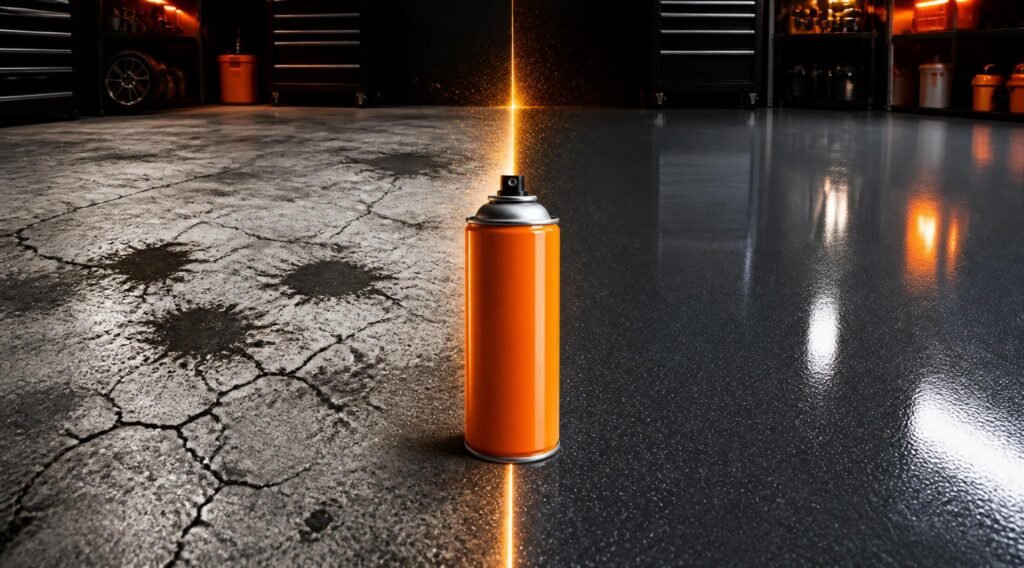
Painting concrete sounds straightforward — but concrete is one of the most unforgiving surfaces to get wrong. Buy the wrong product and you’ll have paint peeling up in sheets within a season. Skip the right primer and no amount of topcoat will compensate. Use interior paint outside and UV degradation makes it look faded and chalky within months.
The best spray paint for concrete in 2026 depends entirely on what type of concrete you’re painting, where it’s located, and what it needs to withstand. A product that’s perfect for a basement wall will fail on a driveway. The product that works brilliantly on a patio slab won’t survive as a garage floor under vehicle traffic.
This guide reviews the best concrete spray paint options available in 2026 — organized by product and surface type — so you can match the right product to your specific project from the start.
💡 Important note: for large concrete surfaces (driveways, garage floors, full patios), aerosol cans are impractical due to coverage limitations. These surfaces require a roller, brush, or pump sprayer. Aerosol spray paint excels on concrete walls, blocks, steps, and decorative surfaces. This guide covers products available in both formats.
🔗 Related: How to Spray Paint Concrete: The Complete Step-by-Step Guide (2026)
Quick Comparison: Best Spray Paint for Concrete (2026)
| Product | Best For | Finish | Coverage | Weather Resist | Rating |
| Rust-Oleum Concrete & Garage Floor | Garage floors, patios | Satin | ~400 sq ft/gal | ⭐⭐⭐⭐⭐ | 9.5/10 |
| Rust-Oleum Masonry Spray Paint | Walls, blocks, decorative | Flat/Matte | ~10–12 sq ft/can | ⭐⭐⭐⭐ | 9.2/10 |
| Rust-Oleum EpoxyShield | Heavy-duty garage floors | High Gloss | ~250 sq ft/kit | ⭐⭐⭐⭐⭐ | 9.7/10 |
| Rust-Oleum Watertight | Basement walls, wet areas | Flat | ~75 sq ft/can | ⭐⭐⭐⭐⭐ | 9.4/10 |
| Krylon Exterior Satin | Outdoor concrete walls/steps | Satin | ~25 sq ft/can | ⭐⭐⭐⭐ | 8.9/10 |
| BEHR Concrete & Masonry | Large patio/driveway areas | Flat/Satin | ~400 sq ft/gal | ⭐⭐⭐⭐ | 9.0/10 |
| Rust-Oleum Chalked (Concrete) | Decorative indoor concrete | Ultra Matte | ~15 sq ft/can | ⭐⭐⭐ | 8.5/10 |
| Drylok Masonry Waterproofer | Foundation/basement walls | Flat | ~75–100 sq ft/gal | ⭐⭐⭐⭐⭐ | 9.3/10 |
Why Concrete Is One of the Hardest Surfaces to Paint
Before reviewing specific products, it’s worth understanding why concrete requires specialized products — and why paint fails on concrete more often than on any other surface.
1. High Porosity
Concrete is riddled with tiny pores and capillaries that absorb liquid paint rather than letting it form a solid film on the surface. Without a primer that fills or seals these pores, paint soaks in unevenly — creating dull, thin spots that wear through quickly.
2. Alkalinity
Fresh concrete has a pH of 12–13. This high alkalinity can chemically break down paint from beneath (saponification), causing it to soften, bubble, and peel. Concrete should be at least 30 days old before painting, and acid etching or an alkalinity-neutralizing primer is essential for new concrete.
3. Moisture Transmission
Concrete transmits moisture from the ground through capillary action. Paint over damp concrete — or concrete with active moisture transmission from below — will eventually delaminate as moisture pressure pushes it from beneath.
4. Mechanical Stress
Concrete floors face vehicle weight, foot traffic, abrasion, chemical spills, and freeze-thaw cycling. These forces require paint with significantly higher mechanical durability than what’s needed for walls or furniture.
⚠️ Always perform the moisture test before painting any concrete: tape a 18″×18″ plastic sheet to the surface with all edges sealed. After 24 hours, check for condensation underneath. If moisture is present, address the source before painting.
🔗 Related: Spray Painting Safety: Everything You Need to Know to Stay Safe
The Best Spray Paints and Coatings for Concrete in 2026 — Detailed Reviews
1. Rust-Oleum EpoxyShield Garage Floor Coating — Best for Garage Floors
Best for: Residential and light commercial garage floors
Available finishes: High gloss
Coverage: ~250 square feet per kit
Approx. price: $45–$75 per kit
Rust-Oleum EpoxyShield is the industry standard for DIY garage floor coating and the most durable option for high-traffic concrete floors. The two-part epoxy formula creates a chemical bond with the concrete surface — not just a mechanical adhesion like paint — producing a floor that resists vehicle traffic, oil, fuel, battery acid, and household chemicals.
The kit includes Part A (epoxy resin), Part B (hardener), decorative color flakes, and detailed instructions. Application requires acid etching and thorough cleaning before applying — shortcuts in prep produce shortcuts in results.
What We Love:
- Exceptional durability — withstands vehicle traffic, chemical spills, and heavy equipment
- Chemical bond to concrete, not just surface adhesion — dramatically more durable than standard paint
- High gloss finish transforms a dull garage into a clean, professional-looking space
- Color flake option hides minor surface imperfections while adding visual texture
- Significantly longer lifespan than standard floor paint — typically 5–10 years before recoating
What to Watch:
- Two-part mixing required — must be applied within the pot life window (typically 2–4 hours after mixing)
- Full cure takes 72 hours before vehicle traffic — plan accordingly
- Temperature sensitive — don’t apply below 50°F or above 90°F
⭐ Verdict: If you’re painting a garage floor and want results that last, EpoxyShield is the non-negotiable choice. It costs more than standard floor paint but lasts 3–5x longer.
2. Rust-Oleum Concrete & Garage Floor Paint — Best All-Purpose Floor Paint
Best for: Patios, basement floors, garage floors (lighter duty), concrete steps
Available finishes: Satin
Coverage: ~400 square feet per gallon
Approx. price: $25–$40 per gallon
Rust-Oleum Concrete & Garage Floor Paint is a single-component (no mixing required), water-based concrete floor paint that delivers excellent results for residential floors that don’t see vehicle traffic. It’s significantly easier to apply than epoxy systems and forgiving of minor prep imperfections.
Applied by roller (a 3/4″ nap roller works best for concrete texture), it covers approximately 400 square feet per gallon in two coats. The satin finish is the most practical choice for floors — it resists scuffing and cleans easily without the slipperiness of high gloss.
What We Love:
- Single component — no mixing, no pot life pressure
- Water-based — easy cleanup, lower VOC than oil-based alternatives
- Excellent for patios, basement floors, and light-duty garage applications
- Available in a wide range of colors
- Can be tinted at the hardware store to match specific colors
🔗 Related: How to Spray Paint Concrete: The Complete Step-by-Step Guide
🔗 Related: 10 Common Spray Paint Mistakes (And How to Fix Every One of Them)
3. Rust-Oleum Masonry Spray Paint — Best Aerosol for Concrete Walls and Blocks
Best for: Concrete walls, concrete masonry units (CMU blocks), retaining walls, outdoor concrete décor
Available finishes: Flat/Matte
Coverage: ~10–12 square feet per can
Approx. price: $6–$10 per can
Rust-Oleum Masonry Spray Paint is the premier aerosol product specifically formulated for concrete and masonry surfaces. The formula includes adhesion promoters engineered for the alkaline, porous nature of concrete — bonding more reliably than general-purpose spray paints on this surface. The flat finish is appropriate for most exterior concrete wall applications.
It’s the top aerosol choice for decorating concrete walls, painting concrete blocks, refinishing outdoor planters, and any concrete surface where a roller application is impractical.
What We Love:
- Specifically formulated for masonry — superior adhesion vs general-purpose spray paint on concrete
- Aerosol format works on walls, blocks, and decorative surfaces where rollers are impractical
- Good weather resistance for exterior applications
- Works over most clean, primed concrete surfaces without compatibility issues
What to Watch:
- Coverage per can is limited — stock up for larger wall areas
- Flat finish can show marks on high-traffic surfaces — consider satin for steps
- A masonry primer applied first dramatically improves both adhesion and coverage
4. Rust-Oleum Watertight Waterproofing Paint — Best for Basement and Wet Walls
Best for: Basement walls, foundation walls, any concrete surface with active moisture infiltration
Available finishes: Flat
Coverage: ~75 square feet per can
Approx. price: $12–$18 per can
Rust-Oleum Watertight is not a standard paint — it’s a waterproofing coating designed to resist hydrostatic pressure, the technical term for moisture being pushed through concrete from the outside. It’s the correct product for basement walls where moisture infiltrates through the concrete itself.
Standard paint on a wet basement wall will always fail — moisture pushes through the concrete and lifts the paint from behind. Watertight’s formula cures to a waterproof membrane that can withstand up to 34 psi of hydrostatic pressure.
⚠️ Watertight and similar products address surface moisture infiltration but don’t fix structural water problems. If you have active water intrusion through cracks or joints, address the waterproofing at the source (exterior drainage, crack injection) before coating the wall.
5. Drylok Masonry Waterproofer — Best for Foundation Walls
Best for: Foundation walls, block walls, below-grade concrete
Available finishes: Flat
Coverage: ~75–100 square feet per gallon
Approx. price: $30–$45 per gallon
Drylok has been the go-to basement waterproofing paint for decades — a US Latex-formulated product that bonds directly to concrete and masonry and creates a barrier against moisture infiltration. It’s available in two versions: Original (resists up to 34 psi hydrostatic pressure) and Extreme (resists up to 15 psi, better for lighter moisture issues with mold resistance).
Drylok is applied by brush, roller, or sprayer — not aerosol. Work it into the surface with a stiff brush to fill all pores and voids for maximum waterproofing effectiveness.
6. Krylon Exterior Satin — Best Aerosol for Outdoor Concrete Walls
Best for: Outdoor concrete walls, concrete steps, exterior decorative concrete
Available finishes: Satin
Coverage: ~25 square feet per can
Approx. price: $7–$10 per can
Krylon Exterior Satin is formulated specifically for outdoor use with UV inhibitors and moisture-resistant chemistry. It performs well on vertical exterior concrete surfaces — walls, planters, garden blocks, and steps — where the satin finish provides better dirt resistance than flat and better appearance in outdoor settings.
Key advantage: The satin finish is practical outdoors — flat finishes on exterior concrete absorb dirt; gloss finishes show every surface imperfection. Satin is the best balance.
7. BEHR Concrete & Masonry Bonding Primer + Paint — Best for Large Outdoor Areas
Best for: Large patios, driveways, walkways (roller application)
Available finishes: Flat, Satin
Coverage: ~300–400 square feet per gallon
Approx. price: $35–$55 per gallon
BEHR’s concrete and masonry line provides excellent coverage at a competitive price point for large outdoor concrete surfaces. The bonding primer + topcoat system provides strong adhesion on properly prepared concrete and good UV resistance for outdoor applications.
Best application: Use a 3/4″ to 1″ nap roller for concrete texture. Apply in two coats, following the manufacturer’s wait time between coats.
Best Concrete Paint by Surface — Quick Reference
| Concrete Surface | Best Product | Application Method | Must Prime? | Sealer Needed? |
| Garage floor | Rust-Oleum EpoxyShield or Concrete & Garage | Roller (not aerosol) | Yes — etch + prime | Yes — epoxy topcoat |
| Concrete patio slab | BEHR Concrete & Masonry or Rust-Oleum C&G | Roller or pump sprayer | Yes — masonry primer | Yes — UV sealer |
| Concrete driveway | BEHR Concrete & Masonry or Rust-Oleum C&G | Roller or pump sprayer | Yes — etch + prime | Yes — penetrating sealer |
| Exterior concrete wall | Rust-Oleum Masonry Spray or Krylon Exterior | Aerosol or roller | Yes — masonry primer | Optional (recommended) |
| Basement/interior wall | Drylok or Rust-Oleum Watertight | Roller or brush | Yes — waterproofing primer | Yes — waterproof sealer |
| Concrete blocks (CMU) | Rust-Oleum Masonry Spray | Aerosol + roller | Yes — block filler primer | Yes — exterior sealer |
| Concrete steps | BEHR or Rust-Oleum C&G (non-slip additive) | Roller | Yes — masonry primer | Yes — non-slip sealer |
| Decorative indoor concrete | Rust-Oleum Chalked or Masonry Spray | Aerosol | Light sand + primer | Yes — polycrylic or wax |
Choosing the Right Concrete Sealer
A sealer is not optional on painted concrete — it’s the protective layer that determines how long your paint job actually lasts. Paint provides color; sealer provides protection.
| Sealer Type | Best Application | Sheen | Reapply Every | Key Benefit |
| Penetrating silane/siloxane | Driveways, exterior concrete | None (invisible) | 3–5 years | Repels water without changing appearance |
| Acrylic sealer | Patios, decorative concrete | Low–Medium sheen | 2–3 years | Enhances color, easy to apply |
| Epoxy sealer | Garage floors, high-traffic | High gloss | 5–10 years | Hardest, most chemical resistant |
| Polyurethane sealer | Outdoor, temperature cycling | Satin to Gloss | 3–5 years | Most UV resistant and flexible |
| Polycrylic spray | Indoor decorative concrete | Matte to Gloss | 2–4 years | Easy spray application, water cleanup |
Which Sealer Should You Choose?
Garage floor (EpoxyShield): The EpoxyShield system includes its own topcoat — no additional sealer needed
Patio or outdoor slab: Penetrating silane/siloxane sealer or polyurethane for UV resistance
Basement wall (Drylok): Drylok is self-sealing — additional sealer is optional
Decorative indoor concrete: Water-based polycrylic spray or furniture wax
Concrete blocks/exterior wall: Acrylic or penetrating sealer every 2–3 years
How to Apply Spray Paint to Concrete for Best Results
Preparation (Most Critical):
- Clean thoroughly — pressure wash at 2,000–3,000 PSI for floors; 1,500 PSI for walls
- Degrease oil stains with TSP cleaner or concrete degreaser — scrub, rinse, repeat until no oil visible
- Acid etch smooth concrete floors — muriatic acid solution, 5 min reaction, neutralize, rinse, dry
- Perform moisture test — plastic sheeting test for 24 hours
- Repair cracks and holes with concrete patching compound — let cure fully
Priming:
- Apply appropriate primer for surface type — masonry primer for walls, block filler for CMU, epoxy primer for heavy-duty floors
- Allow primer to cure fully per manufacturer instructions (usually 4–8 hours)
Painting:
- For aerosol: shake 2 minutes, hold 10–12 inches, even overlapping passes
- For roller: 3/4″–1″ nap roller, work paint into texture, don’t over-roll
- Apply 2–3 thin coats, allow adequate dry time between coats
- Allow final coat to cure 24 hours before foot traffic; 72 hours before vehicle traffic
Sealing:
- Allow topcoat to cure minimum 24 hours before applying sealer
- Apply 1–2 coats of appropriate sealer
- Reapply sealer every 2–5 years depending on traffic and exposure
🔗 Related: How to Spray Paint Concrete: The Complete Step-by-Step Guide
🔗 Related: Best Spray Paint Techniques for a Professional Finish
Frequently Asked Questions — Best Spray Paint for Concrete
What is the best spray paint for concrete?
For concrete walls and decorative surfaces, Rust-Oleum Masonry Spray Paint is the best aerosol option. For garage floors, Rust-Oleum EpoxyShield is the most durable choice. For patios and outdoor slabs, Rust-Oleum Concrete & Garage Floor Paint or BEHR Concrete & Masonry applied by roller provides the best coverage and durability. For basement walls with moisture issues, Drylok Masonry Waterproofer is the correct product.
Do I need special paint for concrete?
Yes — always use paint specifically formulated for masonry or concrete. General-purpose spray paint lacks the bonding chemistry to adhere properly to concrete’s alkaline, porous surface. It will look fine initially but peel within months. Concrete-specific paints include adhesion promoters and are pH-resistant to handle concrete’s high alkalinity.
How long does concrete paint last?
Properly applied concrete paint with adequate preparation and a sealer topcoat lasts 3–7 years on outdoor surfaces and longer indoors. Epoxy floor coatings on garage floors last 5–10 years under normal vehicle traffic. Without a sealer, outdoor paint degrades in 1–3 years. Skipping surface preparation reduces lifespan by 50–80% regardless of product quality.
Can I use aerosol spray paint on a concrete floor?
Aerosol spray paint is impractical for concrete floors due to limited coverage per can — you’d need dozens of cans for even a small garage floor. Use a roller or brush for floor applications. Aerosol spray paint is practical and effective for concrete walls, blocks, steps, planters, and decorative surfaces.
How do I fix peeling paint on concrete?
Remove all peeling paint by scraping, wire brushing, or pressure washing. Sand or grind the edges of stable paint smooth. Clean the area thoroughly, degrease if needed, and address any moisture issues. Re-prime the bare area and repaint with a compatible topcoat. Painting over peeling paint always fails — the adhesion problem must be resolved at the concrete surface.
What is the best paint for a concrete patio?
Rust-Oleum Concrete & Garage Floor Paint or BEHR Concrete & Masonry are the best options for patios — both are exterior-rated, UV-resistant, and durable enough for foot traffic and outdoor furniture. Apply by roller for best coverage and finish. Always seal with a UV-resistant sealer for outdoor applications. Add a non-slip additive to the paint or sealer for sloped surfaces that get wet.
Do I need to prime concrete before painting?
In almost all cases, yes. Concrete primer fills surface pores for even coverage, neutralizes surface alkalinity, and creates a stable bonding layer for the topcoat. On very smooth concrete floors, an acid etch before priming is also required to open the pores. Skipping primer on concrete is the single most common cause of concrete paint failure.
Final Verdict: Which Concrete Paint Should You Buy?
The best spray paint for concrete depends entirely on your specific surface and use case — there is no single product that excels everywhere.
Garage floor: Rust-Oleum EpoxyShield — the most durable system for vehicle traffic and chemical exposure
Patio or outdoor slab: Rust-Oleum Concrete & Garage Floor Paint — practical, durable, wide color selection
Concrete walls (aerosol): Rust-Oleum Masonry Spray Paint — specifically formulated for masonry adhesion
Basement walls: Drylok Masonry Waterproofer — addresses moisture infiltration that defeats standard paint
Decorative / artistic concrete: Rust-Oleum Chalked for matte texture or Krylon Exterior for outdoor color
Whatever product you choose, the preparation is what determines how long it lasts. Clean thoroughly, acid etch smooth floors, prime with a concrete-specific primer, and always seal the finished surface. These four steps will extend the life of any concrete paint product by years.
Complete Your Spray Painting Knowledge:
- How to Spray Paint Concrete: The Complete Step-by-Step Guide → https://spraypainterguide.com/how-to-spray-paint-concrete-complete-guide/
- Best Spray Paint for Metal in 2026: Top Picks for Every Job → https://spraypainterguide.com/best-spray-paint-for-metal-2026/
- Best Spray Paint for Wood in 2026: Top Picks for Every Project → https://spraypainterguide.com/best-spray-paint-for-wood-2026/
- Best Spray Paint for Plastic in 2026: Top Picks That Actually Stick → https://spraypainterguide.com/best-spray-paint-for-plastic/
- How to Spray Paint Cabinets: The Complete Step-by-Step Guide → https://spraypainterguide.com/how-to-spray-paint-cabinets-the-complete/
- 10 Common Spray Paint Mistakes (And How to Fix Every One) → https://spraypainterguide.com/spray-paint-mistakes-and-how-to-fix-them/
- How to Choose the Right Spray Paint for Any Project → https://spraypainterguide.com/how-to-choose-the-right-spray-paint-for-any/
Written by Rodney Shiner | Spray Painter Guide | spraypainterguide.com