
How to Spray Paint Cabinets: The Complete Step-by-Step Guide to a Flawless Finish (2026)
By Rodney Shiner | Application Guides | Updated June 2026
Spray painting cabinets is one of the most transformative — and most searched — DIY projects in the entire home improvement world. A full kitchen cabinet replacement can cost $15,000 to $40,000. A professional cabinet painting service runs $2,000 to $7,000. Spray painting your own cabinets with the right preparation and technique? You can achieve results that rival professional work for under $300.
But here is the honest truth: cabinet spray painting is also one of the most demanding spray painting tasks you will ever take on. Cabinets are high-traffic, high-touch surfaces that get opened, closed, wiped, and bumped hundreds of times every week. They need to look absolutely perfect — no drips, no orange peel texture, no brush marks — and they need to stay that way for years.
The difference between a cabinet job that looks professional and one that peels, chips, or shows every imperfection comes down entirely to preparation and technique. Get those right and you will have a kitchen transformation that looks better than what most painting contractors deliver.
This complete guide covers everything: the right equipment, the correct preparation sequence, the best primers and paints, the exact spraying technique for a flawless finish, and how to avoid every common cabinet spray painting mistake.
Table of Contents
- Spray Paint vs. Brush/Roller for Cabinets: Why Spray Wins
- Equipment You Need to Spray Paint Cabinets
- Best Spray Paint and Primer for Cabinets
- Complete Cabinet Spray Painting Preparation Guide
- Setting Up Your Spray Painting Workspace
- How to Remove Cabinet Doors, Drawers, and Hardware
- Cleaning Cabinets Before Spray Painting
- Sanding Cabinets: The Step Everyone Rushes (And Regrets)
- Priming Cabinets: The Foundation of a Lasting Finish
- How to Spray Paint Cabinet Doors: Technique Step-by-Step
- How to Spray Paint Cabinet Boxes (Frames)
- Applying Multiple Coats: Timing and Technique
- Finishing and Clear Coat Options
- Reinstalling Doors, Drawers, and Hardware
- Common Cabinet Spray Painting Mistakes (And How to Avoid Them)
- How Long Do Spray Painted Cabinets Last?
- FAQ: How to Spray Paint Cabinets
1. Spray Paint vs. Brush/Roller for Cabinets: Why Spray Always Wins
If you have ever tried to paint cabinets with a brush or roller, you already know the problem. Brush marks. Roller stipple texture. Lap lines where wet paint meets dry paint. No matter how carefully you work with hand tools, achieving a truly smooth, factory-like cabinet finish with a brush or roller is nearly impossible.
Spray painting eliminates all of these problems. A properly tuned spray gun atomizes paint into a fine mist that lands on the surface in an even, consistent film with zero marks, zero texture, and zero lap lines. The result is a finish that is genuinely indistinguishable from factory-finished cabinetry.
There are two spray painting approaches for cabinets:
Aerosol cans work for small projects — a bathroom vanity cabinet, a single furniture piece — but are impractical and expensive for a full kitchen. You would need 20 to 30 cans for a typical kitchen, the finish quality is harder to control, and aerosol cans are exhausting to use over a large project.
Spray guns (HVLP or airless) are the right tool for cabinet projects of any meaningful size. An HVLP (High Volume Low Pressure) gun gives you the most control and produces the smoothest finish with the least overspray — which is exactly what cabinet painting requires. If you are unsure which type of spray equipment is right for your project, our complete HVLP vs. Airless Paint Sprayer guide will help you decide.
2. Equipment You Need to Spray Paint Cabinets
The Spray Gun
Recommended for most DIYers: An HVLP gravity-feed spray gun, either turbine-powered or compressor-powered. Look for a gun with a 1.4mm to 1.8mm fluid tip — this range handles most cabinet paints and primers without constant thinning.
Top options that consistently deliver professional results on cabinets include the Fuji Semi-PRO 2 (turbine HVLP, excellent all-around choice), the Graco TrueCoat 360 (airless, easier to clean), and the Earlex 6003 HVLP Spray Station (budget-friendly turbine, good for beginners).
If you are starting out and working with a budget, our guide to the best airless paint sprayers under $200 covers entry-level options that can handle cabinet work when properly set up.
Additional Equipment Checklist
- Air compressor (if using a compressor-powered HVLP gun): minimum 2-gallon tank, 90 PSI output
- Pressure regulator and moisture trap on the air line — moisture contamination destroys cabinet finishes
- Safety respirator rated for organic vapors (N95 dust mask is NOT sufficient for spray painting — see our complete spray painting safety guide)
- Safety glasses and disposable coveralls
- Tack cloths — multiple
- High-quality painter’s tape — Frog Tape or Scotch Blue Professional grade
- Plastic sheeting for masking countertops, appliances, and floors
- Paint strainer bags — strain every batch of paint before spraying to prevent clogs
- Stir sticks and a paint mixing paddle
- Sawhorse pairs — for laying doors flat during painting
- Cabinet door painting stands (optional but excellent — small pyramid-shaped spikes that elevate doors off the surface so all four edges can be painted without waiting)
- Numbered labels and masking tape — number every door, drawer, and hinge position before removal
- Screwdriver or drill for hardware removal
3. Best Spray Paint and Primer for Cabinets
Cabinet surfaces need products specifically formulated for hard-use surfaces. Standard wall paint, even in a spray gun, will not hold up to the wear that cabinets receive.
Best Paints for Spray Painting Cabinets
Benjamin Moore Advance (waterborne alkyd) — The gold standard for cabinet painting. Levels beautifully when sprayed, dries incredibly hard, and resists chips and scuffs better than most other products. Available in any color. Slightly longer recoat time (16 hours) but the finish is worth it.
Sherwin-Williams Emerald Urethane Trim Enamel — Second only to Advance in terms of durability and leveling quality. Hard cure, excellent scrubbability, and beautiful sheen levels. Recommended by professional cabinet painters consistently.
Rust-Oleum Cabinet Transformations (spray-compatible version) — A more budget-friendly option that works reasonably well when properly sprayed. Not as durable as Advance or Emerald Urethane but acceptable for lower-use cabinets.
Choosing your sheen: For kitchen cabinets, use semi-gloss or satin. Gloss is too reflective and shows every surface imperfection. Flat and eggshell are too easily marked and difficult to clean. Satin offers a soft sheen that looks refined and wipes clean easily. Semi-gloss is the traditional choice and provides excellent durability.
Best Primers for Cabinets
Zinsser BIN Shellac-Based Primer — The absolute best primer for previously painted or stained cabinets. Seals stains, blocks tannin bleed from wood, and adheres to almost any existing surface with no sanding. It does require shellac thinner for gun cleanup.
Zinsser Bulls Eye 1-2-3 — Water-based, easy to clean up, and excellent adhesion. Works well when cabinets are properly sanded and clean. Lower stain-blocking ability than BIN.
KILZ Original (oil-based) — Excellent stain blocking and adhesion. Good for raw or previously painted wood cabinets.
Always prime. Cabinet painting without a dedicated primer coat almost always results in poor adhesion, visible tannin bleed from wood, and a finish that chips prematurely. The extra time spent priming is the most important quality investment you can make in this project.
4. Complete Cabinet Spray Painting Preparation Guide
Cabinet preparation is where this project is won or lost. Experienced professional cabinet painters spend 60 to 70 percent of their total project time on preparation — not spraying. If your prep is thorough, the spraying goes quickly and the results are outstanding. If you rush prep, no amount of technique recovers the finish.
The preparation sequence for cabinets follows a strict order. Skipping or reordering steps causes failures that are far more difficult to fix later.
5. Setting Up Your Spray Painting Workspace
Before you touch a single cabinet, set up a proper spray environment. This step is skipped by most first-timers and causes dust contamination, uneven finishes, and safety hazards.
Ideal workspace for cabinet doors: A garage with the door open, a ventilated basement, or an outdoor covered area on a calm day. Cabinet doors should be painted horizontally (laid flat) to prevent runs and allow the paint to level perfectly. Set up sawhorses at a comfortable working height.
Protect everything: Lay heavy plastic sheeting over the garage floor or workshop surface. Overspray from cabinet painting travels surprisingly far and permanently stains concrete and wood floors.
Control dust obsessively. Dust landing on wet cabinet paint creates a textured surface that must be sanded and repainted. Sweep and damp-mop the workspace at least one hour before spraying. Let dust settle completely before opening paint.
Temperature and humidity matter enormously. The ideal spray painting conditions are 65–75°F (18–24°C) with relative humidity below 50%. At high humidity, water-based paints dry slowly, sag easily, and may develop a cloudy appearance. In cold temperatures (below 55°F), paint does not flow or level properly. Our complete guide to spray painting in outdoor conditions covers weather considerations in detail.
6. How to Remove Cabinet Doors, Drawers, and Hardware
Remove everything. Attempting to spray paint cabinet doors while they are still mounted on the cabinets is the fastest route to an unprofessional result. You cannot spray all edges evenly, you risk overspray on adjacent surfaces, and you cannot achieve the level of surface preparation that in-place doors allow.
The systematic removal process:
- Use a smartphone to photograph the entire kitchen before starting — shoot each cabinet individually so you have a clear reference for reinstallation.
- Label every door with a numbered piece of painter’s tape on the inside surface: “1,” “2,” “3,” and so on. Write the corresponding number on a piece of tape on the cabinet frame at the same position. This ensures every door goes back exactly where it came from.
- Remove hinges and set them aside in labeled zip-lock bags. Note which hinges are left-side and right-side if they are not identical.
- Remove all drawer fronts, knobs, pulls, and handles. Store hardware in labeled bags.
- Stack doors horizontally in a safe location — never lean them against walls, as they will develop a slight bow.
7. Cleaning Cabinets Before Spray Painting
Kitchen cabinets accumulate grease, cooking oils, and residue over years of use. This invisible contamination is one of the primary reasons spray paint peels from cabinets — the paint bonds to the grease rather than to the wood, and the grease itself has no adhesion to the surface below.
Clean with TSP substitute (trisodium phosphate substitute): Mix according to package directions, apply with a sponge or cloth, and scrub all surfaces thoroughly. Pay special attention to the areas around the stove, above the refrigerator, and near any cooking surface.
Follow with a degreaser wipe-down. After TSP cleaning, wipe all surfaces with a lint-free cloth dampened with denatured alcohol. This removes any remaining grease and TSP residue.
Rinse with clean water and allow cabinets to dry completely — at least 2 to 4 hours — before proceeding.
Never skip the cleaning step, even on newer cabinets that appear clean. Body oils from daily use contaminate surfaces far more than they appear.
8. Sanding Cabinets: The Step Everyone Rushes and Regrets
Sanding serves two critical purposes in cabinet painting: it scuffs the existing finish to create microscopic texture that primer can bond to, and it removes any raised grain, old drips, or surface irregularities that will show through new paint.
For cabinets with an existing painted or factory finish:
Sand with 120-grit sandpaper using a sanding block or random orbital sander. You are not trying to remove the old finish — just dull it to a consistent matte appearance with fine scratches. When the entire surface looks uniformly dull with no shiny areas remaining, sanding is complete.
For raw wood or stripped cabinets:
Sand with 120-grit to level the surface, then follow with 150-grit for a smoother final prep before priming.
Between primer coats and between paint coats:
Sand with 220-grit (wet/dry paper used dry). This scuffs the previous coat lightly to improve inter-coat adhesion and removes any dust nibs or surface irregularities that landed on the wet coat.
After the final sanding step, use a tack cloth to remove every particle of dust. Fold the tack cloth frequently to expose a fresh surface. Never blow off dust with compressed air — it redistributes particles throughout the air and onto your freshly cleaned surface.
The relationship between sanding and finish quality is direct: more careful sanding produces a smoother final result. This is explained in full detail in our guide to getting a smooth finish with spray paint — the principles there apply directly to cabinet work.
9. Priming Cabinets: The Foundation of a Lasting Finish
Primer is not optional for cabinet work. It serves three functions that paint alone cannot: it seals the substrate to prevent bleed-through, it creates a uniform surface that paint bonds to consistently, and it reveals surface imperfections that need to be filled before topcoat application.
The priming sequence:
Step 1: Spray one full coat of primer. Thin primer according to gun specifications (typically 10–15% with water for water-based primers, or mineral spirits for oil-based). Spray an even coat across all surfaces, maintaining consistent distance and overlap.
Step 2: Allow full cure. Water-based primers need 1–2 hours; oil-based and shellac primers need 3–4 hours minimum before sanding.
Step 3: Sand with 220-grit. After the primer coat dries completely, sand lightly with 220-grit until all surfaces feel smooth to the touch. The primer coat will reveal any grain raise, scratches, or surface defects as small ridges — sand these completely flat.
Step 4: Fill any defects. Use a lightweight spackling compound or dedicated cabinet filler to fill any dents, gouges, or nail holes. Apply, allow to dry, sand flat, and spot-prime before topcoat.
Step 5: Tack cloth the entire surface before applying any additional coats.
For raw wood cabinets with strong grain patterns (especially oak), apply two primer coats with sanding between each. The grain on oak is deep enough that a single primer coat rarely fills it completely — two coats produce a significantly smoother finish.
10. How to Spray Paint Cabinet Doors: Technique Step-by-Step
Cabinet door spraying technique is the skill that separates professional-looking results from amateur ones. The good news: the technique is learnable in one short practice session.
Gun Setup for Cabinet Doors
Fluid needle: 1.4mm for water-based paints (Benjamin Moore Advance, Sherwin-Williams Emerald); 1.6–1.8mm for thicker oil-based products.
Fan width: Set to a 10–12-inch fan pattern for cabinet doors. A fan that is too wide wastes paint at the edges; too narrow creates striping.
Atomization pressure: For HVLP turbine guns, start at the middle setting and adjust until the spray pattern is even without coarse droplets. For compressor-powered guns, 25–35 PSI at the gun inlet is typical for cabinet paints.
Thin paint correctly. Most cabinet paints need 10–15% thinning for spray application. Add thinner gradually, stir thoroughly, and test spray on cardboard before applying to cabinets. Properly thinned paint atomizes into a fine mist without visible drips or sputtering.
Always strain paint through a fine mesh strainer bag before pouring into the gun cup. Unstrained paint clogs the fluid needle tip and ruins spray patterns mid-coat.
The Spraying Sequence for Cabinet Doors
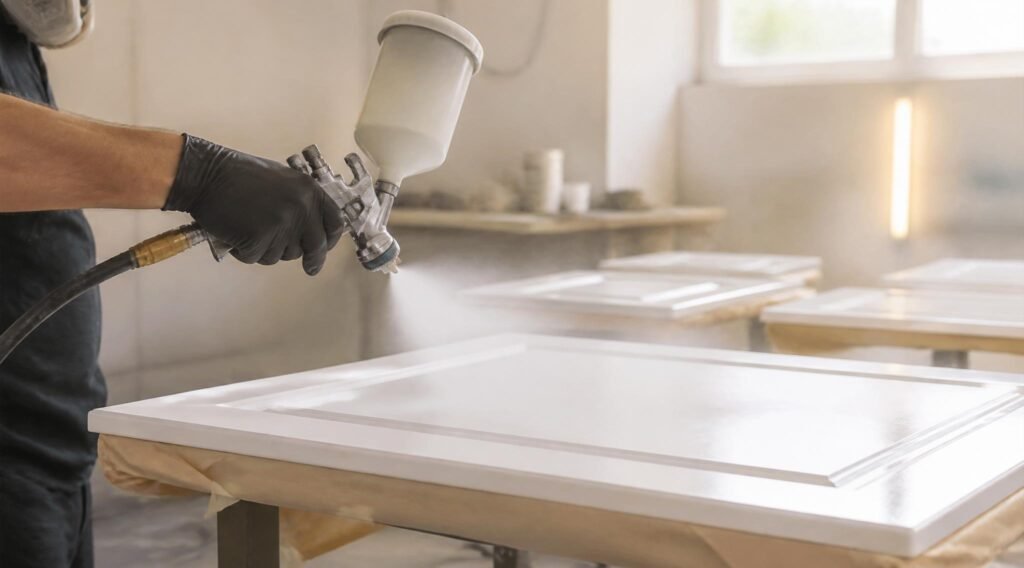
Always spray doors horizontally (laid flat). This is the most important technique point for cabinet painting. Vertical spraying always risks runs and sags, no matter how carefully you work. Flat painting allows gravity to help the paint level rather than fight you.
Step 1: Spray the back of each door first. The back is the less visible face. Spraying it first lets you develop your rhythm and technique for the session before committing to the front.
Step 2: Spray edges before faces. With the door face-down, spray all four edges first, then flip to the face. This prevents overspray from edge spraying from landing on a freshly sprayed face.
Step 3: Apply paint with overlapping parallel passes. Hold the gun 8–12 inches from the surface. Move the gun at a steady, consistent speed — roughly the pace of a brisk walk. Overlap each pass by 50%, meaning each new pass covers half of the previous one.
Step 4: Trigger technique. Pull the trigger just before the gun reaches the edge of the door, and release just after passing the opposite edge. Never start or stop the trigger motion while the gun is stationary over the surface — this creates heavy buildup at the beginning and end of each pass.
Step 5: Maintain perpendicular angle. Keep the gun exactly perpendicular to the surface at all times. Tilting the gun causes uneven film thickness — thicker in the center of the pass, thinner at the edges.
Step 6: Apply thin coats, not thick ones. Two to three thin coats with proper drying time between them always produce a better result than one thick coat. A thin coat dries in 30–45 minutes. A thick coat sags, drips, and takes hours to dry — review our full spray paint drips and runs fix guide for recovery steps if this happens.
11. How to Spray Paint Cabinet Boxes (Frames)
Spraying cabinet boxes — the fixed frames that remain mounted on the wall — requires a different approach than doors.
Mask everything adjacent to the cabinet frames. Run painter’s tape along the ceiling, walls, and countertop edges. Use plastic sheeting to cover countertops, appliances, and the floor area directly in front of the cabinets. Overspray from cabinet box spraying is unavoidable without masking.
Use a smaller fan pattern for cabinet boxes than for doors. A 6–8-inch fan gives you better control inside the confined space of the cabinet interior.
Spray the interior first. Work from the back of the interior forward, then spray the face frame. Interior surfaces are less critical visually but must still be coated for a complete finish.
Be especially careful at corners and inside edges. These areas are prone to buildup — move the gun slightly faster as you approach corners rather than slowing down.
For masking detailed guidance that prevents spray from reaching surfaces you do not want painted, our spray paint mistakes guide covers the most common masking errors and how to recover from them.
12. Applying Multiple Coats: Timing and Technique
How Many Coats Does a Cabinet Need?
For a complete cabinet painting project with proper primer:
- Primer: 1–2 coats (2 for raw wood or heavy grain)
- Topcoat: 2–3 coats
Two topcoats over a properly primed surface is the minimum for durable cabinet work. Three coats produce noticeably better depth, sheen, and durability — particularly for painted cabinets in a busy kitchen.
Timing Between Coats
Water-based paints (Benjamin Moore Advance, Sherwin-Williams Emerald Urethane): Allow a minimum of 2–4 hours between coats in normal conditions (70°F, below 50% humidity). Do not rush recoat time — thin, incompletely dried paint layers trap solvents and produce soft, easily scratched finishes.
Oil-based and alkyd paints: Allow a minimum of 8–16 hours between coats. These products take longer to oxidize and cure, but they also level and harden to a significantly more durable finish.
Sand lightly between every coat with 220-grit paper — even the topcoats. A light scuff between coats removes any dust contamination and improves inter-coat adhesion. After the final coat, skip sanding unless there are specific imperfections to address.
Apply a fresh tack cloth wipe after every sand. Dust from sanding between topcoats is as damaging to the final finish as the original surface contamination. Tack cloth every surface meticulously before each coat.
13. Finishing and Clear Coat Options
For most cabinet painting projects using Benjamin Moore Advance or Sherwin-Williams Emerald Urethane Trim, a clear topcoat is not necessary. These products cure hard enough to handle daily cabinet use without additional protection.
However, in high-traffic kitchens or when using a softer waterborne paint, a clear topcoat adds meaningful protection:
Water-based polyurethane (water-white formula): Adds a hard, scrubbable top layer. Use a “water-white” or “non-yellowing” formula — standard polyurethane yellows over white and light-colored cabinets within months.
Conversion varnish: The most durable finish option for cabinets, used by professional cabinet finishers. Requires careful handling (isocyanate catalyst in some formulas requires full respirator with supplied air), but produces an almost indestructible surface. If you are refinishing commercial kitchen cabinets or high-end residential work, conversion varnish is the gold standard.
Apply clear coats with the same HVLP technique as topcoats — thin, even passes, horizontal application, full dry time between coats.
14. Reinstalling Doors, Drawers, and Hardware
Allow the final coat to dry for a minimum of 24 hours before handling. Even products that feel dry to the touch continue curing for days to weeks. Handling cabinet doors too early dents and mars the finish even when paint appears fully dry.
Allow 72 hours of cure time before reinstalling hinges and rehung doors. Early hinge installation can cause marks where the hinge contacts the paint.
Do not hang loaded cabinets — dishes, pots, and food — for at least 7 days after painting. Water-based paints continue curing for up to 30 days and reach full hardness only at the end of this period. Early loading compresses the paint surface and leaves permanent marks.
Reinstall doors using your numbered labels as a guide. Do not attempt to adjust hinge positions during reinstallation — install each door exactly as it came off. Fine adjustments can be made after all doors are hung and you can step back to assess alignment.
If you notice any final imperfections after reinstallation — minor dust nibs, edge roughness — address them by wet sanding the specific area with 400-grit wet/dry paper, then applying a touch-up coat with a small artist’s brush using thinned paint.
15. Common Cabinet Spray Painting Mistakes and How to Avoid Them
Mistake 1: Not cleaning cabinets thoroughly. Grease contamination is the most common cause of peeling cabinet paint. Solution: TSP wash, followed by denatured alcohol wipe, with complete drying before priming.
Mistake 2: Skipping primer or using wall primer. Wall primers do not have the adhesion or stain-blocking properties needed for cabinet work. Always use a dedicated cabinet-grade primer.
Mistake 3: Not thinning paint sufficiently for the gun. Unthinned paint causes orange peel texture — a bumpy surface that resembles the skin of an orange. Solution: thin to proper viscosity, test spray on cardboard, and adjust before applying to doors. Our guide to getting a smooth finish with spray paint covers orange peel in full detail.
Mistake 4: Spraying too close or moving the gun too slowly. Both cause heavy film buildup that sags and runs. Maintain 8–12 inches distance and keep the gun moving at a consistent, steady pace.
Mistake 5: Spraying in high humidity or low temperatures. Paint will not level or cure properly in these conditions. Check conditions before every spraying session.
Mistake 6: Applying coats too thick. One of the most common beginner errors. Thick coats look appealing during application and become disasters during drying. Two thin coats always outperform one thick coat.
Mistake 7: Rushing recoat time. Applying a second coat over an incompletely dried first coat traps solvents and produces a permanently soft finish. Follow manufacturer recoat windows precisely. A more complete breakdown of spray painting errors and their fixes is in our 10 common spray paint mistakes guide.
Mistake 8: Painting doors vertical. Vertical cabinet door painting always risks runs. Always lay doors flat.
Mistake 9: Skipping between-coat sanding. Light 220-grit sanding between coats removes dust contamination and improves adhesion. Skipping this step produces a rough, dull final surface.
Mistake 10: Reinstalling cabinets before full cure. Always wait the full manufacturer-recommended cure time before loading and using painted cabinets.
16. How Long Do Spray Painted Cabinets Last?
When done correctly — proper cleaning, quality primer, quality topcoat, correct application technique — spray painted cabinets last 8 to 15 years before needing a refresh. This matches or exceeds what most factory-finished cabinets deliver before showing wear.
Longevity depends primarily on:
Product quality. Benjamin Moore Advance and Sherwin-Williams Emerald Urethane consistently outperform budget cabinet paints in long-term durability testing. The extra cost per gallon — typically $20–$40 more — is insignificant compared to the total project investment.
Surface preparation. A finish applied to a properly cleaned, sanded, and primed surface outlasts one applied over poor preparation by many years. This is the most important long-term durability factor you control.
Usage conditions. Cabinets near the cooktop and dishwasher are exposed to more heat, steam, and grease than others. These high-stress areas may need refreshing before the rest of the kitchen.
Curing time allowed. Paint that is put into service before reaching full hardness develops micro-dents and scratches that accumulate over time. The full 30-day cure period for waterborne alkyds makes a measurable difference in long-term durability.
17. FAQ: How to Spray Paint Cabinets
Q: Do I need a spray gun to paint cabinets, or can I use aerosol cans? For a full kitchen, a spray gun is strongly recommended. Aerosol cans are expensive for the coverage area, give you less control over application, and are physically exhausting to use over a large project. For a single cabinet or bathroom vanity, quality aerosol cans like Rust-Oleum Cabinet Transformations or Krylon Fusion are acceptable alternatives.
Q: What is the best color for spray painted cabinets? White, off-white, and soft grey tones remain the most popular choices because they reflect light, make kitchens feel larger, and remain timeless. Benjamin Moore White Dove (OC-17), Sherwin-Williams Alabaster, and Classic French Gray are the three most commonly specified cabinet colors by interior designers. That said, deep navy, forest green, and charcoal grey cabinets have become extremely popular as accent colors for lower cabinets paired with white uppers.
Q: Can I spray paint cabinets without removing the doors? Technically yes, but the results will be significantly worse. Painted-in-place doors are difficult to coat evenly on all edges, and masking the adjacent walls and countertops from overspray is extremely time-consuming. Removing doors and painting them flat always produces a better result.
Q: How do I avoid drips when spray painting cabinets? Apply thin coats, maintain consistent gun distance (8–12 inches), keep the gun moving at a steady pace, and never stop the gun mid-pass. If drips do occur, our how to fix spray paint drips and runs guide walks you through the complete recovery process.
Q: Should I spray paint the insides of cabinets? Interior cabinet surfaces (the inside walls and shelves) are optional. Most homeowners paint the visible inside edges of the face frame — the part you see when the door is open — and leave the deep interior surfaces uncoated. If you choose to paint interiors, use the same primer and topcoat for consistency.
Q: How do I deal with the wood grain showing through on oak cabinets? Oak has a very pronounced open grain that almost always shows through paint unless properly filled. The solution is grain filler — apply it to all surfaces after the first prime coat, sand flat when dry, apply a second prime coat, and sand again. This two-primer approach fills the grain and produces a smooth surface for topcoat application.
Q: How long should I wait to use my cabinets after spray painting? Do not hang doors or load cabinets with items for at least 7 days after the final coat. Wait the full 30-day cure period before using harsh cleaning products on the surface.
Final Thoughts
Spray painting cabinets is a project that genuinely delivers professional results when the preparation is thorough and the technique is correct. The effort required is real — this is not a weekend project that you can rush through — but the payoff is extraordinary. A kitchen that previously felt dated and tired can look completely transformed for a fraction of the cost of replacement or professional repainting.
Take your time with preparation. Use quality products. Apply thin coats. Allow full cure time. Follow these four principles and your results will rival anything a professional painter produces.
For the complete spray painting knowledge base that supports this project, explore these essential companion guides:
- How to Get a Smooth Finish with Spray Paint: The Complete Step-by-Step Guide
- How to Spray Paint Wood: The Complete Guide to a Smooth, Professional Finish
- How to Spray Paint Furniture: The Complete Beginner’s Guide to a Perfect Finish
- 10 Common Spray Paint Mistakes (And How to Fix Every One of Them)
- How to Fix Spray Paint Drips and Runs (Complete Step-by-Step Guide)
- HVLP vs Airless Paint Sprayer: Which One Is Better for Home Use in 2026?
- Best Airless Paint Sprayer Under $200 in 2026 (Tested & Beginner-Friendly Picks)
- Spray Painting Safety: Everything You Need to Know to Stay Safe
- Spray Painting for Beginners: The Complete Starter Guide
- How to Spray Paint Outdoors: Tips for Weatherproof Results
By Rodney Shiner | Spray Painter Guide — Mastering the Art of Spray Painting https://spraypainterguide.com