
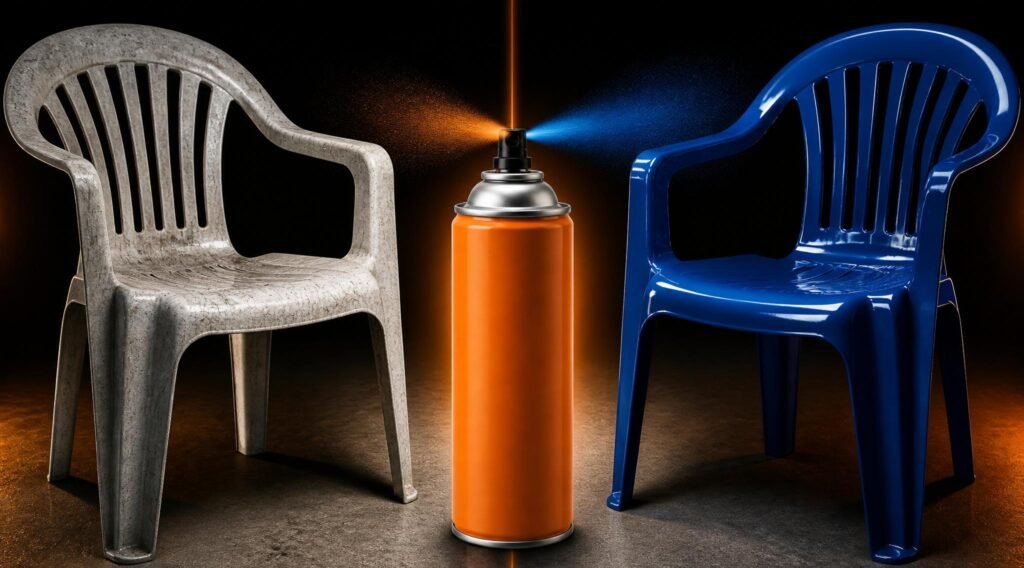
Plastic is the most difficult common surface to paint — and the most likely to produce a failed result when the wrong product is used. Unlike wood or metal, plastic is non-porous, chemically resistant, and often flexible. Standard spray paint has nothing to chemically bond to on a plastic surface, which is why most paint jobs on plastic peel, crack, or lift within days.
The good news is that several products have been specifically engineered to bond to plastic — either through adhesion-promoting chemistry in the formula itself, or paired with a plastic-specific adhesion primer. The key is knowing which product works for which type of plastic and which application.
This guide covers the best spray paint for plastic in 2026, organized by product and use case, so you pick the right one for your specific project — whether you’re refreshing outdoor furniture, painting car bumpers, or refinishing plastic home décor.
💡 The single most important rule for painting plastic: never use general-purpose spray paint without either a plastic-specific formula (like Krylon Fusion) or a dedicated plastic adhesion primer. Without one of these, the paint will peel off in sheets within days.
🔗 Related: How to Spray Paint Plastic: The Complete Guide to a Finish That Actually Sticks
Quick Comparison: Best Spray Paint for Plastic (2026)
| Product | Best For | Primer Needed? | Dry Time | Flex? | Rating |
| Krylon Fusion All-In-One | All-purpose plastic — indoor & outdoor | No | 10–15 min | ⭐⭐⭐⭐ | 9.5/10 |
| Rust-Oleum 2X Paint+Primer | Mixed surfaces, light plastic | Light sanding | 20 min | ⭐⭐⭐ | 9.0/10 |
| Rust-Oleum Universal | Any angle, decorative plastic | Light sanding | 30 min | ⭐⭐⭐ | 8.9/10 |
| Dupli-Color Vinyl & Fabric | Car interior plastic, vinyl | No (specialized) | 30 min | ⭐⭐⭐⭐⭐ | 9.3/10 |
| SEM Color Coat | Automotive plastic, bumpers | Plastic adhesion primer | 30–45 min | ⭐⭐⭐⭐⭐ | 9.4/10 |
| Rust-Oleum Plastic Primer | Primer only — for any topcoat | N/A (is the primer) | 30 min | ⭐⭐⭐⭐ | 9.6/10 (primer) |
| Krylon ColorMaster | Light-duty crafts & small plastic | Light sanding | 10 min | ⭐⭐⭐ | 8.2/10 |
| VHT FlexShot | Flexible plastic, bumpers | No (self-priming) | 1 hr | ⭐⭐⭐⭐⭐ | 9.1/10 |
Why Plastic Is So Hard to Paint (And How the Right Products Solve It)
Understanding why plastic resists paint helps you choose the right product and preparation approach. Plastic surfaces have three properties that work against standard paint adhesion:
1. Non-Porous Surface
Unlike wood (which absorbs paint into its grain) or metal (which has microscopic surface texture), most plastics are completely non-porous. Paint has nowhere to penetrate — it can only sit on the surface. Without chemical bonding, the paint film simply lifts away when flexed or stressed.
2. Low Surface Energy
Many plastics — especially polyethylene (PE) and polypropylene (PP) — have very low surface energy, meaning most liquids (including paint) bead up rather than spreading and wetting the surface. Specialized adhesion promoters in plastic-rated products increase the surface energy, allowing the paint to wet and bond.
3. Flexibility
Flexible plastics like car bumpers, vinyl trim, and PP containers flex under stress. Rigid paint films crack at flex points. The best products for flexible plastic contain elastomers that keep the cured paint film flexible enough to move with the substrate without cracking.
⚠️ If your paint is peeling off plastic in sheets within days of application, it was never bonded — it was just sitting on the surface. This is always a primer/product selection problem, not a technique problem.
🔗 Related: 10 Common Spray Paint Mistakes (And How to Fix Every One of Them)
Know Your Plastic Type Before Buying Paint
Not all plastics are equally paintable — and knowing your plastic type helps you choose the right approach before buying products.
| Plastic Type | Common Items | Paint-Friendly? | Best Approach |
| ABS Plastic | Car bumpers, appliances, LEGO | ✅ Very Good | Krylon Fusion or plastic primer + SEM |
| Polypropylene (PP) | Storage bins, outdoor furniture, food containers | ⚠️ Difficult | Adhesion primer required — Rust-Oleum Plastic Primer |
| Polyethylene (PE) | Bottles, trash cans, garden pots | ❌ Very Difficult | Flame-treat or sand aggressively + adhesion primer |
| PVC | Pipes, vinyl trim, window frames | ✅ Good | Light sanding + adhesion primer + any enamel |
| Polycarbonate | Helmets, face shields, clear panels | ✅ Good | Clean + adhesion primer + flexible topcoat |
| Acrylic (PMMA) | Clear panels, signs | ✅ Good | Adhesion primer + any compatible topcoat |
| Nylon | Gears, clips, industrial parts | ⚠️ Difficult | Sanding + plastic adhesion primer — test first |
| Styrene | Model kits, packaging | ✅ Excellent | Bonds easily with most spray paints |
| Fiberglass | Boat hulls, car body panels | ✅ Very Good | Sand + primer + epoxy or automotive topcoat |
How to Identify Your Plastic Type:
Look for the recycling symbol on the plastic — it contains a number that identifies the polymer type. PP (polypropylene) is #5, PE (polyethylene) is #2 (HDPE) or #4 (LDPE), PVC is #3. If no marking is visible, test a small hidden area with Krylon Fusion — if it adheres after 24 hours, you’re good. If it peels, you need an adhesion primer before any topcoat.
💡 The ‘scratch test’: after paint dries 24 hours, try to scrape it off with your fingernail on a hidden area. If it peels cleanly with minimal effort, the paint has not bonded — you need an adhesion primer before repainting.
The Best Spray Paints for Plastic in 2026 — Detailed Reviews
1. Krylon Fusion All-In-One — Best Overall
Best for: Outdoor plastic furniture, plastic home décor, plastic + wood or metal mixed projects
Available finishes: Gloss, Matte, Satin, Metallic, Hammered
Approx. price: $6–$8 per can
Krylon Fusion is the gold standard for DIY plastic painting and has been for over a decade. Its molecular bonding formula chemically adheres to most plastic surfaces without a separate primer — a genuine advantage that saves both time and the risk of primer-topcoat compatibility issues.
It dries in 10–15 minutes — the fastest touch-dry time in this comparison — and reaches full hardness faster than most competitors. Coverage is consistent and smooth with minimal overspray. The wide range of colors and finishes makes it suitable for virtually any aesthetic.
What We Love:
- Bonds to most plastics without a separate primer — genuine no-prep-needed claim
- Fastest dry time in this comparison (10–15 minutes touch dry)
- Works on plastic, wood, AND metal — ideal for mixed-material projects
- Consistent spray pattern with excellent atomization
- Available in a wide color range across all finish levels
What to Watch:
- On very low surface energy plastics (PP, HDPE) — do a test patch first. Some PP surfaces still require an adhesion primer even with Fusion
- Not formulated for automotive flexible plastic bumpers — use SEM for automotive applications
⭐ Verdict: The best single product for most plastic painting projects. If you’re painting plastic outdoor furniture, décor items, or light-duty plastic and don’t know where to start — start with Krylon Fusion.
🔗 Related: How to Spray Paint Plastic: The Complete Guide
🔗 Related: How to Spray Paint Furniture: Complete Beginner’s Guide
2. Rust-Oleum Plastic Primer Spray — Best Primer (for Any Topcoat)
Best for: Priming any plastic surface before applying a standard topcoat
Available finishes: Gray primer only
Approx. price: $6–$9 per can
Rust-Oleum Plastic Primer is not a topcoat — but it’s arguably the most important product in this entire guide. Applied first, it creates a chemically bonded foundation layer that dramatically improves adhesion of virtually any spray paint topcoat over plastic. It fills in the surface energy gap that causes most plastic paint failures.
Use Rust-Oleum Plastic Primer when you want to use a specific color that isn’t available in Krylon Fusion, when you’re painting a difficult plastic type (PP, HDPE), or when you want maximum adhesion and durability on any plastic surface.
How to Use It:
- Clean and degrease the plastic surface thoroughly
- Lightly sand with 400-grit sandpaper
- Apply 1–2 thin coats of Rust-Oleum Plastic Primer
- Allow to dry 30 minutes between coats
- Apply any compatible topcoat — Rust-Oleum 2X works perfectly over this primer
⭐ The Plastic Primer + Rust-Oleum 2X combination gives you the widest possible color choice for plastic surfaces with professional-grade adhesion. It’s the system to use when color selection matters more than convenience.
3. SEM Color Coat + SEM Plastic & Vinyl Prep — Best for Automotive Plastic
Best for: Car bumpers, automotive interior trim, motorcycle fairings, ATV plastic panels
Available finishes: Flat/Low Gloss (OEM match), many automotive colors
Approx. price: $15–$25 per can
SEM (Surface Engineering Materials) makes professional-grade coatings specifically for automotive plastics. SEM Color Coat is a flexible, adhesion-promoting topcoat that contains elastomers to flex with bumpers and trim without cracking — a critical requirement that consumer-grade paints simply don’t meet for automotive applications.
Pair it with SEM Plastic & Vinyl Prep (a chemical adhesion promoter that’s applied before painting, not a traditional primer) for maximum adhesion on any automotive plastic substrate.
What We Love:
- Specifically engineered for flexible automotive plastic — flexes without cracking
- OEM-quality flat finish that matches factory automotive trim appearances
- SEM Prep dramatically improves adhesion on all automotive plastics
- Widely used by professional auto body shops
What to Watch:
- More expensive than consumer-grade products
- Color range limited to automotive colors — not suitable for decorative projects
⚠️ Never use consumer-grade spray paint on car bumpers without a flexible additive or flexible primer — rigid paint on a flexible bumper will crack at every flex point within weeks of installation.
🔗 Related: How to Spray Paint a Car at Home: A Realistic Step-by-Step Guide
4. Dupli-Color Vinyl & Fabric Coating — Best for Car Interior Plastic
Best for: Dashboard plastic, door panels, center console, interior plastic trim
Available finishes: Flat/Matte (matches OEM interior finish)
Approx. price: $10–$15 per can
Dupli-Color Vinyl & Fabric is the go-to product for automotive interior plastic restoration — the sun-faded, scratched dashboard plastic that makes an older car look tired. Its flat finish replicates the factory matte texture of most automotive interior plastics, and it bonds directly to both vinyl and hard plastic surfaces without a separate primer.
Available in black, grey, and a small range of automotive interior colors. Not suitable for exterior automotive applications.
5. VHT FlexShot — Best for Flexible and Rubber-Like Plastic
Best for: Flexible plastic trim, rubber-like surfaces, mudflaps, flexible tubes
Available finishes: Gloss, Semi-Gloss, Flat
Approx. price: $10–$14 per can
VHT FlexShot is a rubber-based coating that remains permanently flexible after curing — making it the ideal choice for extremely flexible plastic surfaces where even automotive-grade elastomeric paints would eventually crack. It’s self-priming and bonds directly to most flexible plastic and rubber surfaces.
Key application: Rubber bumper fascias, flexible plastic trim, mudflaps, and any surface that experiences constant flexing or bending.
6. Rust-Oleum Universal — Best for Decorative and Complex-Shaped Plastic
Best for: Decorative plastic items, complex-shaped plastic, any-angle spraying
Available finishes: Gloss, Flat, Satin, Metallic, Hammered, Textured
Approx. price: $7–$10 per can
Rust-Oleum Universal’s any-angle spray technology makes it exceptionally useful for painting complex plastic items — figurines, decorative objects, furniture with intricate shapes, and any surface where you need to spray from odd angles including completely upside-down. Light sanding and cleaning before application improves adhesion significantly.
Best Spray Paint by Project — Quick Reference
| Project/Use | Best Product | Primer? | Key Consideration |
| Outdoor plastic furniture | Krylon Fusion All-In-One | No | UV resistance — Fusion holds up well outdoors |
| Car bumpers (DIY respray) | SEM Color Coat + SEM Plastic Primer | Yes | Must use flexible paint — rigid paint cracks on bumpers |
| Car interior plastic trim | Dupli-Color Vinyl & Fabric | No | Matches OEM-style flat finish |
| Storage bins / containers | Rust-Oleum Plastic Primer + 2X | Yes | PP plastic is difficult — primer is mandatory |
| Plastic toys / crafts | Krylon Fusion or ColorMaster | No (Fusion) / Light sand (ColorMaster) | Light use — durability less critical |
| PVC pipes / trim | Any enamel + adhesion primer | Yes | PVC is flexible — use a flexible topcoat |
| Motorcycle / ATV fairings | SEM Color Coat + SEM Primer | Yes | Automotive-grade required for durability |
| Plastic plant pots | Krylon Fusion All-In-One | No | UV + moisture resistance important |
| Fiberglass panels | Epoxy primer + urethane topcoat | Yes | Professional-grade products for best results |
How to Apply Spray Paint to Plastic for a Finish That Lasts
Even the best plastic spray paint will fail without proper preparation and technique. Follow this process:
Step 1: Clean the Plastic Thoroughly
- Wash the plastic with warm soapy water to remove dirt, grease, and mold release compounds
- Wipe down with isopropyl alcohol (70%+) or a plastic-safe degreaser
- Allow to dry completely — even fingerprint oils can prevent bonding
Step 2: Sand Lightly (Even for Fusion)
- Sand with 400-grit sandpaper in circular motions — this creates microscopic scratches that give paint mechanical grip
- Wipe clean with a tack cloth
- Even Krylon Fusion (which claims no-sand required) benefits from a light scuff on very smooth or glossy plastic
Step 3: Apply Primer (If Not Using Fusion)
- Shake plastic primer for 2 full minutes
- Apply 1–2 thin coats, 30 minutes apart
- Allow primer to fully dry before topcoat
Step 4: Apply Topcoat in Thin Layers
- Shake the can for 2 full minutes after the ball rattles
- Test on cardboard first — confirm spray pattern
- Hold 10–12 inches from surface, even passes, 50% overlap
- Apply 2–3 thin coats — never one heavy coat
- Allow 15–30 minutes between coats
Step 5: Allow Full Cure
- Touch dry in 10–30 minutes depending on product
- Handle carefully — full cure takes 24–72 hours
- Don’t test adhesion by scratching until fully cured
🔗 Related: Best Spray Paint Techniques for a Professional Finish
🔗 Related: Spray Painting Safety: Everything You Need to Know
Frequently Asked Questions — Best Spray Paint for Plastic
What is the best spray paint for plastic that won’t peel?
Krylon Fusion All-In-One is the most reliable consumer-grade spray paint for plastic that actually bonds without peeling. Its molecular bonding formula is specifically designed for plastic adhesion without a separate primer. For difficult plastics or automotive applications, use Rust-Oleum Plastic Primer as a base coat before any topcoat.
Do I need a special primer for plastic?
For most plastic surfaces, yes — either a plastic-specific spray paint (like Krylon Fusion) that has adhesion promoters built in, or a dedicated plastic adhesion primer (like Rust-Oleum Plastic Primer) applied before a standard topcoat. Using standard spray paint over plastic without either of these will result in paint that peels off within days.
Can you spray paint hard plastic?
Yes — hard plastics like ABS (car bumpers, appliances) and styrene (model kits, packaging) are the most paintable plastic types. Krylon Fusion bonds directly to ABS without primer. For styrene, almost any spray paint adheres well with light sanding and cleaning.
Can you spray paint flexible plastic?
Yes, but you need a flexible or elastomeric paint — not standard rigid enamel. Rigid paint on flexible plastic will crack at every flex point. For car bumpers and flexible trim, use SEM Color Coat or VHT FlexShot, both of which remain flexible after curing.
How long does spray paint last on plastic?
With proper preparation (cleaning, sanding, adhesion primer) and the right product, spray paint on plastic lasts 3–7 years for outdoor applications and longer for indoor use. UV exposure, temperature cycling, and physical flexing are the main factors that reduce lifespan. A UV-resistant clear coat over the topcoat extends longevity on outdoor plastic significantly.
Can I use Krylon Fusion on all types of plastic?
Krylon Fusion works excellently on ABS, PVC, polycarbonate, and styrene. It performs variably on polypropylene (PP) and polyethylene (PE), which have very low surface energy. Always do a test patch on a hidden area with PP or PE plastics before committing to a full project. If Fusion doesn’t bond after 24 hours, switch to a plastic adhesion primer system.
Is spray paint or brush paint better for plastic?
Spray paint is generally better for plastic because it avoids brush marks on a smooth non-porous surface where imperfections are very visible, and it produces more even coverage. Brush painting plastic with the right adhesion primer is possible but requires more coats and careful technique to avoid visible brush texture.
Final Verdict: Which Spray Paint for Plastic Should You Buy?
For most DIY plastic projects — outdoor furniture, home décor, plastic crafts, and mixed-material items — Krylon Fusion All-In-One is the clear winner. It’s the most convenient, most widely available, and most proven plastic spray paint on the market.
For automotive plastic — bumpers, trim, interior panels — step up to SEM Color Coat (exterior flexible plastic) or Dupli-Color Vinyl & Fabric (interior plastic). Consumer-grade products simply don’t have the flexibility and adhesion chemistry that automotive applications demand.
And for any difficult plastic type where you’re not confident about direct adhesion — use Rust-Oleum Plastic Primer first. It’s the most reliable way to ensure any topcoat bonds properly to virtually any plastic surface.
💡 When in doubt, prime. A dedicated plastic adhesion primer adds 30 minutes and $8 to your project — and saves you from a peeling, failed paint job that requires starting over completely.
Complete Your Spray Paint Knowledge:
- How to Spray Paint Plastic: The Complete Guide → https://spraypainterguide.com/how-to-spray-paint-plastic-2/
- Best Spray Paint for Metal in 2026: Top Picks for Every Job → https://spraypainterguide.com/best-spray-paint-for-metal-2026/
- Best Spray Paint for Wood in 2026: Top Picks for Every Project → https://spraypainterguide.com/best-spray-paint-for-wood/
- How to Choose the Right Spray Paint for Any Project → https://spraypainterguide.com/how-to-choose-the-right-spray-paint-for-any/
- 10 Common Spray Paint Mistakes (And How to Fix Every One) → https://spraypainterguide.com/spray-paint-mistakes-and-how-to-fix-them/
- How to Spray Paint a Car at Home: A Realistic DIY Guide → https://spraypainterguide.com/how-to-spray-paint-car-at-home-diy-guide/
- Best Spray Paint Techniques for a Professional Finish → https://spraypainterguide.com/best-spray-paint-techniques-for-professional-finish/
Written by Rodney Shiner | Spray Painter Guide