
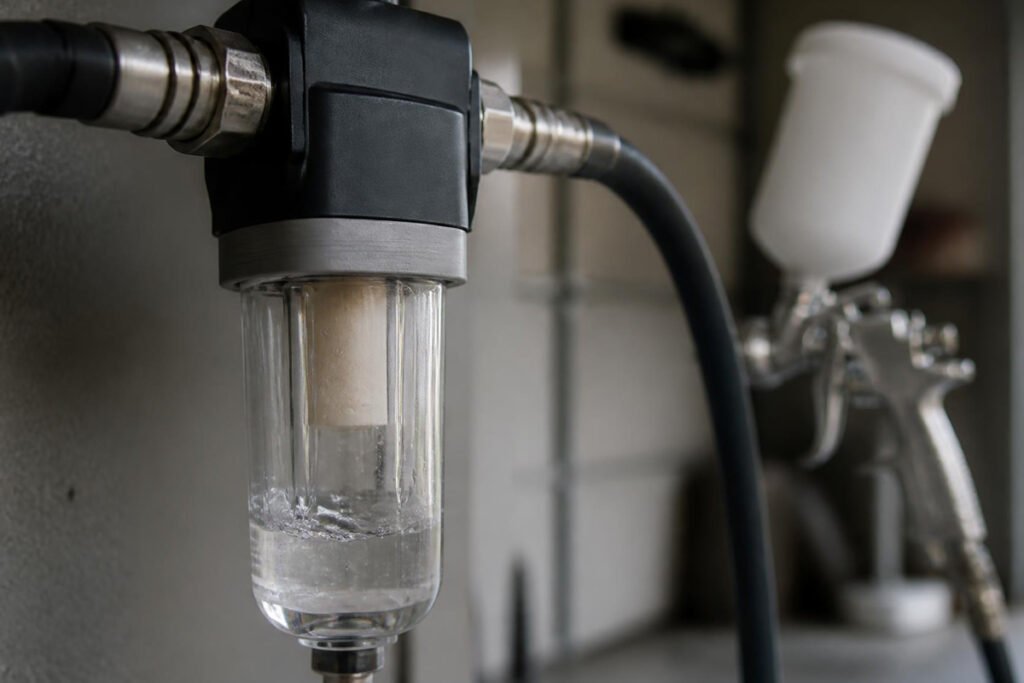
Fisheye craters that show up out of nowhere. Tiny water spots baked into an otherwise flawless clear coat. A fine white mist that sputters out of the gun right when you’re laying down the final pass. Most home sprayers chase these problems by blaming the paint, the gun, or their technique — and rarely think to check the compressed air itself. But every air compressor pulls in humid ambient air, compresses it, and heats it. As that hot, compressed air travels through the hose and cools back down, the moisture it was holding condenses into liquid water — right inside the line feeding your spray gun.
That water, along with oil aerosol carried over from the compressor pump, gets atomized along with your paint and sprayed directly onto the surface. It’s one of the most common causes of finish failures that experienced painters check first and beginners never think to check at all. The fix is a filter or moisture trap installed in the air line between the compressor and the gun — and this guide compares five real, current options so you can match the level of filtration to your setup instead of guessing.
If you’re still settling on which spray gun to run this air through in the first place, our types of spray gun guide covers HVLP, conventional, and airless options before you build out the air supply around it.
Quick Comparison: 5 Best Air Line Filters & Moisture Traps
| Product | Best For | Filtration | Port Size | Approx. Price |
| LE LEMATEC AI303 Water Separator | Best Overall | 5-micron water/dirt separator | 1/4″ NPT | $20–$28 |
| NANPU Filter Regulator Combo | Best All-in-One (Filter + Regulator) | 5-micron + pressure regulation | 3/8″ NPT | $35–$50 |
| Motor Guard M-30 Submicronic Filter | Best for Fine Automotive Finish Work | 0.01-micron sub-micronic | 1/4″ NPT | $85–$100 |
| Motor Guard D-12-1 Disposable Filter | Best Point-of-Gun Final Defense | 0.01-micron disposable element | 1/4″ NPT | $8–$12 each |
| TCP Global Mini In-Line Filter | Best Budget Pick | Basic water/oil separator | 1/4″ NPT | $10–$15 |
Whole-Line Separator vs. Filter/Regulator Combo vs. Point-of-Gun Filter — What’s the Difference?
- Whole-line water separators: install between the compressor and the rest of your air line, catching bulk moi
5 Best Air Line Filters & Moisture Traps for Spray Guns: Complete Buying Guide sture and larger dirt before it ever reaches your tools. This is your first line of defense and the minimum most home setups should run.
- Filter/regulator combos: add pressure control to the same job — filtering moisture and dirt while also letting you dial in the exact PSI your gun needs, which matters more than most painters realize since HVLP guns are far more pressure-sensitive than framing nailers or impact wrenches sharing the same compressor.
- Sub-micronic professional filters: rated down to 0.01 microns, these catch oil aerosols and vapor-fine moisture that a basic separator’s larger element lets straight through. Auto body shops run these because a clear coat job has zero tolerance for contamination.
- Disposable point-of-gun filters: small, cheap, single-use elements that thread directly onto the gun’s air inlet as a last line of defense — catching anything that made it past the upstream filters, especially in long hose runs where condensation reforms after the main separator.
For anyone spraying at the gun’s cup rather than a wall-mounted feed, this pairs directly with your choice of disposable cup system — clean air and a clean cup solve two different halves of the same contamination problem.
The 5 Best Air Line Filters & Moisture Traps for Spray Guns
1. LE LEMATEC AI303 Air Compressor Water Separator — Best Overall
Best for: most home garage setups that need one solid filter installed right after the compressor tank.
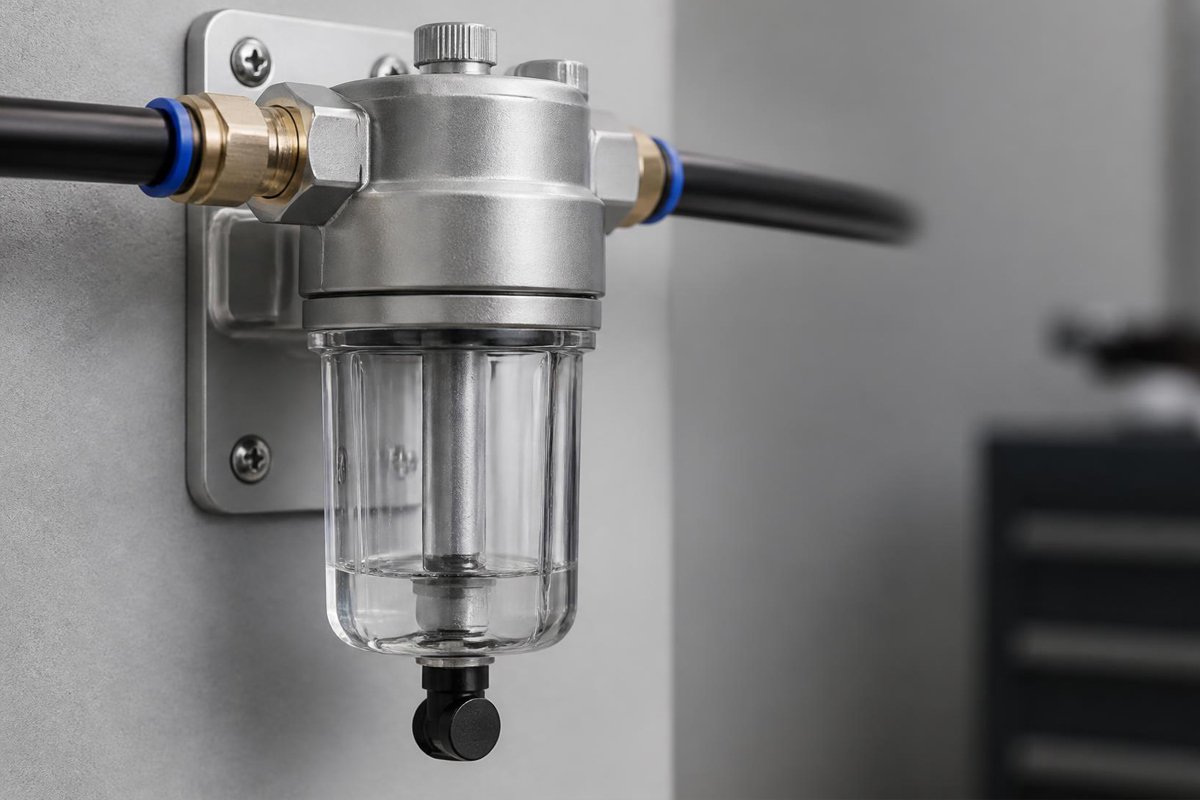
The AI303 is a straightforward 5-micron inline water separator with an aluminum body, a clear polycarbonate bowl so you can see how much moisture it’s pulling out, and a push-button drain that doesn’t require tools to empty. It threads onto standard 1/4″ NPT fittings, which covers the vast majority of home compressor outlets and HVLP gun hoses without needing an adapter.
It’s rated for up to 200 PSI, well above what any spray gun runs, so there’s headroom if the same compressor also feeds air tools that need more pressure. It won’t catch the ultra-fine oil aerosol a sub-micronic filter does, but for keeping bulk water and larger particulate out of the line, it’s the right first investment for almost any home setup.
- ✅ Clear bowl shows exactly how much moisture is being trapped
- ✅ Push-button drain — no tools needed for maintenance
- ✅ Standard 1/4″ NPT fittings fit most home compressors and guns
- ❌ 5-micron rating won’t catch sub-micron oil aerosol
- ❌ Best used alongside, not instead of, a point-of-gun filter for fine finish work
Our verdict: the right default first filter for a home garage — cheap insurance against the most common form of water contamination.
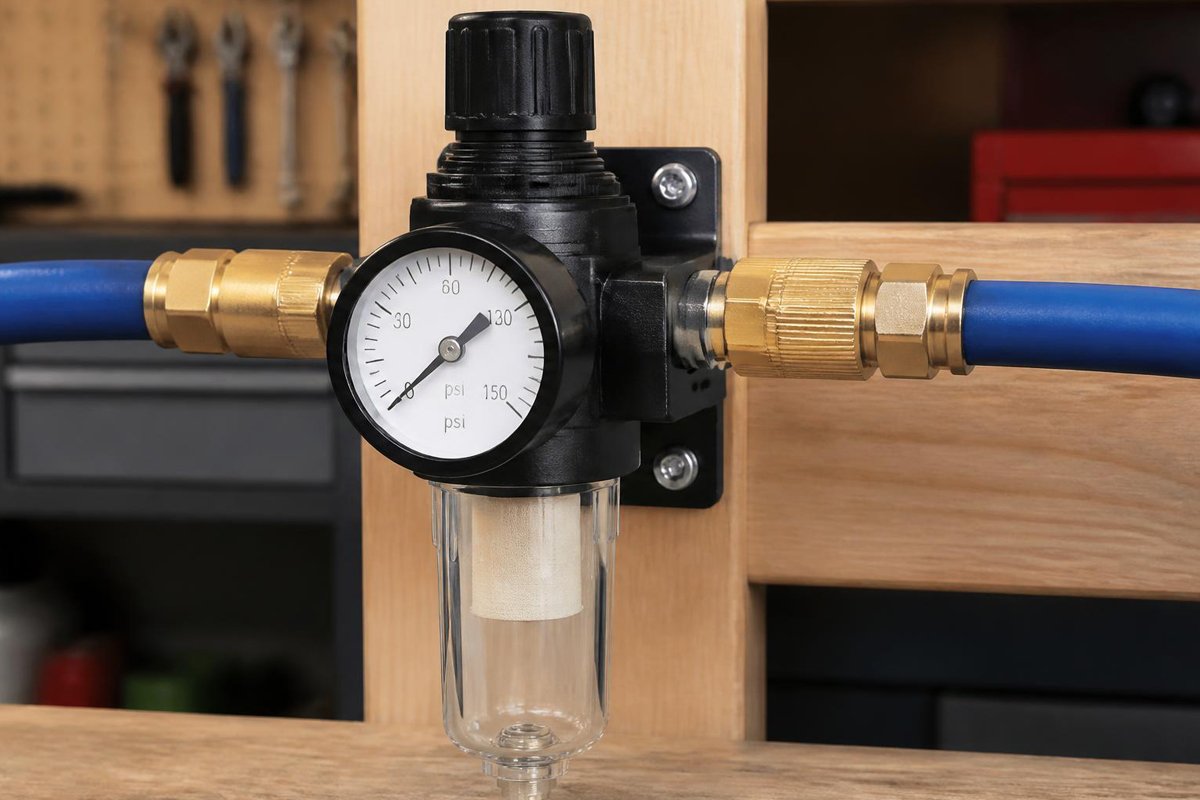
2. NANPU 3/8″ NPT Filter Regulator Combo — Best All-in-One (Filter + Regulator)
Best for: a shared garage air line running multiple tools where the spray gun needs its own dialed-in pressure.
NANPU’s combo unit pairs a 5-micron water/oil separator with an integrated pressure regulator and gauge in a single housing, using a semi-automatic drain and a metal mounting bracket. The advantage over a standalone separator is pressure control at the point of use: if your compressor and main line are set up for framing nailers or impact tools running at 90+ PSI, this lets you drop the pressure specifically at the spray gun connection without touching the compressor’s main regulator every time you switch tools.
The 3/8″ NPT port size moves more air volume than the smaller 1/4″ units on this list, which matters for higher-CFM HVLP guns doing larger projects like cabinets or fencing rather than small touch-up work.
- ✅ Combines filtration and pressure regulation in one unit
- ✅ Visible gauge makes it easy to dial in exact PSI for your gun
- ✅ Larger 3/8″ port supports higher-CFM guns and bigger projects
- ❌ Bulkier and more expensive than a simple separator
- ❌ Overkill if your compressor is dedicated to spray painting only
Our verdict: worth the extra cost the moment you’re sharing one compressor between a spray gun and other pneumatic tools with different pressure needs.
3. Motor Guard M-30 Submicronic Compressed Air Filter — Best for Fine Automotive Finish Work
Best for: clear coats, base coats, and any project where a single contamination speck means redoing the whole panel.
Motor Guard has supplied auto body shops since 1966, and the M-30 is their flagship point-of-use filter, rated to remove particulates, moisture, and oil aerosol down to 0.01 microns — roughly 500 times finer than the basic separators most home setups run. It uses a compressed, wound-fiber depth filter rather than a simple screen, which is what allows that level of filtration without a significant pressure drop at the gun.
This is a professional-grade tool with a professional price, and it’s genuinely unnecessary for spraying a fence or a set of patio chairs. But for automotive clear coat and metal finish work where fisheye or a trapped moisture bubble means stripping and redoing an entire panel, it’s the filter that shops actually rely on rather than a nice-to-have upgrade.
- ✅ Removes contaminants down to 0.01 microns — far beyond basic separators
- ✅ Low pressure drop despite the ultra-fine filtration
- ✅ Industry-standard choice in professional auto body shops
- ❌ Significantly more expensive than any other option on this list
- ❌ Replacement filter elements add an ongoing cost
Our verdict: the right tool when the cost of a ruined finish is higher than the cost of the filter — automotive and fine furniture work, not casual DIY projects.
4. Motor Guard D-12-1 Disposable Spray Gun Filter — Best Point-of-Gun Final Defense
Best for: anyone running a long hose from the compressor to the gun, where condensation can reform after the main filter.
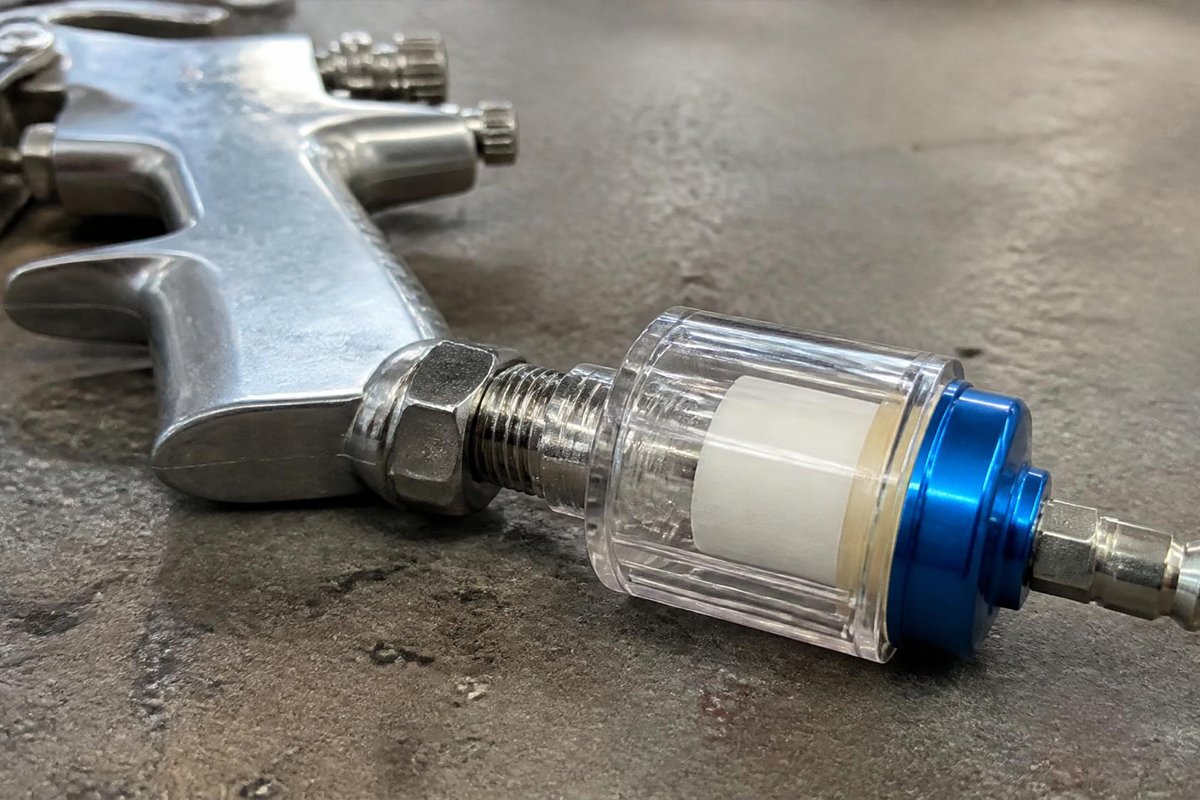
Even with a good separator installed near the compressor, moisture can re-condense inside a long hose run as the air cools further on its way to the gun — especially in humid climates or unheated garages. The D-12-1 solves that specific problem by mounting directly onto the gun’s air inlet as a last line of defense, using the same 0.01-micron depth-filter technology as Motor Guard’s larger M-30 unit, just sized down to a disposable, gun-mounted cartridge.
Because it’s disposable, there’s no bowl to drain or element to clean — once it’s visibly saturated or airflow drops noticeably, you swap it for a fresh one. That makes it a natural companion to a whole-line separator like the AI303 rather than a replacement for it.
- ✅ Mounts directly on the gun for a true final line of defense
- ✅ Same 0.01-micron filtration as Motor Guard’s professional M-30
- ✅ No maintenance — replace and go
- ❌ Ongoing per-unit cost if used on every project
- ❌ Adds a small amount of weight and length at the gun inlet
Our verdict: cheap insurance for long hose runs or humid garages, and a smart pairing with any upstream filter rather than a standalone solution.
5. TCP Global Mini In-Line Air Filter — Best Budget Pick
Best for: occasional spray painters who want basic protection without a real investment.
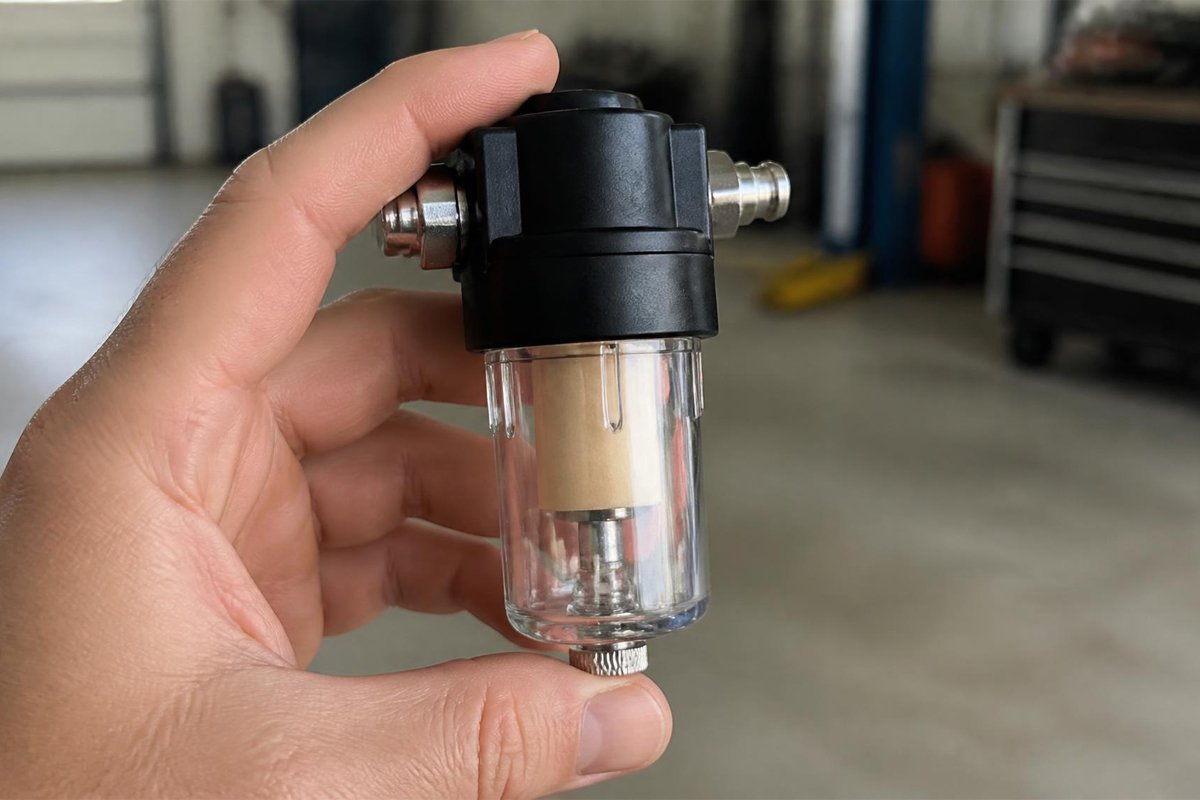
TCP Global’s mini filter is a compact water and oil separator with a clear reservoir and a push-button condensation drain, built for occasional use rather than daily shop duty. It won’t match the flow capacity or filtration depth of the larger units on this list, but for someone who sprays a few projects a year — furniture, outdoor pieces, or small home fixes — it catches the bulk moisture that causes most beginner contamination problems at a fraction of the cost.
It’s genuinely a step down from the AI303 in build quality and micron rating, but for a first filter on a budget, it beats running with no filtration at all by a wide margin.
- ✅ Lowest price point on this list
- ✅ Compact size fits tight home garage setups
- ✅ Clear reservoir shows trapped contaminants
- ❌ Lower flow capacity than the larger separators here
- ❌ Less durable for frequent, heavy use
Our verdict: a reasonable starting point for infrequent painters, with the expectation you’ll upgrade if spraying becomes a regular habit.
How to Choose Based on Your Setup
- Occasional home projects, tight budget: start with the TCP Global mini filter — basic protection is far better than none.
- Dedicated home garage sprayer: the LE LEMATEC AI303 is the right permanent first filter for most setups.
- Sharing one compressor across a spray gun and other air tools: the NANPU filter/regulator combo lets you dial in gun-specific pressure without extra steps.
- Automotive or fine finish work: run the Motor Guard M-30 upstream, paired with a D-12-1 disposable filter right at the gun for double protection.
- Long hose runs or humid climates: add a D-12-1 disposable filter at the gun regardless of what’s installed upstream — re-condensation happens closer to the gun than most painters expect.
Common Mistakes That Let Moisture Through Anyway
- Installing a filter but never checking or draining the bowl — a full separator stops separating and just pushes trapped water straight through.
- Relying on a single filter right at the compressor tank when the hose run to the gun is long enough for new condensation to form downstream.
- Using a filter rated for general air tools (5-micron) for fine automotive clear coat work that actually needs sub-micron filtration.
- Coiling a hot compressor hose tightly right after use, which traps heat and increases the condensation the next time air passes through it.
- Skipping filtration entirely because the respirator and safety setup gets all the attention — protecting the operator matters, but the finish quality depends on protecting the air supply too.
Frequently Asked Questions
Do I need a filter if I only spray with aerosol cans, not a gun?
No — aerosol cans are self-contained and don’t draw from your compressor’s air line, so this entire category doesn’t apply. Air line filters are specifically for compressor-fed spray guns, whether HVLP, conventional, or airless.
Can I use just a disposable point-of-gun filter without an upstream separator?
You can, and it’s better than nothing, but a disposable filter saturates much faster when it’s catching bulk water instead of just fine residual moisture. An upstream separator extends the life of a point-of-gun filter significantly by removing the bulk of the water before it gets that far.
How often should I drain a water separator bowl?
Check it before every spraying session, especially in humid weather or after the compressor has been running heavily. A full bowl stops filtering effectively regardless of the unit’s rated micron size.
Does filter placement matter — right at the compressor or right at the gun?
Both locations matter for different reasons. A separator near the compressor catches bulk moisture early; a filter at the gun catches whatever condenses in the hose afterward. For anything beyond casual use, running both is the more reliable setup.
Will a moisture trap reduce my spray gun’s air pressure?
A quality filter causes minimal pressure drop, but very fine sub-micronic filters like the Motor Guard M-30 restrict flow slightly more than a basic separator. If you notice reduced atomization at the gun, check your compressor’s output CFM against the filter’s rated flow capacity before assuming the gun itself is at fault.
Final Thoughts
Water and oil contamination in the air line is one of those problems that’s completely invisible until it shows up as a ruined finish — and by then, the paint, the prep work, and the time are already spent. The LE LEMATEC AI303 is the right first filter for most home garages, the NANPU combo earns its price the moment you’re sharing a compressor across multiple tools, the Motor Guard M-30 and its D-12-1 disposable companion are worth the investment for automotive-grade finish work, and the TCP Global mini filter is a reasonable low-cost starting point for occasional painters. Whatever you choose, the rule that matters most is simple: check and drain it before every session, because a filter that’s full is no filter at all.