
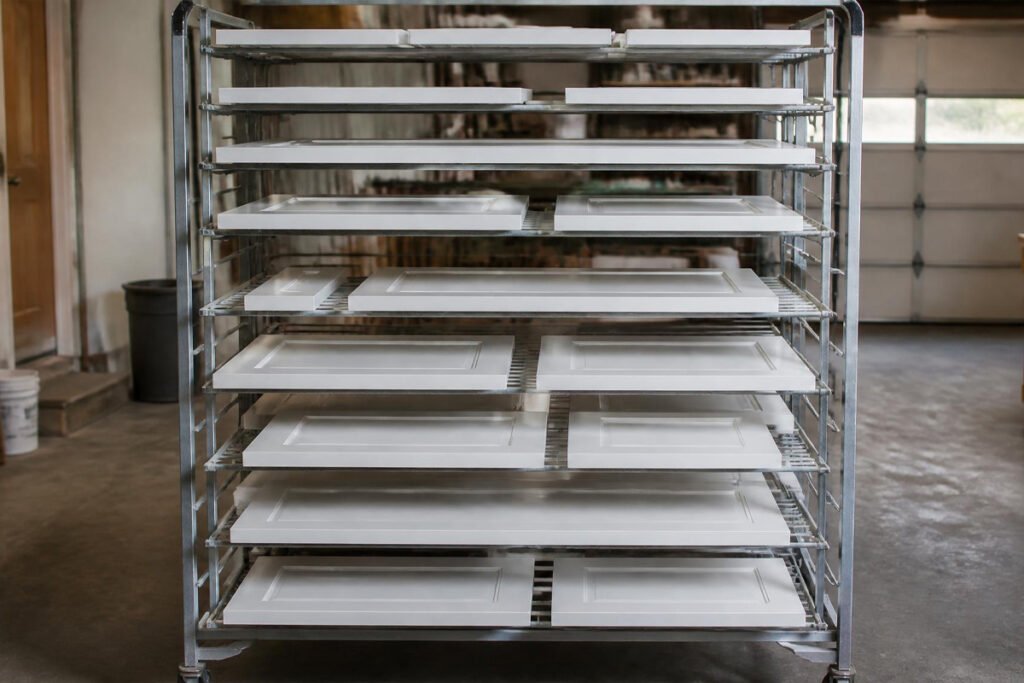
The paint job itself went perfectly. You prepped the surface, laid down clean coats with your HVLP gun, kept the air moisture-free with a proper inline filter, and let your booth’s ventilation clear the fumes. Then you set the piece down on a cardboard box to dry, walked away, and came back to find a flat, dented smudge exactly where it was resting — or worse, it stuck to the surface underneath and pulled paint off when you tried to move it.
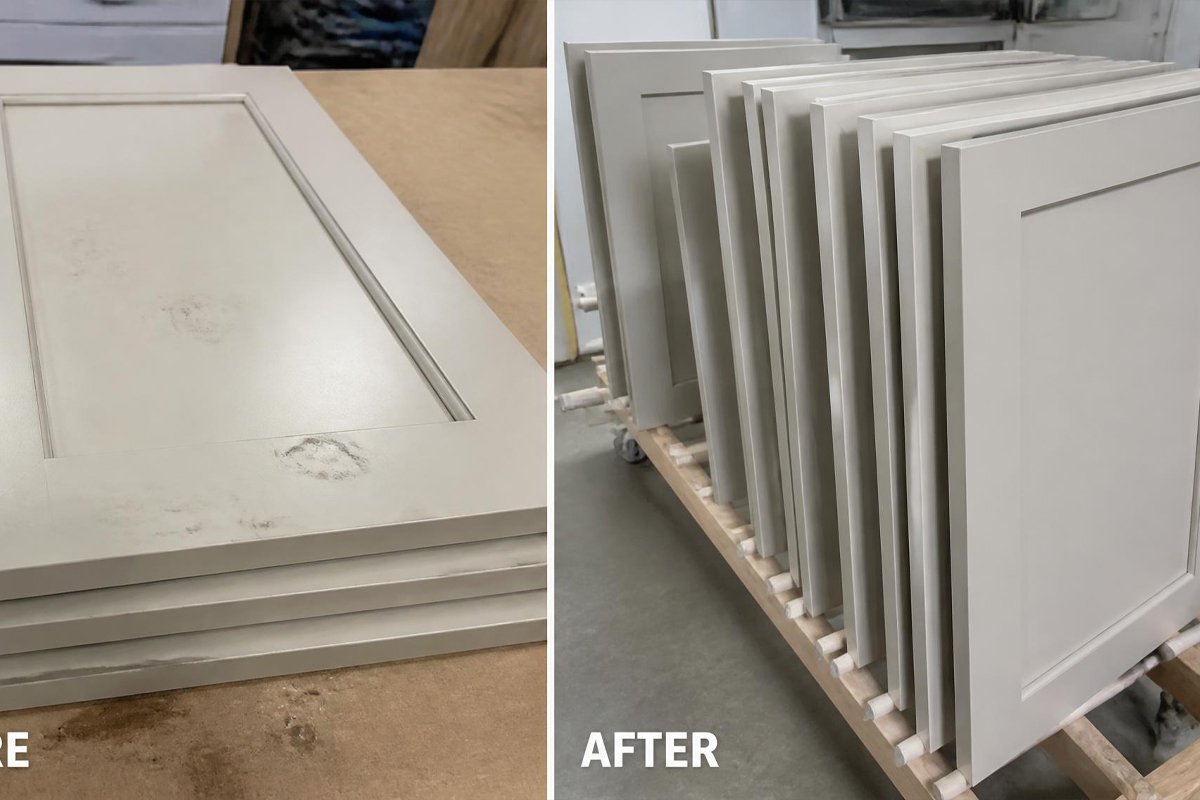
This is the part of the process most people don’t think about until it ruins an otherwise perfect coat: where the piece actually dries. Wet or tacky paint needs airflow on every side and zero contact with anything else while it cures. Laying a freshly sprayed cabinet door flat on a table, leaning it against a wall, or stacking pieces on top of each other are the three fastest ways to undo everything you just did right.
A dedicated drying rack solves this by holding parts vertically, with space between them, so air reaches every surface and nothing touches while it’s still soft. This guide breaks down what actually matters when choosing one — capacity, spacing, mobility, and build quality — and reviews five real racks that cover everything from a compact wall-mountable unit to a full 50-shelf mobile stand for cabinet-refinishing projects.
Quick Answer
The best drying rack for spray painted parts depends on your project size and how often you’re painting. For occasional furniture projects and small batches, a compact, foldable rack like the Colingmill 18-Tier Folding Drying Rack is enough and tucks away when not in use. For full kitchen cabinet refinishing jobs with dozens of doors and drawer fronts, a high-capacity mobile rack like the Mouuy 50-Shelf Paint Drying Rack is built for exactly that volume. If you need to move pieces between your spray area and a separate drying area, the Colingmill Transport Rack with Casters is designed specifically for that workflow. Painters who prefer hanging pieces by an edge or hinge point rather than resting them on shelves should look at the Beeveer Cabinet Door Painting Hanger System. And for tight spaces or classroom/studio setups, the compact Pearington 25-Shelf Mobile/Wall Mountable Rack is the space-efficient pick.
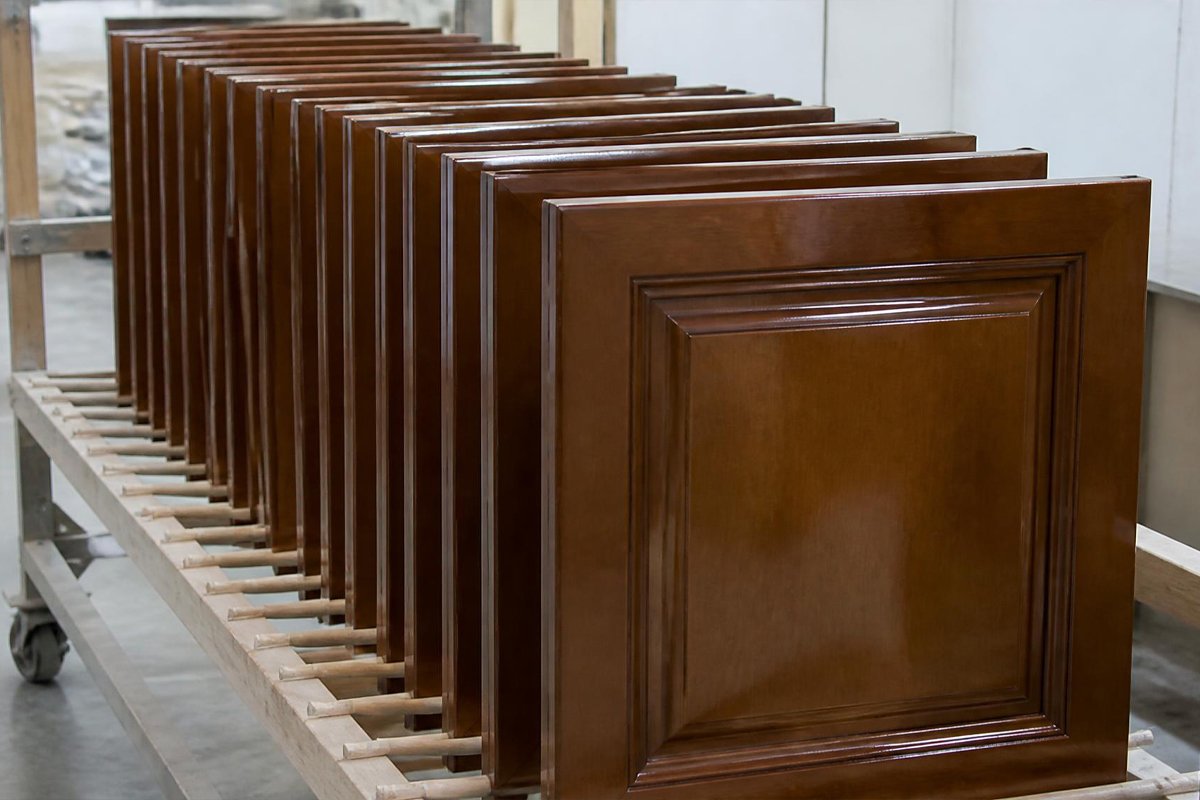
Table of Contents
- Why a Dedicated Drying Rack Matters
- How to Choose the Right Rack for Your Project
- Best Drying Racks for Spray Painted Parts in 2026
- Comparison Table
- Best Racks for Different Project Sizes
- How to Set Up and Load a Drying Rack Correctly
- Common Mistakes
- Expert Tips
- Final Verdict
- FAQ
Why a Dedicated Drying Rack Matters {#why-it-matters}
Freshly sprayed paint is at its most vulnerable in the first hour after application — before it’s touch-dry, any contact leaves a permanent mark, and even after it feels dry to the touch, most coatings need days to fully cure and harden. A proper drying rack addresses three problems at once: it keeps parts vertical or angled so nothing rests against a flat surface, it spaces multiple pieces apart so drying paint never touches another piece, and it allows air to circulate around all sides for even, consistent curing.
Skipping this step is one of the more common reasons a technically good paint job ends up with flat spots, fingerprints, or a piece that sticks to whatever it was set on. It’s a similar principle to why proper booth ventilation matters for the spraying stage — airflow is just as important once the piece is drying as it was while it was being coated.
How to Choose the Right Rack for Your Project {#how-to-choose}
Ask yourself these three questions before buying:
1. What size and how many pieces am I drying at once? A handful of small decorative items needs a very different rack than a full set of kitchen cabinet doors and drawer fronts.
2. Do I need to move the rack between spray and drying areas? If your spray station and drying space are in different parts of your garage, a rack with locking casters saves a lot of awkward handling of wet parts.
3. How much floor space can I dedicate to it, and do I need it to fold away afterward? Some racks are built for permanent shop use; others are designed to collapse flat between projects, which matters a lot in a shared garage.
If you’re just getting your overall furniture-painting workflow sorted, our complete guide to spray painting furniture is worth reading alongside this one.
Best Drying Racks for Spray Painted Parts in 2026 {#best-racks}
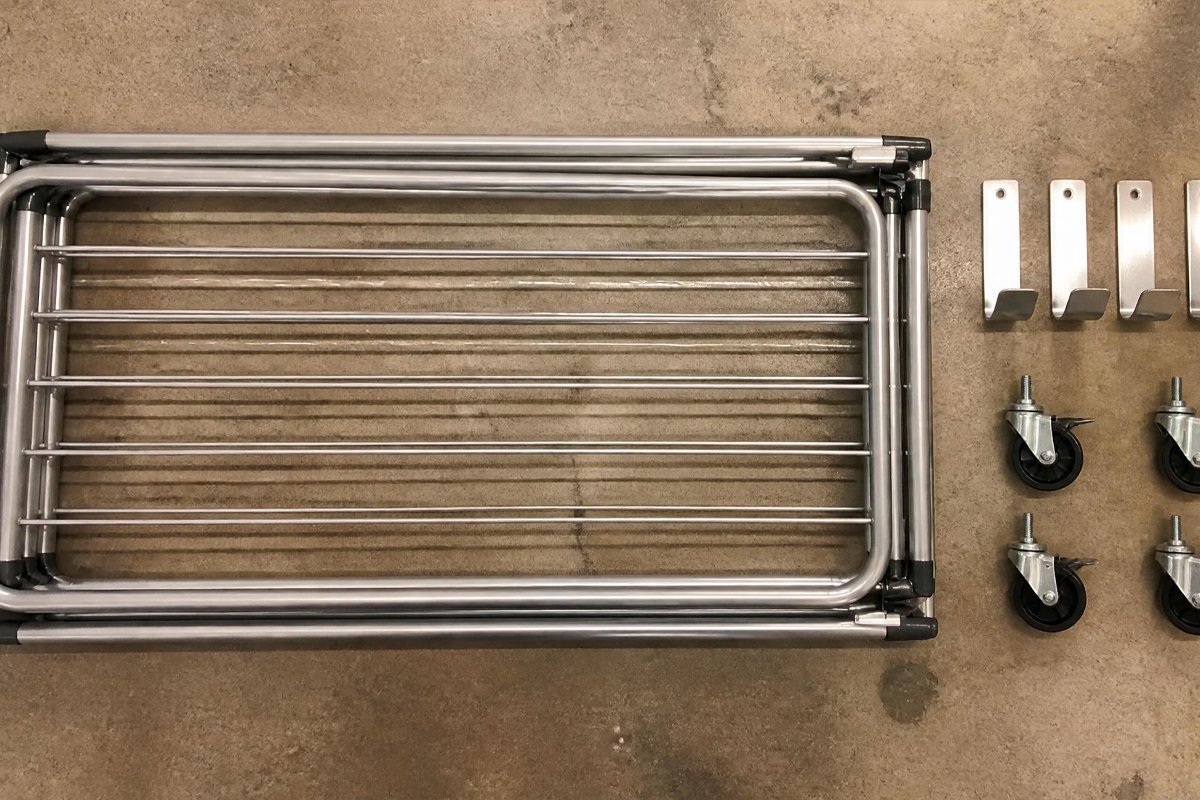
1. Mouuy 50-Shelf Paint Drying Rack — Best Overall / Best High-Capacity
Overview: The Mouuy is a heavy-duty vertical rack built specifically for cabinet-refinishing volume, with 50 individual shelf slots and a genuinely solid steel frame — reviewers consistently note the unit’s overall weight (close to 110 lbs assembled) as a sign of real stability rather than a cheap, wobbly frame.
Approximate Price: Typically listed in the $150–$220 range, depending on current retailer pricing and promotions.
Key Features:
- 50 vertical shelf slots with roughly 2.4″ spacing between them
- 25 lbs per-shelf weight capacity, built from carbon steel
- 4 heavy-duty locking swivel casters
- Vertical footprint keeps floor space use to roughly one shelf unit’s worth of room
Best For: Full kitchen or bathroom cabinet refinishing projects, or anyone regularly drying dozens of pieces at once.
Pros: ✅ Genuinely heavy, stable frame — reviewers specifically call out the lack of wobble even fully loaded ✅ 50-shelf capacity handles an entire cabinet set in one pass instead of multiple drying rounds ✅ Locking casters let you reposition a fully loaded rack without unloading it first
Cons: ❌ Its size and weight make it a poor fit for small garages or anyone without a dedicated permanent spot for it ❌ Assembly takes noticeably longer than smaller folding racks
Our Verdict: Based on manufacturer specifications and aggregated owner feedback, this is the rack most repeat cabinet-refinishing painters land on once they’ve outgrown smaller options — the capacity and stability are built for volume, not occasional hobby use. Pair it with our guide on spray painting cabinets and furniture for the full refinishing workflow.
2. Colingmill 18-Tier Folding Paint Drying Rack — Best for Small Spaces
Overview: This Colingmill model takes the opposite approach from the Mouuy — instead of maximizing capacity, it’s built to fold flat and disappear into a corner or closet when you’re not actively drying anything, which matters a lot for anyone sharing garage space with a car or other equipment.
Approximate Price: Typically listed in the $60–$100 range.
Key Features:
- 18-tier folding design, 44.5″ height when set up
- Heavy-duty metal construction with a non-slip base
- Collapses to a slim, flat profile for storage
- Lightweight enough for one person to move and store easily
Best For: Occasional furniture painters, apartment or shared-garage setups, and anyone who needs the floor space back between projects.
Pros: ✅ Genuinely folds flat — this isn’t a “technically collapsible but still bulky” design ✅ Non-slip base adds stability despite the lighter overall weight ✅ Priced well below the higher-capacity racks on this list
Cons: ❌ 18 tiers is limiting for anyone doing full cabinet sets rather than individual furniture pieces ❌ Lighter frame means it’s not rated for the heaviest doors or panels the way the Mouuy is
Our Verdict: For anyone doing occasional dressers, side tables, or a handful of cabinet doors at a time — and who needs to reclaim garage space in between — this is the sensible pick. It won’t handle a 40-door kitchen remodel, but that’s not the job it’s built for.
3. Colingmill Cabinet Doors Paint Transport Rack with Casters — Best for Mobile Workflows
Overview: This is a different category of product from a standard drying rack — it’s built specifically to move painted panels between your spray area, drying area, and assembly area without having to handle each piece individually during the transition.
Approximate Price: Typically listed in the $90–$140 range.
Key Features:
- 15-tier capacity with a 53.1″ base and 16.1″ support rods
- 4 smooth casters rated for concrete and tile workshop floors
- Detachable, quick-release rod system for fast loading
- Powder-coated iron construction for durability in damp workshop conditions
Best For: Painters whose spray station and drying/assembly area are physically separate, or anyone doing batch work who needs to shuttle multiple pieces between stages efficiently.
Pros: ✅ Purpose-built for moving loaded panels, not just holding them in place ✅ Quick-release rods make loading and unloading noticeably faster than fixed-shelf racks ✅ Handle and caster combination is genuinely comfortable to push fully loaded
Cons: ❌ 15-tier capacity is modest compared to the Mouuy’s 50 shelves ❌ Primarily suited to flat panels and doors rather than irregularly shaped furniture pieces
Our Verdict: If your workflow involves spraying in one spot and drying in another, this solves a real logistical problem that a stationary rack doesn’t — you’re not required to handle each wet piece by hand during the move.
4. Beeveer Cabinet Door Painting Hanger System — Best for Hanging Application
Overview: Rather than resting pieces on shelves, this system hangs cabinet doors and panels from a rolling stand using zinc-plated hooks, which means paint can be applied and cured on all edges simultaneously without a single flat contact point anywhere on the piece.
Approximate Price: Typically listed in the $70–$110 range.
Key Features:
- 10 hangers included, compatible with up to 50 zinc-plated mounting screws
- Adjustable rolling stand
- Hanger design allows full 360-degree spray and dry access per piece
- Suitable for both spraying and drying stages on the same stand
Best For: Painters who want zero contact points anywhere on a piece during both spraying and drying — particularly useful for cabinet doors with decorative edges or moulding.
Pros: ✅ Genuinely zero flat-contact drying, since pieces hang rather than rest ✅ Doubles as a spraying stand, not just a drying rack ✅ Rolling base makes repositioning individual pieces easy mid-project
Cons: ❌ Requires screwing small mounting hardware into each door, which isn’t ideal on finished or delicate surfaces ❌ Handles fewer pieces at once than a multi-shelf rack of similar footprint
Our Verdict: This is the right tool specifically for painters chasing a flawless edge finish on cabinet doors with visible profiles, where even a small contact mark from a shelf rod would show. It’s a more specialized tool than a general-purpose rack, and it shows in both its strengths and its narrower use case.
5. Pearington 25-Shelf Mobile/Wall Mountable Rack — Best Budget & Compact Pick
Overview: Originally designed for art studios and classrooms, this compact rack translates well to light spray-painting use thanks to its small footprint and the option to mount it to a wall instead of using floor space at all.
Approximate Price: Typically listed in the $50–$90 range.
Key Features:
- 25 removable shelves
- Compact 13″ D x 17.5″ W x 39.4″ H footprint
- Mobile with wheels, or wall-mountable to free up floor space entirely
- Removable shelf design for easy cleaning between projects
Best For: Small parts, decorative items, small cabinet batches, and anyone with very limited garage or workspace floor area.
Pros: ✅ Wall-mount option is unique among racks on this list — genuinely frees up floor space ✅ Lowest price point alongside the Colingmill folding rack ✅ Removable shelves make cleanup of drips and overspray simple
Cons: ❌ 25-shelf capacity and smaller footprint limit it to smaller parts rather than full-size cabinet doors ❌ Originally built for lighter art materials, so weight capacity per shelf is modest compared to steel cabinet-door racks
Our Verdict: For anyone painting smaller décor items, small parts, or a handful of pieces at a time in a tight space, the wall-mount option alone makes this worth considering over a floor-standing rack that competes for space with everything else in a garage.
Comparison Table {#comparison-table}
| Rack | Best For | Capacity | Approx. Price | Mobility |
|---|---|---|---|---|
| Mouuy 50-Shelf | Full cabinet refinishing jobs | 50 shelves, 25 lbs/shelf | $150–$220 | 4 locking casters |
| Colingmill 18-Tier Folding | Small spaces, occasional projects | 18 tiers | $60–$100 | Foldable, portable |
| Colingmill Transport Rack | Moving pieces between stations | 15 tiers | $90–$140 | 4 casters, handle |
| Beeveer Hanger System | Hanging application, zero contact points | 10 hangers (up to 50 screws) | $70–$110 | Rolling stand |
| Pearington 25-Shelf | Small parts, tight spaces | 25 shelves | $50–$90 | Mobile or wall-mounted |
Prices fluctuate by retailer and current promotions — treat these as general ranges rather than fixed figures.
Best Racks for Different Project Sizes {#by-project-size}
Small Projects & Decorative Items
The Pearington or Colingmill folding rack handle small batches well without eating up permanent floor space, especially useful when combined with a compact turntable setup for the spraying stage itself.
Full Cabinet & Kitchen Refinishing Projects
This is squarely Mouuy territory — the 50-shelf capacity means you’re not running multiple drying batches for a full kitchen’s worth of doors and drawer fronts.
Multi-Station Workflows
If your spraying and drying happen in different areas of your garage, the Colingmill Transport Rack removes the awkward step of hand-carrying wet panels between them.
How to Set Up and Load a Drying Rack Correctly {#how-to-set-up}
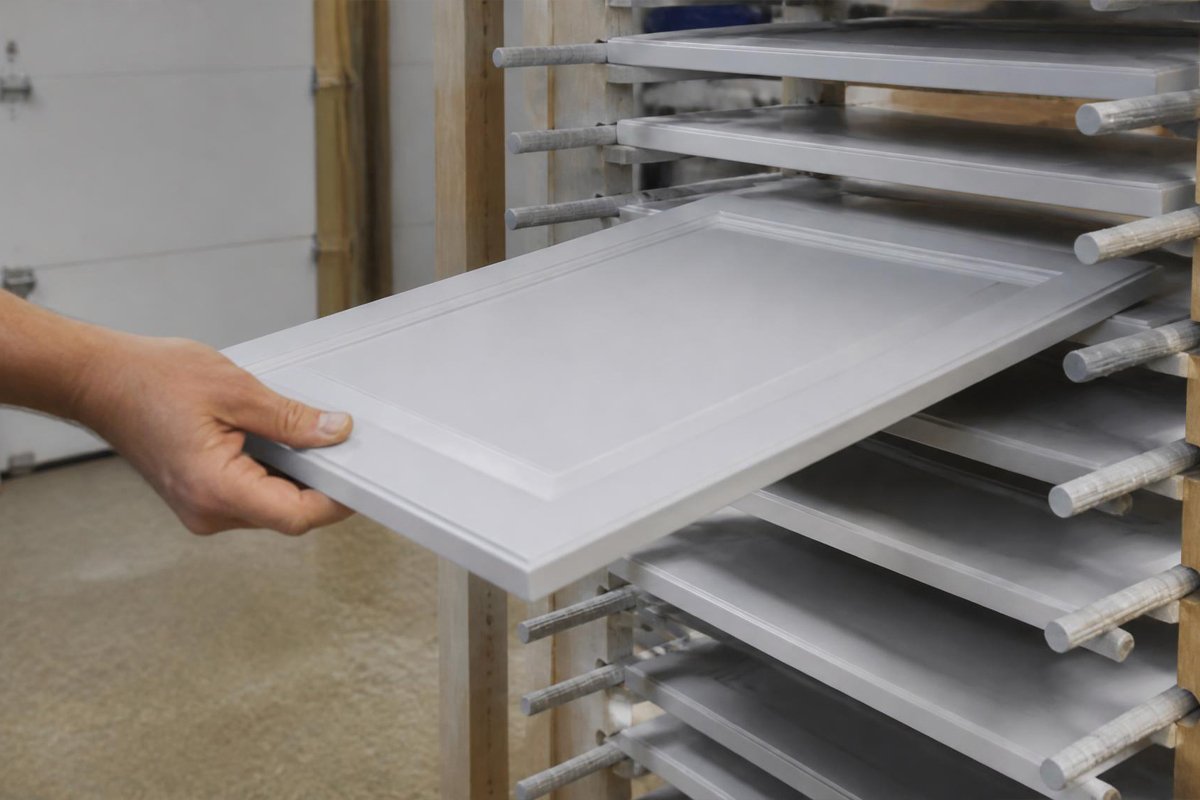
Step 1: Position the Rack Before Loading
Set the rack up in its final drying location before adding wet pieces — moving a loaded rack unnecessarily risks bumping still-tacky surfaces.
Step 2: Load from the Bottom Up
Fill lower shelves first when possible, since reaching over already-loaded wet pieces to fill higher shelves risks accidental contact.
Step 3: Leave Real Spacing Between Pieces
Don’t overcrowd shelves designed for spacing — cramming pieces closer than the rack’s designed gap defeats the airflow benefit you bought the rack for in the first place.
Step 4: Position for Airflow
Where possible, position the rack so your booth’s exhaust fan or ambient airflow passes across it, not just around it — moving air speeds even curing more than still air does.
Step 5: Leave Pieces Undisturbed Through Full Cure Time
Touch-dry doesn’t mean fully cured — leave pieces on the rack for the paint manufacturer’s recommended cure time before handling, stacking, or reinstalling hardware.
Common Mistakes {#common-mistakes}
1. Drying pieces flat instead of vertically or hung. Flat surfaces almost always leave contact marks or cause sticking, even on a supposedly “safe” surface like cardboard or a drop cloth.
2. Overloading shelf spacing. Packing pieces closer than the rack’s designed gap traps humidity and slows drying, sometimes leading to the same smudging problems a rack is supposed to prevent. See our guide on common spray paint mistakes for more setup pitfalls that show up as finish problems but start elsewhere.
3. Moving pieces before they’re fully cured. Touch-dry paint can still soften and mark under pressure or friction — a piece that looks and feels dry can still be damaged by handling, stacking, or reattaching hardware too soon.
Expert Tips {#expert-tips}
Match rack capacity to your actual project size, not your longest-term ambition. Buying a 50-shelf rack for the occasional side table means it’s mostly sitting empty and taking up space you didn’t need to give up.
Combine a rack with active airflow, not just ambient air. A piece drying in a stagnant corner takes noticeably longer to cure than one positioned where your booth ventilation or a general room fan is actually moving air across it.
Label or photograph piece positions before disassembly-heavy projects. For cabinet door sets especially, it’s easy to lose track of which door goes where once everything’s drying on a rack — a quick photo before you start saves real headaches at reassembly.
Final Verdict {#final-verdict}
- Best Overall / High-Capacity: Mouuy 50-Shelf Paint Drying Rack — built for full cabinet-refinishing volume with real structural stability.
- Best for Small Spaces: Colingmill 18-Tier Folding Rack — genuinely folds away when you need the floor space back.
- Best for Mobile Workflows: Colingmill Transport Rack with Casters — solves the “different spray and drying areas” problem directly.
- Best for Hanging Application: Beeveer Cabinet Door Painting Hanger System — zero flat-contact points for decorative edges.
- Best Budget & Compact Pick: Pearington 25-Shelf Mobile/Wall Mountable Rack — the only wall-mount option here, ideal for tight spaces.
Whichever you choose, it’s one piece of a full workflow — check our guides on spray painting furniture, booth ventilation, and inline air filtration to make sure the drying stage gets the same attention as the spraying stage.
Frequently Asked Questions {#faq}
Do I really need a dedicated drying rack, or can I just prop pieces against a wall? Leaning wet pieces against a wall usually creates a contact point exactly where the piece touches, and doesn’t allow airflow on that side at all — a proper rack avoids both problems by keeping pieces vertical with space around them.
How long do painted parts need to stay on the rack? This varies by paint type, but most coatings need at least a few hours to become touch-dry and considerably longer — often 24 to 72 hours — to fully cure enough for normal handling and stacking.
Can I use a drying rack for spraying too, not just drying? Some racks, particularly hanging-style systems like the Beeveer, work for both stages; shelf-style racks are generally better suited to drying only, since spraying usually needs more clearance around each piece.
How many pieces can I dry at once without airflow problems? This depends on your rack’s spacing and your room’s general ventilation — as a rule, don’t exceed the rack’s designed shelf spacing just to fit more pieces in, since overcrowding slows drying regardless of rack capacity.
Do I need a different rack for cabinet doors versus furniture? Not necessarily — flat-panel racks work well for cabinet doors and drawer fronts, while furniture with legs or irregular shapes sometimes dries better hung or on a stand rather than a flat-shelf rack.
Will a metal rack rust from repeated exposure to wet paint? Powder-coated steel racks are built to resist this, but wiping down any overspray or drips after each project extends the rack’s life regardless of coating.
Can I fold or disassemble a rack while pieces are still drying? No — pieces should be fully cured and removed before folding or moving a loaded rack, since disturbing a loaded rack risks contact damage to still-curing pieces.
Is a mobile rack with casters worth the extra cost over a stationary one? If your spray and drying areas are in different parts of your space, yes — the time and risk saved by not hand-carrying wet panels usually justifies it; if everything happens in one spot, a stationary rack is simpler and often cheaper.
Author: Rodney Shiner Last Updated: July 2026