
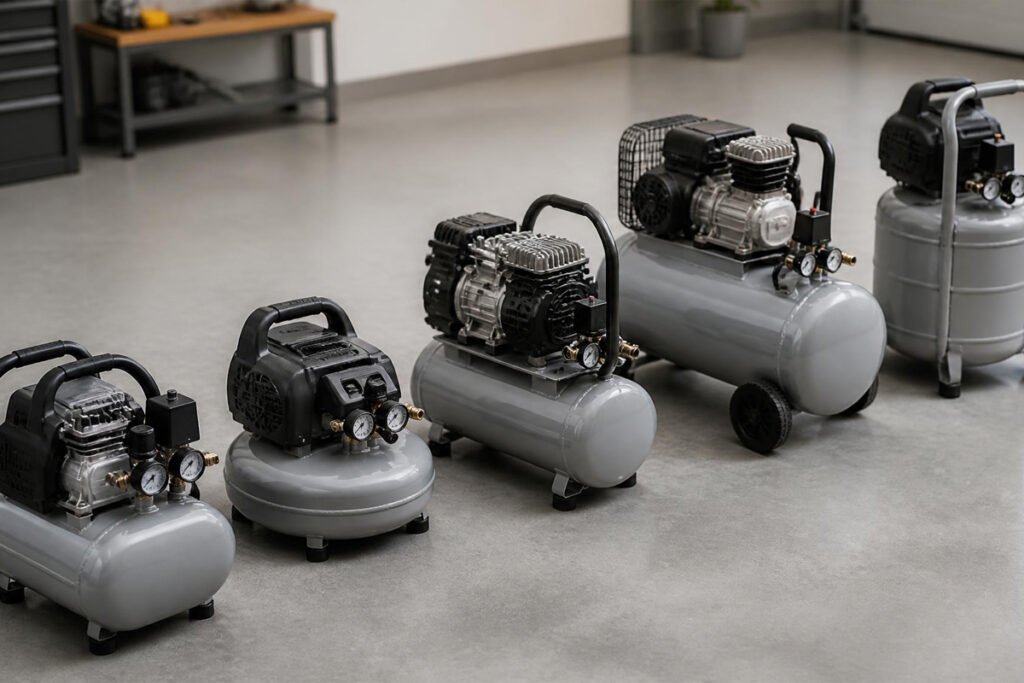
You finally picked up a solid HVLP spray gun, you’ve got your primer sorted, and you’re standing in the garage ready for a flawless, glass-smooth finish. Then you plug the gun into whatever compressor has been sitting under the workbench for years — and the spray pattern sputters, surges, and spits paint in blotches instead of a fine mist. Nothing about your technique changed. The problem is almost always the air supply.
HVLP stands for “high volume, low pressure,” and that phrase describes exactly what these guns need to work properly: a steady, generous stream of air delivered at a gentle pressure, not a short burst of high-pressure air the way a nail gun or impact wrench uses. Most of the small “trim” or “pancake” compressors people already own in their garage were built for exactly that kind of short, high-pressure burst — not for the sustained, high-CFM airflow an HVLP gun demands. Pair an HVLP gun with the wrong compressor and you’ll spend your whole project fighting orange peel texture, uneven coats, visible stop-start lines, and long pauses waiting for the tank to rebuild pressure between passes.
The good news is that you don’t need an industrial-grade shop compressor to spray well at home. You need the right combination of sustained CFM output, reasonable tank size, and noise level for your space. Below are five compressors that are genuinely capable of feeding an HVLP gun properly, based on real-world specs and what actual users report after switching from underpowered units.
Why HVLP Guns Are So Demanding on Air Supply
Before getting into specific compressors, it’s worth understanding why this pairing trips up so many first-time sprayers. A framing nailer might need a short burst of 90 PSI for a fraction of a second. An HVLP spray gun, by contrast, needs continuous airflow — often in the 4 to 12 CFM range depending on the gun and nozzle size — for as long as the trigger is pulled, sometimes for ten or fifteen seconds at a stretch while you sweep across a panel or door. If your compressor can’t replenish air as fast as the gun consumes it, tank pressure drops mid-pass, atomization gets worse, and the paint stops laying down evenly. This is why compressor shopping for HVLP work is really about sustained CFM at your gun’s operating pressure, not the peak PSI number printed on the box.
1. California Air Tools 8010A Ultra Quiet
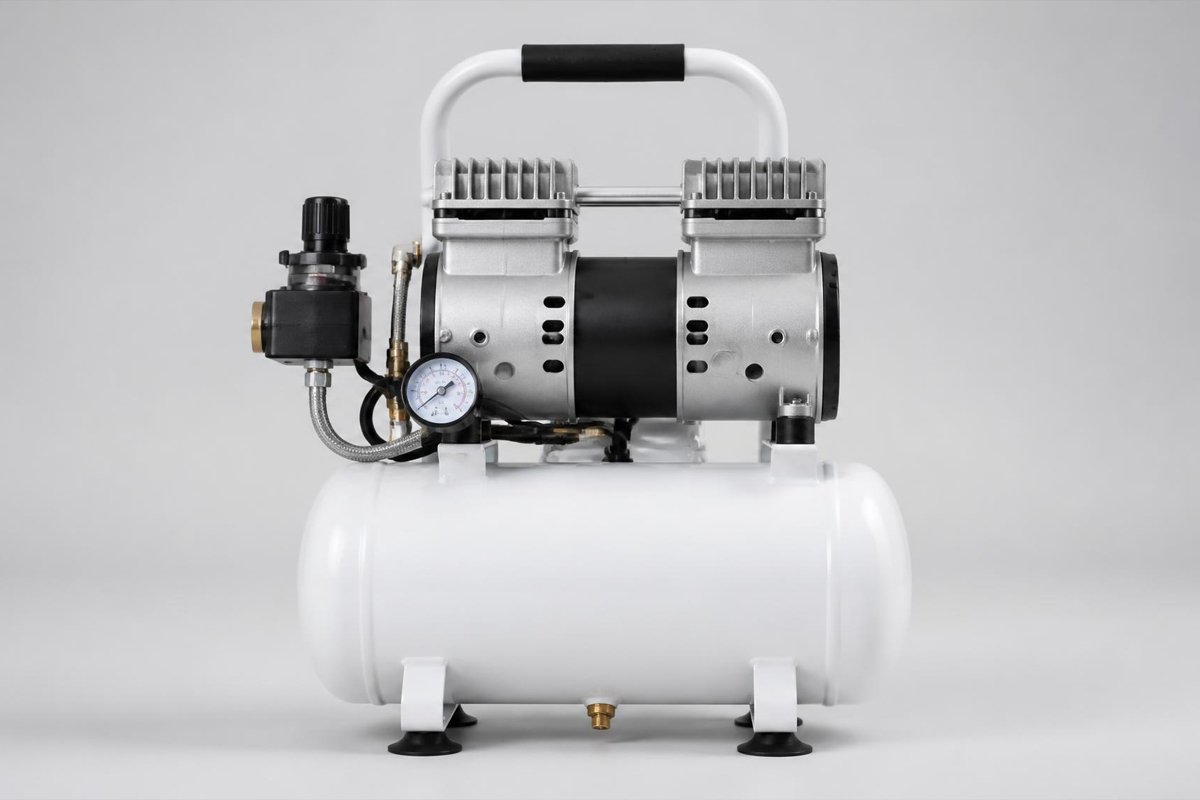
The California Air Tools 8010A has become something close to the default recommendation for home HVLP setups, and the reason comes down to one word: noise. At roughly 60 decibels, it runs about as loud as a normal conversation — a genuine relief if your garage shares a wall with a bedroom, or if you’re spraying in an attached space where a screaming compressor would end the project fast. Most oil-free compressors in this price range hit 75-80 decibels or louder, which is loud enough to require hearing protection and annoy anyone nearby.
Despite the quiet operation, the 8010A isn’t underpowered. Its 1.0 HP motor and 8-gallon tank deliver enough sustained air for most HVLP guns during small-to-medium projects — kitchen cabinets, dining chairs, car body panels, porch furniture. The compressor uses a dual-piston design rather than a single-cylinder pump, which spreads the workload across two smaller strokes instead of one large one. That translates into a compressor that runs cooler, experiences less wear per cycle, and tends to outlast single-piston oil-free units doing the same job.
The trade-off is capacity for continuous, all-day professional spraying. If you’re refinishing an entire car body or running the gun for hours without breaks, the 8010A’s recovery time will start to show. For the overwhelming majority of home and hobbyist HVLP work, though, it hits a rare sweet spot of quiet, reliable, and genuinely sufficient.
Best for: Noise-sensitive environments — shared garages, apartments, attached workspaces — and light-to-medium HVLP projects.
2. DeWalt DWFP55126 Pancake Compressor
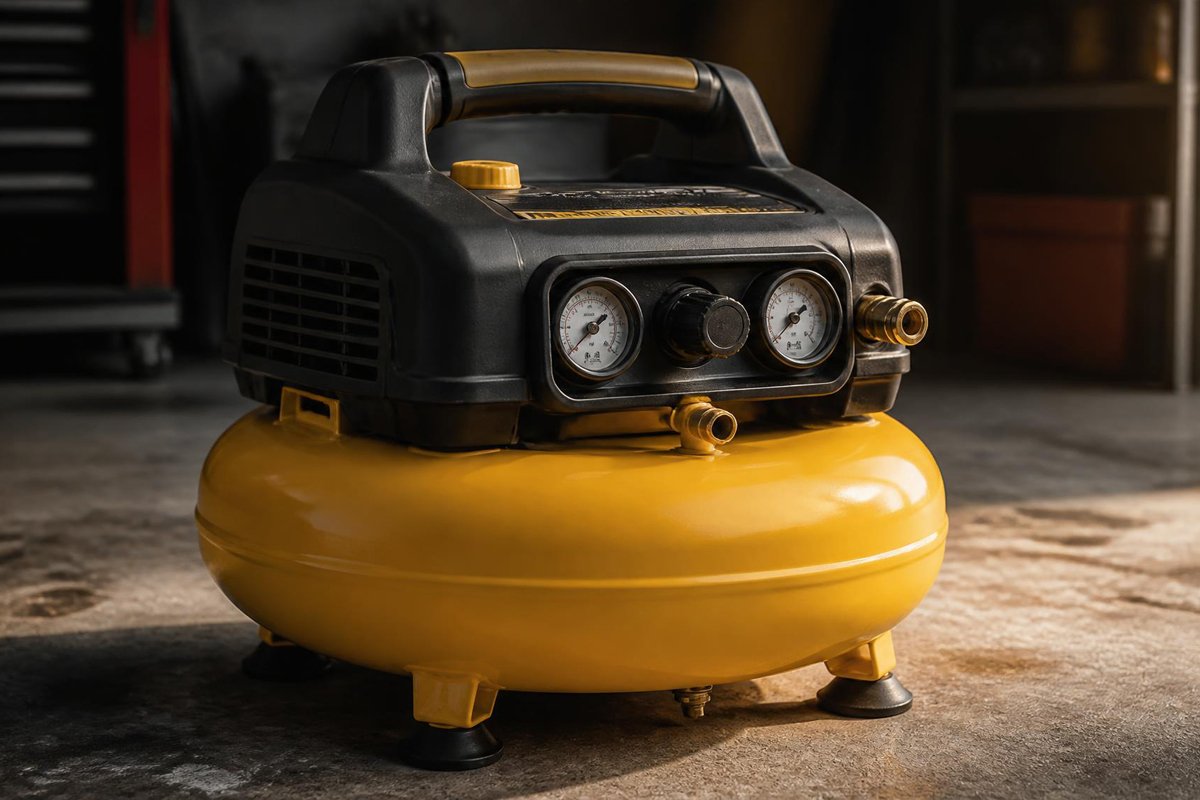
If the California Air Tools unit prioritizes quiet, the DeWalt DWFP55126 prioritizes toughness and speed of recovery. It’s a classic pancake-style compressor: a flat, wide base tank that sits low to the ground and won’t tip over on an uneven garage floor or when the air hose gets yanked mid-project. The oil-free pump needs essentially no maintenance beyond periodic filter checks and tank draining, which appeals to anyone who wants a compressor they can ignore between projects and still have it start reliably a year later.
Where the DWFP55126 earns its keep for HVLP use is pressure recovery speed. Because the motor spins up quickly and the pump moves air efficiently, the tank refills fast between spray passes — which matters more than raw tank size when you’re doing continuous coats on larger surfaces like doors, fence panels, or furniture sets. A compressor that recovers quickly can effectively “keep up” with an HVLP gun even with a moderate tank, because it’s rebuilding pressure faster than the gun is depleting it.
The compromise is noise. The DWFP55126 runs noticeably louder than the California Air Tools option — closer to a typical shop-vac or louder — so hearing protection is worth having on hand, especially for longer sessions. It’s also a single-stage oil-free pump, so while it’s low-maintenance, it won’t have quite the longevity of an oil-lubricated design under constant heavy use.
Best for: Buyers who want durability and fast pressure recovery on a reasonable budget, and who aren’t as concerned about noise.
3. Makita MAC2400 Big Bore
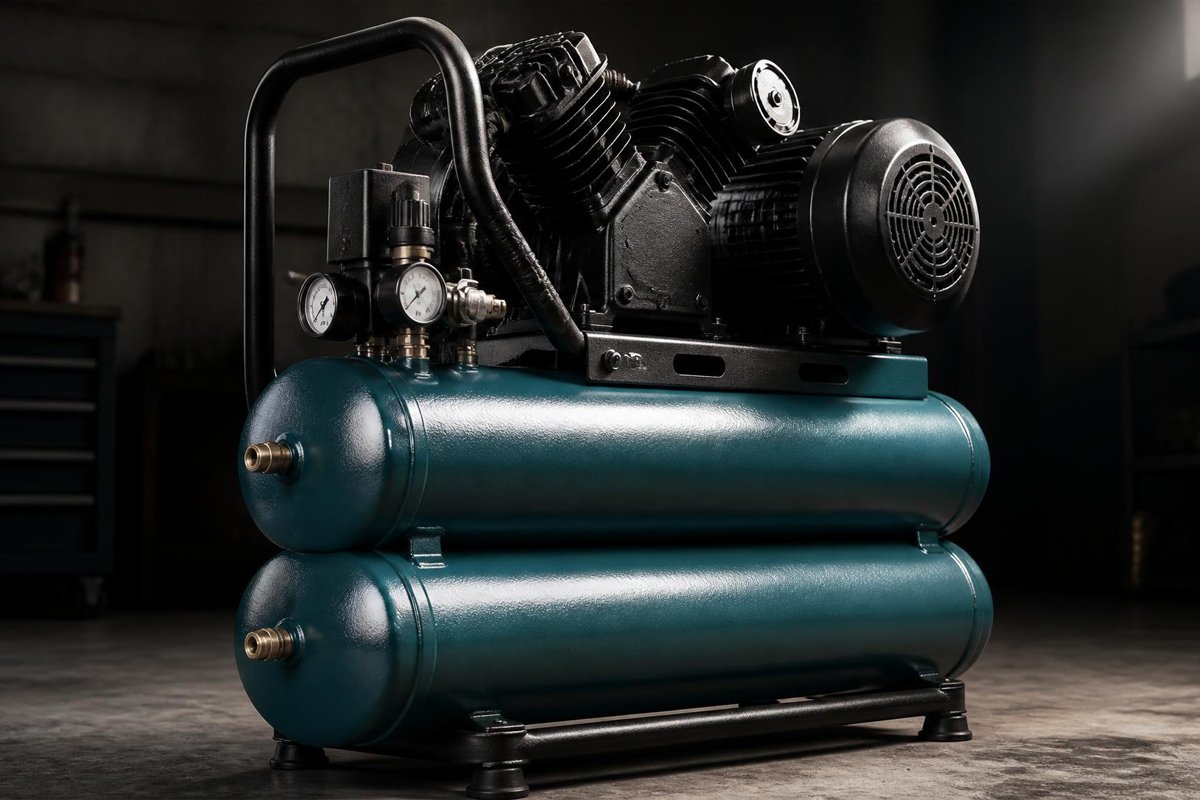
The Makita MAC2400 is aimed at a different type of buyer: someone who sprays often enough that maintenance and long-term durability matter more than upfront convenience. Unlike the oil-free units above, the MAC2400 uses an oil-lubricated pump. That single design choice changes the ownership experience in a few important ways. Oil lubrication produces smoother piston action with less metal-on-metal friction, which means less internal wear over thousands of duty cycles, and — somewhat counterintuitively — often quieter long-term operation than an oil-free pump of similar power, since there’s less mechanical clatter as parts age.
Makita’s “Big Bore” cylinder design is the other headline feature. A larger cylinder bore moves more air per stroke, which is exactly what sustained HVLP spraying needs: high CFM output relative to the compressor’s physical size and weight. Reviewers who spray frequently — weekend car restorers, furniture refinishers who run several projects a month — consistently point to the MAC2400 as one of the few compressors in this size class that doesn’t struggle to keep an HVLP gun fed during long, uninterrupted passes.
The trade-off for that performance is upkeep. Oil-lubricated compressors need periodic oil changes and a bit more attention to level checks than a “buy it and forget it” oil-free unit. It’s also heavier than the pancake-style options, which matters if portability between workspaces is a priority.
Best for: Frequent users, semi-professional refinishing work, and anyone spraying long, continuous passes on a regular basis.
4. Campbell Hausfeld DC080500
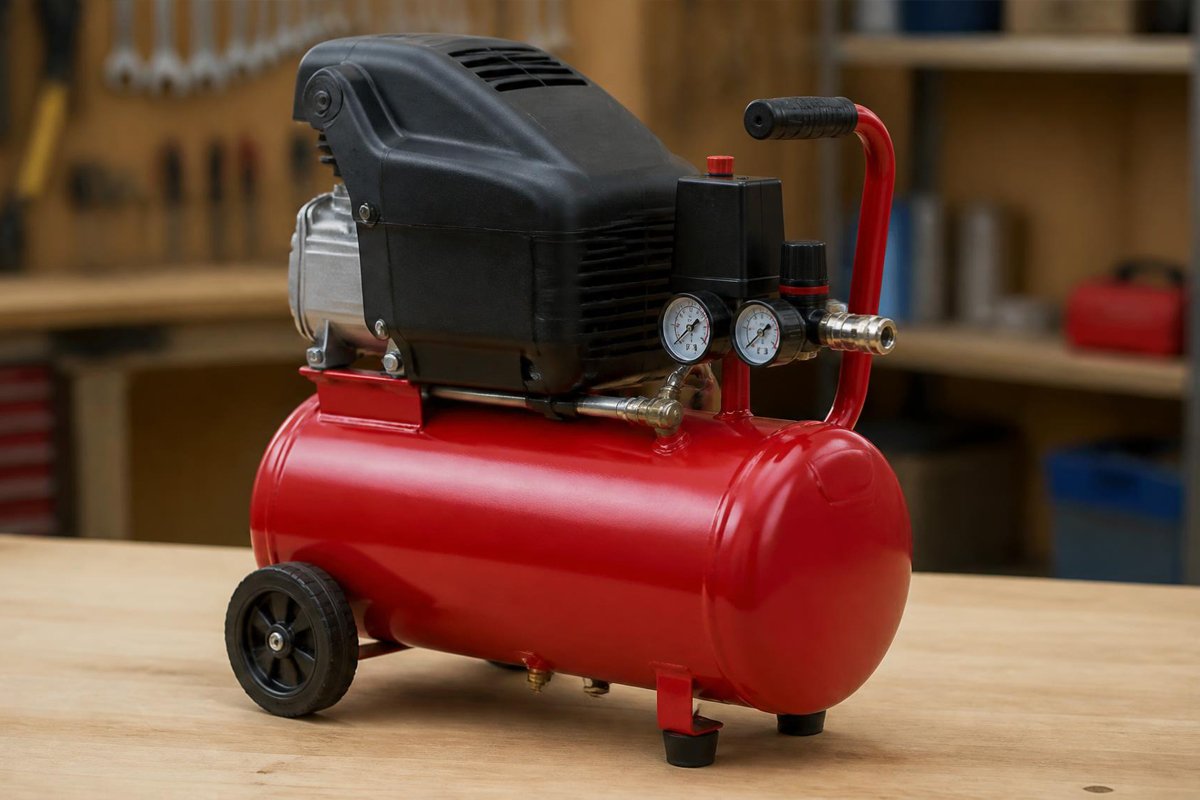
Not everyone needs — or wants to pay for — a compressor built for daily professional use. The Campbell Hausfeld DC080500 is the pick for weekend DIYers who paint a piece of furniture, a bumper, or a set of cabinet doors every month or two, rather than running an HVLP gun every week. It’s a genuinely budget-friendly option, and importantly, it doesn’t cut corners on the one spec that actually matters for HVLP compatibility: it still delivers CFM output in the range most home HVLP guns need for basic, non-continuous spraying.
The 8-gallon tank and oil-free pump keep the maintenance list short — check the filter, drain the tank after use, and that’s about it. For someone spraying occasionally, that low-maintenance profile is worth more than a higher-end compressor that requires oil changes for a machine that mostly sits idle.
Where it falls short compared to the other options on this list is under sustained, heavy use. It’s not the quietest compressor here, and its recovery time lags behind the DeWalt and Makita units when you’re doing back-to-back passes on a large surface. For short sessions and smaller projects, though, it’s hard to beat on price, and it remains a legitimate HVLP-capable compressor rather than an underpowered trim-nailer unit pressed into the wrong job.
Best for: Occasional DIYers on a tight budget who spray small projects a few times a year.
5. Porter-Cable C2002 Pancake Compressor
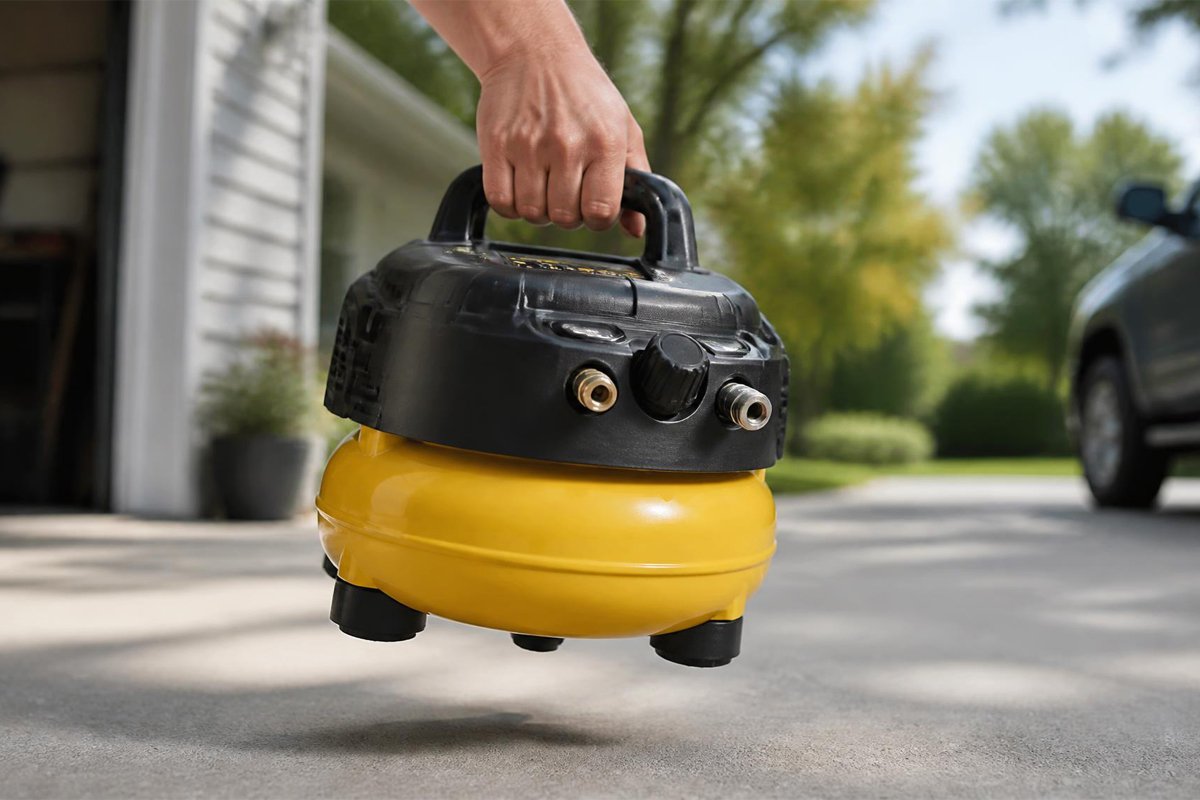
The Porter-Cable C2002 rounds out this list as the most portable option, and portability is a real, practical consideration for a lot of home sprayers. If your “shop” changes location — garage one weekend, driveway the next, a friend’s carport after that — a compact, lightweight compressor you can actually carry matters as much as raw specs.
The C2002 has less tank capacity than the DeWalt or Makita, which means it suits shorter spray sessions and smaller projects better than all-day panel work. That said, its oil-free pump keeps maintenance minimal, and the reduced weight makes it genuinely easy to move without a hand truck or a second set of hands. For touch-up work, smaller furniture pieces, or projects that don’t require long continuous spray passes, it holds up well against pricier alternatives.
Best for: Buyers who prioritize portability and lighter weight over tank size, working on smaller or shorter HVLP projects.
Comparison at a Glance
| Compressor | Pump Type | Noise Level | Best For |
|---|---|---|---|
| California Air Tools 8010A | Oil-free, dual-piston | Very quiet (~60 dB) | Noise-sensitive spaces |
| DeWalt DWFP55126 | Oil-free, pancake | Moderate-loud | Fast recovery, durability |
| Makita MAC2400 | Oil-lubricated | Moderate | Frequent, sustained use |
| Campbell Hausfeld DC080500 | Oil-free | Moderate | Occasional, budget use |
| Porter-Cable C2002 | Oil-free, pancake | Moderate | Portability |
How to Choose the Right Compressor for Your HVLP Gun
Start with your gun’s CFM requirement, not the compressor’s PSI rating. Every HVLP gun manual lists a required CFM at a specific PSI — this is the number that actually determines compatibility, not the maximum pressure a compressor can produce. Choose a compressor rated comfortably above your gun’s stated CFM requirement, since manufacturer figures are typically measured under ideal lab conditions that real-world use rarely matches exactly.
Prioritize sustained output over tank size. A smaller tank paired with a compressor that recovers air quickly will consistently outperform a larger tank on a compressor that can’t refill fast enough between passes. Tank size mainly buys you time before the motor needs to kick back in — it doesn’t change how well the compressor keeps up with continuous demand.
Weigh noise against your workspace. If you’re spraying in a garage attached to living space, or anywhere neighbors might be affected, decibel rating deserves as much weight as CFM. A technically superior compressor that’s unbearable to run for twenty minutes at a stretch isn’t actually the better choice for your situation.
Decide between oil-free and oil-lubricated based on how often you’ll use it. Oil-free pumps are simpler, need less attention, and are ideal for occasional or seasonal use. Oil-lubricated compressors cost a bit more in upkeep but tend to last longer and run more smoothly under frequent, heavy-duty use — the right trade depends entirely on your actual spraying frequency, not on which technology sounds more “premium.”
Setting Up Your Compressor for Best HVLP Results
Once you’ve picked a compressor, a few setup details make a real difference in spray quality. Always run a moisture trap or inline filter between the compressor and the gun — even a small amount of condensation in the air line can cause fisheyes and blotching in your finish, especially in humid climates or during long sessions when the tank has time to accumulate moisture. Keep hose length reasonable and diameter wide enough that you’re not creating unnecessary pressure drop between the tank and the gun; a long, narrow hose can undo the benefit of an otherwise capable compressor. Finally, let the compressor build to its regulated working pressure before starting your first pass rather than spraying while it’s still ramping up — starting a pass on rising pressure is a common cause of uneven coverage at the start of a stroke.
Compressor Maintenance That Actually Affects Spray Quality
A compressor that’s technically powerful enough for your HVLP gun can still deliver poor results if it isn’t maintained. Drain the tank after every session, even on oil-free models — accumulated moisture inside the tank eventually works its way into the air line and shows up as tiny craters or fisheyes in your finish. Clean or replace the intake filter on a regular schedule; a clogged filter forces the motor to work harder to pull in air, which slows recovery time exactly when you need it most, mid-project. For oil-lubricated units like the Makita, check oil level and color before every extended session — dark, gritty oil is a sign the pump is due for a change, and running it low on oil accelerates wear far faster than the maintenance interval would suggest. None of this takes more than a few minutes, but skipping it is one of the most common reasons a perfectly capable compressor starts underperforming after a year of use.
Frequently Asked Questions
Can I use a small pancake compressor from a hardware store for HVLP spraying? It depends entirely on the CFM output, not the compressor’s size or brand. Many small pancake compressors are built for brad nailers and staplers, which need brief bursts rather than continuous airflow, so they often fall short of what an HVLP gun needs for a smooth, uninterrupted pass. Check the CFM rating against your gun’s requirement before assuming any compressor will work.
Is a bigger tank always better for spray painting? Not necessarily. Tank size determines how long you can spray before the motor needs to refill the tank, but it doesn’t determine how well the compressor keeps up with the gun’s demand once it’s running. A compressor with fast recovery and moderate tank size often outperforms a large tank paired with a slow-recovering pump.
How loud is too loud for a home garage compressor? There’s no universal cutoff, but anything above roughly 75-80 decibels for extended periods generally warrants hearing protection and can be genuinely disruptive in shared or attached spaces. If your garage is near living areas, a quieter unit like the California Air Tools 8010A is worth the trade-off even at a slightly higher price.
Do I need an oil-lubricated compressor for HVLP work? Only if you’re spraying frequently — weekly or more, or for extended professional-length sessions. Oil-free compressors handle occasional to moderate HVLP use perfectly well and require far less maintenance, making them the more practical choice for most home users.
Final Thoughts
Matching your compressor to your HVLP gun is one of those upgrades that doesn’t show up on a spec sheet comparison but makes an immediate, visible difference in finish quality. Once your air supply is properly dialed in, the remaining variables come down to technique and prep — a good masking tape and film setup keeps overspray from turning a clean paint job into a cleanup job, and if your HVLP gun runs a disposable liner system, pairing it with a reliable PPS cup setup will save you the twenty-minute post-spray scrub-down entirely. Get the air supply right first, and the rest of the setup falls into place a lot more easily.
Last Updated: August 2026
Pingback: 5 Best Respirators and Masks for Spray Painting: Complete Buying Guide | Spray Painter Guide