
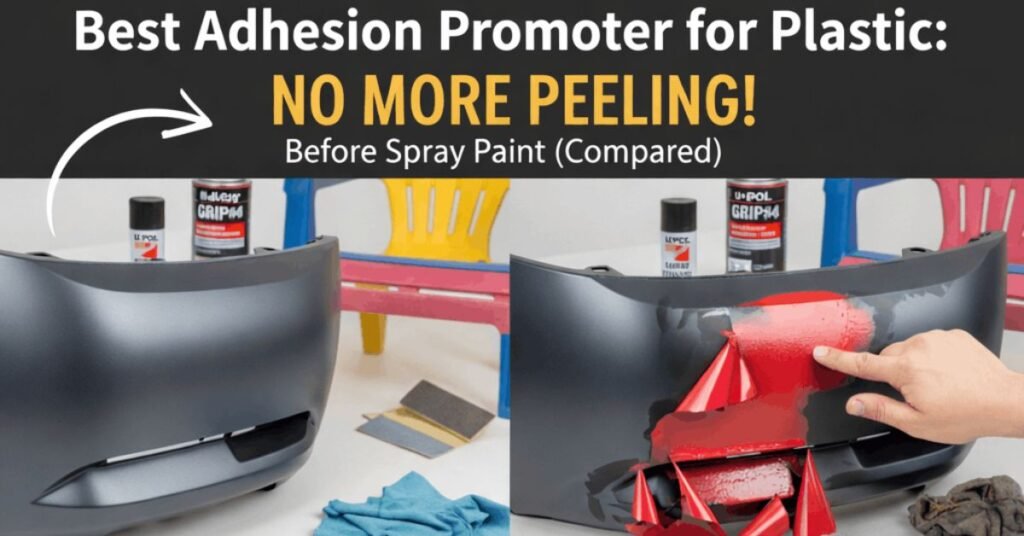
Best Adhesion Promoter for Plastic Before Spray Paint: How to Choose the Right One
If you’ve ever spray-painted plastic and watched it peel, chip, or flake soon after, it usually wasn’t your spray technique. It was the surface.
A lot of common plastics especially polyolefins like PP (polypropylene) and TPO (often found in bumpers, exterior trim, outdoor furniture, storage bins, and similar items) have low surface energy. In plain English: paint doesn’t “grab” them very well, even when the plastic looks clean.
That’s exactly what an adhesion promoter is meant to solve. It’s a thin “bonding bridge” layer that helps paint and primer hold onto plastic more reliably. Rust-Oleum, for example, describes its Automotive Adhesion Promoter as a fast-drying clear primer designed to promote adhesion to polyolefin surfaces (automotive plastics, vinyl, trim, bumpers, fiberglass, and more).
This guide focuses on the most dependable options (based on manufacturer documentation), how to choose one, and how to apply it the right way so you don’t end up repainting the same part twice.
Why plastic paint fails (and why promoter matters)
Plastic isn’t one material. It’s a huge category ABS, PVC, PP, TPO, nylon, polyurethane, and more each with different paint compatibility. Some plastics accept coatings fairly well after a scuff and primer. Others especially olefin-based plastics like PP/TPO are known for poor adhesion unless you use the right system.
Most failures fall into two patterns:
1) The coating never truly bonded
Although the coating may appear smooth and intact immediately after application, it never forms a strong chemical or mechanical bond with the surface. As a result, the finish remains weak beneath the surface. When the material is exposed to normal stresses such as flexing, vibration, minor impacts, or changes in temperature and weather the coating begins to fail. Over time, this poor adhesion leads to visible problems like chipping, peeling, lifting, or flaking, significantly reducing durability and overall performance.
2) The coating bonded unevenly
You get patchy peeling, edge lift, or scratch-off areas. This often comes from contamination (oils/silicone), uneven scuffing, or missing timing windows between layers. A promoter helps by creating a surface topcoats can bond to more easily especially on plastics with inherently poor wetting/bonding behavior. SEM’s XXX Adhesion Promoter documentation states it increases adhesion to a wide variety of raw plastics and highlights performance on olefin-based plastics.
The short list that actually matters
You don’t need 20 products to achieve durable, long-lasting results. What matters is choosing a few proven options backed by real-world testing, clear technical documentation, and manufacturer guidelines. Just as important is proper application. Even the best coating will fail with poor surface preparation,incorrect mixing, or improper curing. Real success comes from using the right products, with the right information, applied the right way not from using more products.
Bulldog® Adhesion Promoter System
Bulldog is commonly positioned for collision repair and mixed-plastic scenarios. Its documentation describes it as a single-component product combining an adhesion promoter plus other supporting properties, and it’s described as providing strong adhesion on flexible and rigid plastic parts.
Best fit if you want:
- A broad “covers most situations” option
- A good choice when plastic type is unknown
- Something positioned for flexible + rigid plastics
Rust-Oleum® Automotive Adhesion Promoter ATO-01
Rust-Oleum’s ATO-01 documentation explicitly targets polyolefin surfaces and calls it a fast-drying clear primer designed to promote adhesion to plastics/vinyl/trim/bumpers and related surfaces.
Best fit if you want:
- A widely available option
- A product explicitly documented for polyolefin-type surfaces
SEM XXX Adhesion Promoter
SEM’s XXX technical data sheet states it increases adhesion of topcoats to raw plastics and describes it as excellent on olefin-based plastics, also listing olefin-based plastics as suitable substrates.
Best fit if you want:
- Strong documentation for olefin plastics (PP/TPO-type issues)
- A product aligned with refinishing workflows
U-POL GRIP#4 Universal Adhesion Promoter (UP0799)
U-POL’s application guide is valuable because it reads like a repeatable recipe: wash/dry, degrease, then apply 2 light even coats with a 5-minute flash between coats, and allow it to dry 10–20 minutes before applying primer, color, or clear.
U-POL also positions GRIP#4 for improving adhesion across multiple automotive surfaces (including plastics and more), which is useful in mixed-substrate repairs.
Best fit if you want:
- The clearest “do-this-then-that” process
- Consistency and fewer timing mistakes
How to choose the right one (fast decision guide)
Use this logic and you won’t overthink it:
If you don’t know the plastic type:
Pick a broad-compatibility option that’s positioned for flexible and rigid plastics Bulldog is documented for that “wide coverage” role.
If you know it’s PP/TPO/polyolefin (or it behaves like it):
Choose one that explicitly calls out olefin/polyolefin use: Rust-Oleum ATO-01 targets polyolefin surfaces and SEM XXX emphasizes olefin-based plastics.
If you want the clearest, most repeatable instructions:
Pick the option with the clearest published steps and timing windows U-POL GRIP#4 spells out coat style and timing.
The major process that makes adhesion promoter work
This is the exact part that determines success. Brand matters less than prep + film build + timing.
1) Clean until the surface is truly clean
Plastics can hold oils, silicone residues, and mold-release compounds you can’t see. Bulldog’s documentation specifically calls out removing wax/grease and mold release agents because they can cause defects and adhesion problems.
Goal: remove anything that acts like a barrier between plastic and coatings.
Reality check: if you touch the part with bare hands after cleaning, you can re-contaminate it with skin oils.
2) Scuff for uniform “tooth”
You don’t need deep scratches. You need a consistent dull surface with no glossy patches. Smooth glossy patches are weak points that often become the first peeling zones.
Goal: uniform micro-scratch so coatings can key in consistently.
3) Apply promoter as a thin tie layer
This is where DIY jobs fail: spraying it like paint.
Promoter is meant to be thin and controlled. U-POL explicitly instructs 2 light even coats with a 5-minute flash between coats.
That “light coat” guidance matters heavy coats can create a weak film, solvent issues, or texture.
4) Hit the timing window
Timing matters more than brand. Once the promoter is applied, the next layer should happen inside the recommended window. Too soon can trap solvents; too late can reduce bonding.
U-POL states GRIP#4 should dry 10–20 minutes before applying primer, color, or clear.
Treat those windows as instructions, not suggestions.
5) Build the coating system for the job
For low-contact decorative items, promoter + paint can work (depending on the coating system). For anything exposed to outdoors, handling, flexing, and abrasion, durability usually improves with a full stack:
plastic → adhesion promoter → (plastic primer if needed) → color → clear
What to buy for a “no-peel” plastic prep setup
This is the practical checklist most successful plastic jobs end up using:
- A quality cleaner/degreaser appropriate for paint prep
- Scuff pads or fine abrasives for uniform dulling
- Adhesion promoter (choose from the short list above)
- A compatible plastic primer when durability matters (especially outdoors/handled parts)
- Quality masking tape and masking paper/film for clean edges
- Clean wiping cloths (to avoid lint/dust recontamination)
This setup isn’t about buying more it’s about avoiding the most expensive outcome: repainting.
Common reasons plastic paint jobs still peel
If someone says “I used promoter and it still peeled,” it’s almost always one of these:
- Contamination remained (silicone/oils) → paint never truly bonds
- Uneven scuffing → paint releases first from smooth patches
- Promoter sprayed too heavy → weak film (U-POL’s “light coats” guidance exists for a reason)
- Timing window missed → reduced bonding (U-POL provides explicit dry guidance before topcoat)
- Flexing part + brittle coating stack → chipping/cracking under movement
FAQ
Do I always need an adhesion promoter on plastic?
Not always. Some plastics accept coatings more easily than others. But if your plastic is PP/TPO/polyolefin—or you’ve had peeling problems before—using a promoter documented for those plastics is one of the most reliable ways to prevent failure.
Can I paint immediately after adhesion promoter?
Follow the product’s timing. U-POL states GRIP#4 should dry 10–20 minutes before applying primer, color, or clear, and includes a 5-minute flash between coats.
What plastic is the hardest to paint?
Olefin-based plastics (PP/TPO) are among the most challenging. SEM XXX’s technical data explicitly highlights performance on olefin-based plastics, which is a strong signal these are “special handling” surfaces.
Why does paint peel even after I used promoter?
Usually contamination, uneven scuffing, heavy coats, or missed timing windows. Promoter improves bonding, but it can’t overcome oil/silicone barriers or poor layer timing.
Final thoughts
If you only remember one thing: adhesion promoter is a system step, not a shortcut. It works when you combine:
- truly clean surface,
- uniform scuff,
- thin promoter coats,
- correct flash/dry timing,
- and a coating stack that matches the job’s durability needs.
Quick picks:
- For broad “unknown plastic” coverage: Bulldog
- For polyolefin-focused DIY availability: Rust-Oleum ATO-01
- For olefin-based plastic emphasis and refinish workflows: SEM XXX
- For the clearest step-by-step timing guidance: U-POL GRIP#4