
Why Using the Best Rust Converter Before Spray Painting Is the Secret to a Professional Finish
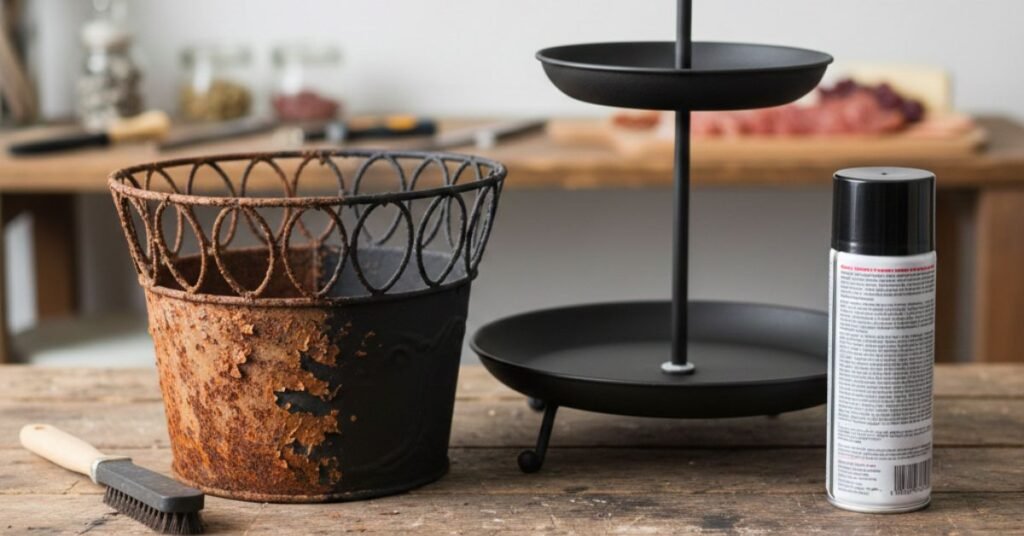
Rust has a way of ruining “quick projects” especially when you’re trying to make things look intentional and polished. One week you’re styling trending charcuterie board accessories (tiered metal stands, wire baskets, label holders, small candle lanterns, mini utensil caddies), and the next you notice orange rust freckles on the metal pieces that were supposed to look clean and modern.
So you grab a wire brush, a can of spray pain and then the big question hits:
Is the best rust converter before spray painting actually worth it or should you just sand to bare metal and call it a day?
Here’s the truth: rust converters can work extremely well, but only in the right situations and only when you apply them correctly. This guide compares the most common converter types, explains when you should use one, and gives you a prep + priming process that prevents paint failure.
Rust Converter vs Sanding Only
If you want results that last, you need to understand what each method actually does.
What sanding-only does well
Sanding (or wire brushing/grinding) is the most straightforward approach:
- Removes loose rust and flaky metal
- Lets you inspect the metal underneath
- Creates a clean surface for primer and paint
When you can realistically get to clean, bright metal, sanding-only + a good primer is often the “gold standard.”
Where sanding-only falls short
The problem is that on many real-world projects, you can’t perfectly remove rust:
- Rust hiding in pits
- Rust trapped in seams or inside corners
- Ornate shapes (scrollwork, grates, wire frames)
- Thin metal where aggressive sanding can weaken the piece
That’s where converters become useful.
What a rust converter actually does
A rust converter is designed to react with rust (iron oxides) and turn it into a more stable, paintable layer. Many are water-based and commonly use chemistry like tannic acid (forming ferric tannate) plus polymers to create a protective film.
Some products and systems describe conversion to a black barrier layer (often described as magnetite or similar conversion products) combined with a primer-like film. For example, Corroseal’s technical data describes converting rust into a barrier layer and functioning as a bonding primer for various coatings.
The “best” approach isn’t either/or
For most DIY spray paint projects, the most reliable method is:
Remove what you can + convert what you can’t.
That usually means:
- Wire brush/sand to remove loose rust
- Rust converter for remaining tight rust/pitting
- Primer (often rust-inhibiting)
- Topcoat
When You Should Use a Rust Converter
Rust converters are not magic, but they’re very useful in the right conditions.
Use a rust converter when…
1) You can’t remove rust completely
If your metal has pitting, seams, corners, or textured surfaces (common with decorative accessories), you’ll almost always have some “stubborn rust” left behind after brushing.
2) The project has light-to-moderate rust, not crumbling metal
Converters are meant for sound metal with rust, not structural metal that’s flaking apart. Rust-Oleum’s High Performance Rust Reformer, for example, is described for use on “sound rusted steel surfaces” and not intended for clean metal or galvanized steel.
3) You want a faster workflow than sandblasting
Converters are widely used when abrasive blasting isn’t practical.
4) You’re painting decorative items (like event/hosting pieces)
For things like metal stands or baskets used around trending charcuterie board accessories, conversion + primer is often a “best balance” between durability and effort.
Skip the rust converter when…
1) The rust is heavy, scaly, and lifting in sheets
If the rust is loose enough to flake off, you need mechanical removal first. Many rust-treatment products (including converter/“reformer” style coatings) still require removing loose rust/paint and contaminants.
2) You can easily sand to clean metal
If it’s flat steel and you can get it clean quickly, sanding-only + primer is simple and strong.
3) The item will be continuously wet or immersed
Some rust treatments are not intended for continuous immersion. Loctite Extend Rust Neutralizer’s technical information notes it should not be used for continuous immersion and should be topcoated appropriately for the environment.
Best Rust Converters Compared
There isn’t one universal “best rust converter.” The best choice depends on your project type, how rusty the metal is, and how you plan to topcoat.
Below are popular, widely available converter-style options and what they’re best for (based on manufacturer technical descriptions).
Quick comparison (what each is “best at”)
|
Product type |
Example products | Best for |
Notes |
| Converter + primer/sealer combo | Corroseal Rust Converter Primer | Rust + conversion + primer-like film in one step | Corroseal TDS describes converting rust to a barrier layer and acting as a bonding agent for many coatings. |
| Rust “reformer” (converter-style coating) | Rust-Oleum Stops Rust Rust Reformer | Fast conversion to a paintable black surface | Rust-Oleum describes chemically converting rust to a smooth, paintable surface; topcoat after 24 hours. |
| Acidic rust converter/remover hybrid | SEM Rust Mort | Light-to-heavy rust conversion/removal before filler/primer/topcoat | SEM describes converting/removing rust to an insoluble black coating prior to filler/primer/topcoat. |
| Latex converter that also primes | Permatex Rust Treatment; Loctite Extend | Small parts, tools, DIY repairs | Permatex describes a fast-drying latex coating that stops rust, protects, and acts as a primer. |
| Phosphoric acid prep / rust neutralizing (not always “converter” in the same sense) | OSPHO; POR-15 Metal Prep | Etching + rust neutralization + better adhesion | POR-15 Metal Prep is described as etching, neutralizing rust, and leaving a zinc phosphate coating for adhesion. |
Which one is the “best rust converter before spray painting” for most DIYers?
If your goal is spray painting and you want a converter that’s simple and widely compatible:
- Converter + primer/sealer products are often the easiest path (fewer steps, good coating compatibility)
- A rust reformer coating can be very convenient for medium rust and quick topcoating windows
If you’re working on decorative hosting items (metal stands/baskets/caddies) you’re repainting to match trending charcuterie board accessories, these “converter + coating” products tend to give the best balance of effort vs durability.
How to Apply Rust Converter Correctly
This is where most people mess up. Rust converters don’t fail because they’re “fake” they fail because the surface wasn’t prepared or the converter wasn’t allowed to fully react and dry.
Step 1: Remove loose rust and weak paint first
Even converter-style products generally require removing loose contamination.
A common requirement in technical sheets is:
- remove loose paint
- remove loose rust
- remove wax/oil/grease
For example, Rust-Oleum’s Rust Reformer instructions emphasize surfaces must be free of loose paint, rust, wax, oil and grease, and previously painted surfaces should be abraded.
Tools that work (choose what fits your project):
- Wire brush (hand brush for light rust, cup brush on drill for faster work)
- Sandpaper (80–120 for heavy rust, 180–220 to smooth edges)
- Scraper for lifting paint
- Scotch-Brite / abrasive pads for contours
Major point: Don’t try to convert flaky rust. Convert the “tight rust” that remains after brushing.
Step 2: Clean and degrease (non-negotiable)
Rust converters need contact with rust to react properly.
Before applying:
- Wash off dust
- Degrease oily spots (especially if the item lived in a kitchen, garage, or outdoors)
If you can rub your finger on the metal and feel grime, paint will fail later.
Step 3: Apply the rust converter in the right film thickness
This depends on product type:
For converter + primer/sealer types (example: Corroseal)
Products like Corroseal are described as a water-based rust converter combined with a primer, converting rust into a barrier layer and bonding for topcoats.
Best practice:
- Brush/roll a uniform coat
- Work it into pitted areas
- Avoid overworking as it starts to set
For “rust reformer” aerosol coatings (example: Rust-Oleum Rust Reformer)
Rust-Oleum notes the product chemically converts rust into a smooth, paintable surface and can be topcoated after 24 hours.
Best practice:
- Multiple light passes
- Don’t soak it to the point of runs
- Hit edges and corners (where rust returns first)
For acidic converter/remover hybrids (example: SEM Rust Mort)
SEM describes Rust Mort as an acidic compound that removes or converts rust to an insoluble black coating prior to filler/primer/topcoat.
Best practice:
- Follow dwell time carefully
- Neutralize/rinse if the product requires it (varies by product)
- Do not trap acid residues under primer
Step 4: Let it fully convert and dry
A converter isn’t “done” when it looks black it’s done when:
- it has fully reacted
- the surface is dry/hard per product guidance
- you’re within the product’s recoat/topcoat window
Rust-Oleum’s Rust Reformer technical sheet notes aerosol dry/recoat guidance and states you can topcoat after 24 hours.
Major point: If you topcoat too early, you can trap moisture or solvents and weaken adhesion.
Step 5: Inspect and spot-treat
After drying:
- Look for orange/brown spots that didn’t convert
- Re-brush and reapply converter on those areas
- Don’t move on until conversion is uniform
Priming After Rust Treatment
This is where you lock in durability. Even if a converter claims it “primes,” you often get better long-term results by using a primer that matches your topcoat and exposure conditions.
Do you always need primer after a rust converter?
Not always but often, yes.
- Converter/primer combos are designed to accept topcoats
- Some rust reformers are intended to be topcoated after a cure period
However, for spray paint durability (especially outdoors or in humid environments), a rust-inhibiting primer is usually worth it.
What a rust-inhibiting primer does?
Rust-inhibiting primers are designed to:
- increase topcoat adhesion
- slow down corrosion return
- create a stable base layer
Rust-Oleum’s Stops Rust primer technical data describes primers promoting topcoat adhesion and helping prevent chipping, cracking, and peeling.
Rust-Oleum also states its Rusty Metal Primer provides strong rust prevention benefits when used with topcoats.
Which primer should you use?
Match primer choice to your project:
For general DIY spray paint projects (indoor or mild outdoor):
- Quality rust-inhibiting spray primer from a reputable brand
For outdoor metal stands, baskets, and hosting pieces:
- Rusty metal primer designed for corroded surfaces
For higher corrosion resistance systems:
- Zinc phosphate primers are widely described as rust-inhibitive steel primers with corrosion protection properties.
Primer application tips (to prevent future peeling)
- Apply primer in light, even coats
- Don’t flood pitted areas
- Respect dry-to-recoat windows
- Let primer dry before spray paint topcoat
FAQ
Do rust converters really stop rust permanently?
They can significantly slow rust by converting existing oxides into a more stable layer and leaving a coating/primer film, but no rust product is “forever” without a proper topcoat system and maintenance. Converter systems are designed to be topcoated for better long-term protection.
Can I spray paint directly over a rust converter?
Often yes…but you must follow the product’s instructions for dry time and topcoat compatibility. Rust-Oleum’s Rust Reformer technical info indicates topcoating after 24 hours for aerosol applications.
For maximum durability, many DIYers still use a rust-inhibiting primer before the final color coat.
What happens if I don’t remove loose rust first?
You risk coating over unstable material. Many systems require removing loose rust/paint and contaminants before application.
If the layer underneath lifts, your converter + paint lifts with it.
Rust converter vs rust remover: what’s the difference?
- Rust remover dissolves rust (often acids/chelators) and typically needs rinsing/neutralizing.
- Rust converter reacts with rust and converts it into a stable, paintable layer (often black) and may also act like a primer.
Should I still prime after using a converter-primer combo?
Sometimes you can go straight to the topcoat if the product is designed for it. But for outdoor or high-wear pieces, adding a rust-inhibiting primer can improve long-term durability and chip resistance.
What’s the fastest method for small rusty items?
For small metal decor pieces:
- Wire brush quickly
- Spray a rust reformer (converter-style)
- Prime (optional but recommended)
- Spray paint topcoat
Final Recommendation
So… is the best rust converter before spray painting worth it?
Yes…when rust is present and you can’t fully remove it, rust converters are absolutely worth it. But they’re not a replacement for prep. The “winning” workflow is almost always:
The best real-world system (works for most DIY projects)
1) Mechanical removal: wire brush + sand the loose stuff
2) Convert the remaining tight rust: rust converter / rust reformer / converter-primer combo
3) Prime for durability: rust-inhibiting primer
4) Topcoat: your spray paint system
5) Cure fully: avoid handling too early
“Best choice” by scenario
If you’re repainting decorative items (like metal pieces that pair with trending charcuterie board accessories), you want something that’s:
- easy to apply
- compatible with topcoats
- reliable on light-to-moderate rust
In that case, a converter + primer/sealer style product (like Corroseal-type systems) is usually the best blend of convenience + performance.
If you want the simplest sprayable option:
A rust reformer aerosol can be very convenient, with many systems recommending topcoat after a set time like 24 hours.
If you’re doing automotive-style metal work and want a chemical prep step:
Products like POR-15 Metal Prep are described as etching, neutralizing rust, and leaving a zinc phosphate coating to improve adhesion in their coating system.